The October Pinterest Funnel for Royal Icing Template Shops
Turn holiday cookie-planning searches into template sales with a two-lane Pinterest funnel for ready buyers and beginner decorators.

On October 5, a small royal icing template shop has an awkward problem: its “Christmas cookie ideas” Pins are collecting saves, but the holiday bundle is not moving quickly enough to make November production worthwhile.
The answer is not to send every person to the same sales page or make more generic cookie Pins. A baker searching for a gingerbread house template is close to buying. A parent searching for easy Christmas cookie decorating may need a low-pressure planning tool first.
This operator playbook separates those two moments, then gives each one a useful next step.
Diagnose the gap between Pinterest attention and revenue
Start with the offer ladder, not the Pin count. For a digital decorating business, a simple October ladder could look like this:
| Visitor stage | Pinterest search intent | Best destination | Next offer |
|---|---|---|---|
| Planning a holiday activity | “easy Christmas cookie decorating” | Free cookie-decorating prep planner | $9 starter template pack |
| Choosing a project | “gingerbread house cookie template printable” | Product or collection page | $24 holiday template bundle |
| Hosting an event | “cookie decorating party ideas” | Party kit page | Party template bundle and supply list |
| Troubleshooting | “how to make royal icing colors” | Short technique guide | Color planner, then template bundle |
The free resource should solve one small planning problem that naturally precedes the paid offer. A one-page Holiday Cookie Prep Planner might include:
- Number of cookies to bake
- How many icing colors to prepare
- Drying-time reminders
- A shopping list for bags, couplers, and food color
- A short note pointing to matching downloadable templates
It is useful even if someone never buys. But it also attracts people who are about to do the activity your products support.
Build two routes, not one long detour
Route A: ready buyers.
Send precise product searches directly to a fast, mobile-friendly product page. Someone searching “Santa cookie stencil printable” should see the Santa set, a preview image, price, file format, license, and a clear purchase button. Do not make them trade an email address for a product they have already decided to find.
Route B: planners and beginners.
Send broader searches to the free planner landing page. The page should state what the download includes, show a real preview, explain who it is for, and make the email field the only required action.
This distinction is the heart of good Pinterest search intent. One visitor is choosing which item to buy; the other is deciding whether they can pull off the project at all.
Use a revenue view, not a save-count view
Add a consistent UTM pattern to every Pin destination:
?utm_source=pinterest&utm_medium=organic&utm_campaign=holiday_cookie_2026&utm_content=prep_planner_beginner_01
Then review each route separately in your Pinterest ecommerce analytics:
- Pinterest outbound clicks
- Landing-page conversion rate
- Email signups
- Product-page views
- Add-to-cart rate
- Paid orders
- Revenue per 100 outbound clicks
- Refunds or support requests caused by confusing product expectations
For the email route, include a 14-day buyer cohort. A planner Pin may not produce a sale on the first visit, which does not make it weak.
Here is a simple hypothetical comparison after two weeks:
| Pin route | Outbound clicks | Direct revenue | New subscribers | Revenue from those subscribers within 14 days | Total attributable revenue per click |
|---|---|---|---|---|---|
| Gingerbread template product Pin | 150 | $216 | 0 | $0 | $1.44 |
| Easy cookie prep planner Pin | 480 | $96 | 60 | $168 | $0.55 |
| Pretty cookie inspiration Pin | 900 | $18 | 4 | $0 | $0.02 |
The planner route deserves continued attention even though it has lower immediate revenue per click. The generic inspiration Pin does not automatically deserve more design time just because it has the largest reach.
Run a small weekly publishing and follow-up routine
This takes about two to three focused hours a week once the pages and emails exist. The goal is to keep offers, Pin promises, and inventory aligned as holiday demand changes.
Monday: choose one buyer decision
Spend 20 minutes looking at customer questions, search suggestions, product-page searches, and last week’s traffic. Choose one decision, not a broad seasonal theme.
Good weekly decisions include:
- Which cookie projects are realistic for beginners?
- How many icing colors are needed for a decorating party?
- Which template works for classroom treat bags?
- What can a first-time decorator finish in one afternoon?
Weak topic: “Christmas cookies.” It is too broad to determine a Pin, landing page, or offer.
Tuesday: create a three-Pin family around that decision
Create three distinct Pins from the same source material. Give each a different promise and destination.
For the decision “How do I plan a cookie decorating party?” the family might be:
“Cookie Decorating Party Checklist: What to Prep Before Guests Arrive”
Destination: free prep planner.“Printable Christmas Cookie Templates for a 12-Guest Decorating Party”
Destination: party bundle product page.“3 Cookie Shapes That Are Easier for First-Time Royal Icing Decorators”
Destination: a helpful guide with a relevant starter-pack call to action.
Keep the visual evidence specific. Show the actual template shapes, finished examples, download format, or checklist preview. A beautiful cookie photograph without context earns curiosity; a clear visual earns qualified clicks.
Wednesday: inspect the handoff before publishing
Open each Pinterest landing page on a phone. Check:
- The Pin headline and page headline describe the same thing.
- The pictured product is available now.
- Digital-file details are obvious: format, access method, printing guidance, and commercial-use limits if applicable.
- The signup confirmation appears immediately.
- The first email arrives promptly and contains the promised download.
- UTM links load properly.
This is also a good time to check Pinterest product pins if you use a catalog. Catalog Pins are helpful for specific, stable products, but they should not replace curated Pins that explain an occasion or a beginner decision.
Thursday: publish with a realistic queue
Publish the three-Pin family to the most relevant boards. Do not duplicate the exact Pin across every board just to fill a schedule.
A lightweight scheduling queue is enough. If you want a single place to organize Pin variations, destination links, and publishing dates, PinPinMe can support that part of the process.
Keep boards practical, such as:
- Christmas Cookie Decorating Ideas
- Royal Icing Tips for Beginners
- Cookie Decorating Party Ideas
- Printable Baking Templates
Friday: read the signal and capture the language
Review the prior week’s Pins by route. Write down the exact phrases from email replies, product questions, comments, and site search.
For example, if subscribers repeatedly ask, “Can I do this with store-bought icing?” that is next week’s decision. It could become a Pin to a beginner guide, with an optional template offer after the answer.
This weekly feedback loop improves Pinterest landing pages and email relevance at the same time.
Build the email follow-up around the project, not a countdown clock
The email sequence should help people complete the project they came to plan. An aggressive “buy now” sequence is especially costly for a beginner audience that is still deciding whether decorating is manageable.
A five-message sequence for the prep planner could be:
| Timing | Email purpose | Useful content | Commercial next step |
|---|---|---|---|
| Immediately | Deliver the planner | Printing and use instructions | Link to the matching starter pack |
| Day 1 | Reduce overwhelm | Explain how to choose two to three icing colors | Show templates designed for fewer colors |
| Day 3 | Prevent a common failure | Drying and packaging guidance | Link to party-ready designs |
| Day 5 | Help them choose | Compare a mini pack, party bundle, and full holiday set | Recommend the right bundle by project size |
| Day 9 | Give a timely reminder | Explain digital-download cutoff versus physical supply timing | Offer a genuine deadline only if one exists |
Avoid inventing scarcity for a digital item. A real deadline might be the last day you can offer live customer support before a holiday break. A false “sale ends tonight” message trains subscribers to ignore you.
Match the offer to the email behavior
Tag subscribers by the link they click. This does not require complicated automation.
- Clicked party planning: send the party template bundle.
- Clicked gingerbread: send the structural-template pack.
- Clicked beginner help: send a small starter pack, not a huge collection.
- Clicked licensing or classroom use: show the appropriate license page.
This is better Pinterest merchandising than one blanket coupon. You are using the project they selected to offer the next logical item.
Examples of Pins that belong in each route
Use the following as starting points, then rewrite them around your own products and customers.
Direct-to-product Pins
These work when the query already contains product language.
- “Gingerbread House Cookie Template Printable for Beginners” → Gingerbread template product page
- “Christmas Ornament Cookie Template Set: 18 Printable Designs” → Holiday bundle page
- “Cookie Decorating Party Printable Pack for 8, 12, or 20 Guests” → Party collection page
The destination should answer practical purchase questions above the fold: what is included, whether it is printable, how it is delivered, and whether tools or cutters are included.
Planner-to-email Pins
These work when someone is still estimating time, skills, supplies, or scope.
- “Holiday Cookie Decorating Prep Checklist” → Planner opt-in page
- “How Many Icing Colors Do You Need for Christmas Cookies?” → Color-planner opt-in
- “First Cookie Decorating Party: A Simple Timeline” → Party timeline opt-in
The free download needs to deliver on the Pin’s promise. Do not label a sales brochure as a checklist.
Helpful article Pins with a gentle bridge
These work for problem-led searches and can earn durable traffic beyond December.
- “Why Royal Icing Colors Darken Overnight” → Troubleshooting guide → related templates
- “How to Package Decorated Cookies Without Smudging” → Packaging guide → gift-tag templates
- “The Easiest Cookie Shapes for Piping Practice” → Beginner guide → starter pack
These are useful search assets, but they must still have one relevant next step. A guide with five unrelated calls to action gives the reader no decision to make.
Mistakes that make the funnel leak
Making the freebie broader than the paid offer
A general “holiday meal planner” may attract a large audience, but it does not qualify people who want decorating templates. Keep the resource close to the purchase: cookie prep, color planning, project timing, or party setup.
Sending product-intent traffic through an unnecessary opt-in
If someone searches for a printable gingerbread house template, they may happily buy on the first visit. Hiding the product behind a download gate adds friction and can reduce revenue.
Treating every Pin as a coupon ad
Pinterest users often begin with a planning task. Lead with the decision, the project, or the problem. Let the offer resolve it.
Ignoring the product-page expectation gap
If a Pin shows a finished iced cookie but the product is only a digital outline template, say so clearly. Display the file preview and list what is not included. Fewer confused buyers usually means fewer refunds and fewer support tickets during the busiest weeks.
Measuring email signups without measuring buyers
A high opt-in rate can hide a poor offer match. Use Pinterest UTM tracking to connect the original Pin route to subsequent purchases. Review the 14-day buyer rate and revenue per subscriber, not signups alone.
Launching too many themes at once
In October, pick two or three high-confidence holiday projects and go deep. A scattered account with Halloween, Thanksgiving, Christmas, winter birthdays, and Valentine’s Day Pins can make both the buyer journey and internal reporting harder to read.
Short operating checklist
Before publishing this week’s Pin family, confirm:
- I selected one concrete decorating decision, not a vague holiday topic.
- Each Pin has one intended route: direct purchase, email signup, or helpful guide.
- The landing page repeats the Pin’s promise and works on mobile.
- Product pages explain exactly what is digital, included, and excluded.
- Every destination has a consistent UTM structure.
- The email download and first message have been tested.
- I will review direct revenue and 14-day subscriber revenue separately.
- Next week’s topic will come from buyer questions, not just the highest-save Pin.
A holiday Pinterest funnel works when it respects the difference between “I need a template now” and “I want this project to feel possible.” Serve both moments well, and the revenue path becomes much clearer.
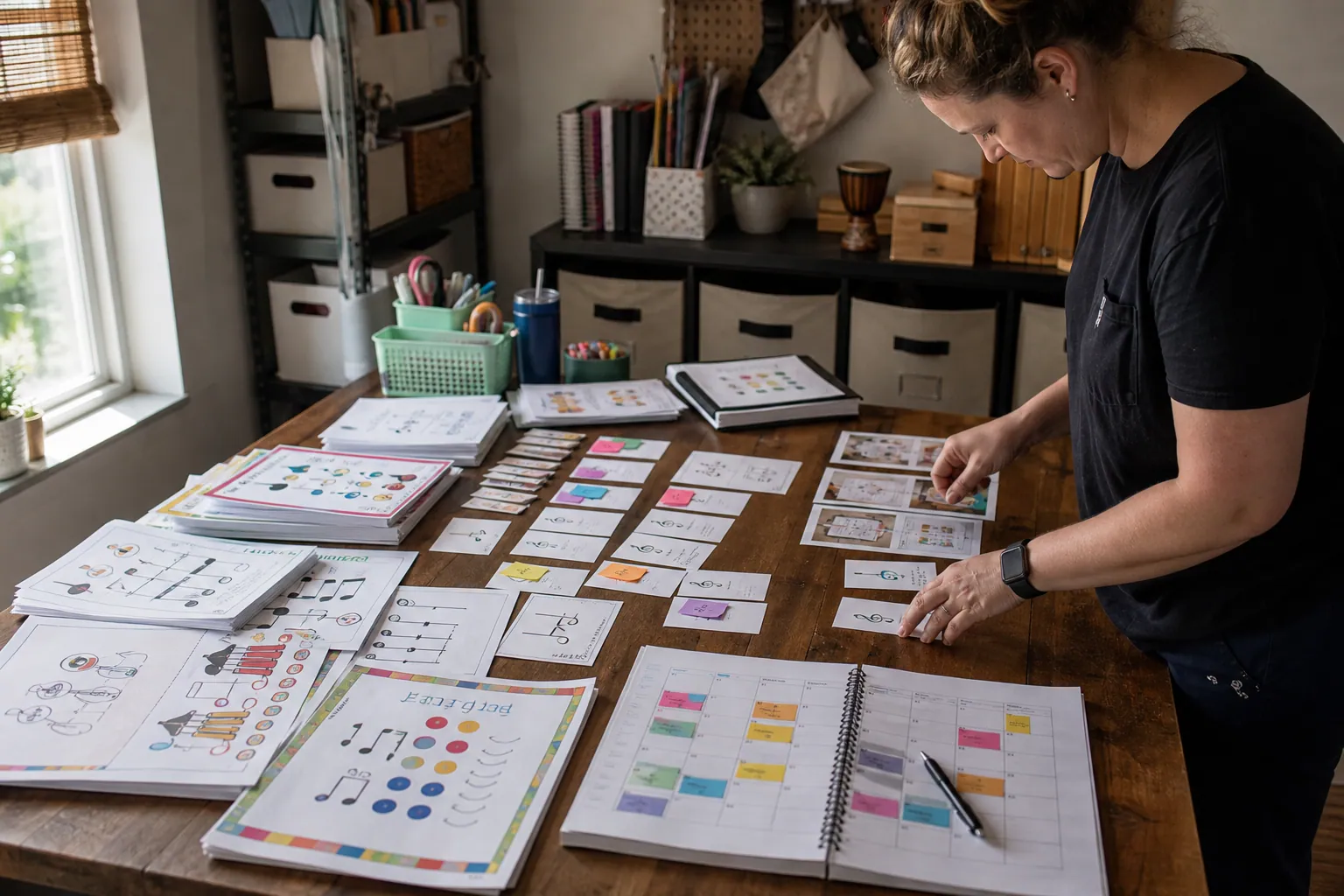
Case Study: How an Elementary Music Printable Shop Turned Pinterest Freebies Into Bundle Sales
A composite teardown of a music printable seller that stopped sending every Pinterest visitor to one freebie and built intent-led paths to bundle sales.

Strategy Memo: Build a Pinterest Revenue Ladder for Chicken Coop Plan Sellers
Turn coop-size, winter ventilation, and predator-control searches into plan sales without forcing every Pinterest visitor into the same email funnel.

The Collection-to-Enrollment Pinterest Desk for Surface Pattern Design Courses
A copyable Pinterest content operation for surface pattern design educators who want sketchbook searches to become useful email subscribers and course enrollments.

The Lean Pinterest Tool Stack for Printable Party Game Shops Before Holiday Hosting
A practical Pinterest content blueprint for printable party game shops: choose the right tools, batch seasonal Pins, prevent wrong-link errors, and maintain winners.

The Pinterest Tool Stack for Laser-Cut SVG Shops Before Ornament Season
A lean tool audit for laser-cut SVG sellers who need holiday maker searches to become accurate downloads—not a queue full of broken links and generic Pins.

The AI Gift-Intent Pinterest Desk for Merino Sock Shops
A practical weekly routine for merino sock retailers using AI to turn verified product facts, gifting questions, and stock signals into accurate Pinterest traffic.