The Pinterest Search Map: Plan Keywords Before You Plan Pins
A practical Pinterest SEO workflow for mapping keywords, pin angles, boards, and blog destinations before creating another batch of pins.

Most Pinterest SEO problems start before the pin is designed
A lot of operators treat Pinterest SEO as a final step: write a blog post, make a few graphics, add a keyword to the title, and schedule the pins.
That can work occasionally, but it usually creates scattered content. You end up with 40 pins pointing to 12 different pages, each using slightly different language, without a clear reason why Pinterest should understand your account as relevant for a topic.
A better workflow is to build a Pinterest Search Map before you write the next blog post or design the next pin.
The Search Map is a simple planning document that connects four things:
- What your audience searches for on Pinterest
- Which page on your site should answer that search
- What pin angles should be created for that page
- Which boards and follow-up pins reinforce the topic over time
This is not a replacement for Pinterest analytics or testing. It is the upstream system that makes your Pinterest testing more useful.
Why Pinterest keyword research is different from Google keyword research
Pinterest is a visual search and discovery engine. People do search with words, but they are often searching before they know exactly what they want to buy, download, cook, build, wear, organize, or learn.
That changes the keyword strategy.
Google searches often sound like this:
- best inventory software for Shopify
- how to fix low conversion rate landing page
- tax deductions for freelance designers
Pinterest searches often sound like this:
- small pantry organization ideas
- neutral summer outfit work
- meal prep for busy moms
- online course launch checklist
- craft fair booth display ideas
Pinterest keywords are often more visual, outcome-based, seasonal, and use-case specific. That is why copying your Google SEO keyword list into Pinterest usually underperforms.
The goal is not just to find keywords. The goal is to understand the pinner’s mental picture.
What are they trying to see? What decision are they trying to make? What would make them save the pin now and click later?
The five-column Pinterest Search Map
You do not need a complex tool to start. A spreadsheet works. A Notion table works. A whiteboard works.
Create five columns:
| Cluster | Search phrases | Best destination | Pin angles | Board fit |
|---|---|---|---|---|
| Pantry organization | small pantry organization, pantry labels, pantry storage ideas | Blog post or service page | before and after, checklist, mistakes, product roundup | Kitchen Organization, Small Home Storage |
| Course launch planning | online course launch checklist, course sales page ideas | Lead magnet or article | timeline, checklist, template, mistakes | Online Course Business, Digital Product Marketing |
| Customer onboarding | customer onboarding checklist, SaaS onboarding email sequence | Resource page | template, workflow, audit, examples | SaaS Growth, Customer Success |
The value is in the connection between columns. A keyword without a destination becomes a random pin. A blog post without multiple pin angles leaves search demand on the table.
If you use a dedicated workflow tool, this map can also become your production queue. For example, PinPinMe can help keep keyword clusters, pin titles, descriptions, and scheduling organized once your Search Map is defined.
Step 1: Start with business pages, not random keywords
Before opening Pinterest search, list the pages that actually matter to your business.
These usually fall into five buckets:
- Product or collection pages
- Service pages
- Lead magnets
- Blog posts that support sales
- Evergreen resources or templates
For each page, ask: If Pinterest sent qualified traffic here for the next 12 months, would that help the business?
If the answer is no, do not build a Pinterest content system around it yet.
A recipe blogger may choose a seasonal recipe hub. A course creator may choose a free workshop page. A local organizer may choose a closet organization service page. A SaaS company may choose a checklist that introduces the problem their product solves.
Pinterest SEO should support a commercial path, even when the pin itself is educational.
Step 2: Pull keywords from Pinterest like a pinner
Use Pinterest search manually for the first pass. Type your seed topic and slow down before pressing enter.
Look at:
- Autocomplete phrases
- Related search modifiers
- Repeated wording in top pin titles
- Board names that rank for the topic
- Visual patterns in the first screen of results
For example, if your seed topic is closet organization, you may see modifiers like:
- small closet organization
- closet organization ideas
- closet organization bedroom
- closet organization for apartments
- closet organization hacks
- closet organization DIY
Each modifier gives you a different pin angle.
Small closet organization is about constraints. DIY closet organization is about budget and process. Bedroom closet organization may be more visual and lifestyle-driven. Apartment closet organization may need renter-friendly language.
This is where many Pinterest keyword clusters become stronger than a single keyword list. Clusters help you create variations that match intent without repeating the same pin title 20 times.
Step 3: Separate broad discovery from click-ready intent
Not every keyword should lead to the same type of pin.
I like to divide Pinterest keywords into three intent levels.
1. Browse intent
These searches are early and visual.
Examples:
- home office ideas
- capsule wardrobe inspiration
- wedding table decor
- healthy lunch ideas
The pinner may save now and click later. Your pin should be highly visual, easy to understand, and specific enough to stand out.
Good pin angles:
- 7 ideas for a small home office that still feels calm
- Neutral capsule wardrobe inspiration for spring travel
- Healthy lunch ideas you can prep on Sunday
2. Plan intent
These searches show a pinner is organizing a project or decision.
Examples:
- online course launch checklist
- pantry organization list
- family photo outfit guide
- content calendar template
The pinner is closer to clicking because they need structure. Your pin can promise a checklist, framework, template, timeline, or guide.
Good pin angles:
- Online course launch checklist for your first 30 days
- Pantry organization list before you buy more bins
- Family photo outfit guide for neutral fall sessions
3. Solve intent
These searches show a problem.
Examples:
- why my pins are not getting clicks
- small pantry no storage
- course sales page not converting
- customer onboarding drop off
These are often great for blog posts, audits, tutorials, and lead magnets. The pinner wants relief.
Good pin angles:
- Why your pins get saves but not outbound clicks
- Small pantry with no storage: what to fix first
- Course sales page not converting? Check these 9 sections
A balanced Pinterest content planning system includes all three. Browse intent can build reach and saves. Plan intent often earns stronger clicks. Solve intent can drive better conversion.
Step 4: Match each keyword cluster to one primary destination
This is where Pinterest SEO becomes operational.
For each cluster, choose the best page on your site. Do not send every pin to your homepage. Do not send every idea pin to the newest blog post just because it is fresh.
Use this decision rule:
- If the pinner wants inspiration, send them to a gallery, roundup, collection, or idea-rich post.
- If the pinner wants steps, send them to a tutorial, checklist, or guide.
- If the pinner wants a solution, send them to a service page, product page, lead magnet, or comparison article.
Example for a local interior stylist:
| Keyword cluster | Best destination | Why |
|---|---|---|
| small living room layout ideas | Blog post | The pinner needs inspiration and examples |
| living room styling checklist | Lead magnet | The pinner wants a practical planning tool |
| virtual interior styling service | Service page | The pinner is closer to hiring |
This alignment matters because Pinterest outbound clicks depend on the promise being clear. If the pin promises a checklist but lands on a vague homepage, the click is wasted.
Step 5: Build pin titles from intent, not templates alone
Pinterest pin titles should be clear before they are clever. A strong title tells Pinterest and the pinner what the pin is about.
Use these frameworks as starting points.
Outcome + context
- Small Pantry Organization Ideas for a Narrow Kitchen
- Pinterest SEO Workflow for Evergreen Blog Traffic
- Customer Onboarding Checklist for Early-Stage SaaS Teams
This works well when the pinner knows the outcome they want.
Problem + first step
- Pins Getting Saves but No Clicks? Start With Your Landing Page
- Small Closet Always Messy? Fix These 5 Zones First
- Course Launch Feels Scattered? Build This 30-Day Plan
This works well for solve-intent keywords.
Asset + audience
- Content Calendar Template for Wedding Photographers
- Meal Prep Grocery List for Busy Parents
- Brand Messaging Checklist for Service Businesses
This works well for lead magnets and templates.
Mistake + correction
- 7 Pinterest Description Mistakes That Limit Search Reach
- The Pantry Storage Mistake That Makes Small Spaces Worse
- Course Sales Page Mistakes That Confuse Warm Leads
This works when your content teaches judgment, not just steps.
Seasonal modifier + core keyword
- Fall Family Photo Outfit Ideas for Neutral Wardrobes
- Holiday Gift Guide Pins for Handmade Shops
- Summer Meal Prep Ideas for Hot Weather Weeks
This works when your audience plans ahead. Pinterest often rewards early seasonal content because pinners search before the event.
Step 6: Write descriptions that add context, not fluff
Pinterest descriptions should not be a pile of keywords. They should help Pinterest understand the content and help the pinner decide whether to click.
A practical description structure:
- First sentence: say the main keyword naturally.
- Second sentence: add use case, audience, or problem context.
- Third sentence: explain what the destination includes.
- Final phrase: add a soft action.
Example:
Small pantry organization ideas for narrow kitchens, apartments, and homes with limited storage. Use this guide to plan zones, choose containers, and avoid buying bins before you measure. Includes a simple checklist for making a small pantry easier to maintain.
Notice what is not happening here:
- No keyword stuffing
- No vague hype
- No giant hashtag block
- No misleading promise
Good Pinterest descriptions are specific, readable, and aligned with the landing page.
Step 7: Turn one destination into a 90-day pin set
Once you have a keyword cluster and destination, create multiple pins over time. This is not about reposting the same design repeatedly. It is about giving Pinterest different entry points into the same useful resource.
For one blog post, plan 8 to 12 pin angles across 90 days.
Example destination: Blog post about small pantry organization.
| Week | Pin angle | Search intent |
|---|---|---|
| 1 | Small Pantry Organization Ideas for Narrow Kitchens | Browse |
| 2 | Small Pantry Checklist Before You Buy Storage Bins | Plan |
| 3 | 5 Mistakes That Make a Small Pantry Hard to Use | Solve |
| 4 | Budget Pantry Organization Ideas for Apartments | Browse |
| 6 | Pantry Zones That Make Meal Prep Faster | Plan |
| 8 | Before and After Small Pantry Organization Plan | Browse |
| 10 | How to Organize a Pantry With Deep Shelves | Solve |
| 12 | Small Pantry Storage Ideas You Can Maintain | Plan |
This is where an evergreen content system starts to compound. You are not inventing new topics every week. You are exploring one useful topic from multiple search angles.
Step 8: Make boards part of the SEO system
Boards are not just filing cabinets. They help reinforce topical relevance.
For each keyword cluster, identify two or three boards that make sense.
A pin about small pantry organization could fit:
- Pantry Organization Ideas
- Small Kitchen Storage
- Home Organization Tips
A pin about course launch checklists could fit:
- Online Course Business
- Digital Product Marketing
- Course Launch Planning
A pin about SaaS onboarding could fit:
- SaaS Marketing
- Customer Success
- B2B Growth
Avoid dumping every pin into one generic board like Business Tips. Specific boards give Pinterest clearer signals and give humans a better reason to follow or browse.
Step 9: Add UTMs before you judge performance
Pinterest SEO takes time, but you still need clean measurement.
Use Pinterest UTMs so you can see which clusters, titles, and destinations are driving traffic. At minimum, track:
- Source: pinterest
- Medium: organic
- Campaign: keyword cluster or content theme
- Content: pin angle or title variation
Then review both Pinterest analytics and your website analytics.
Useful signals include:
- Impressions: Is Pinterest understanding and distributing the topic?
- Saves: Is the pin useful or aspirational enough to keep?
- Outbound clicks: Is the promise strong enough to leave Pinterest?
- Landing page engagement: Did the click match the page?
- Conversions: Did the destination support the business goal?
A pin with high saves and low clicks may still be useful for reach, but it may need a more click-oriented title. A pin with fewer impressions but strong conversion may deserve more variations in the same cluster.
A practical weekly workflow
Here is a lightweight operating rhythm for one person or a small team.
Monday: Map
Choose one business-relevant destination. Add or refine one keyword cluster. Pull Pinterest search phrases manually.
Output: 1 cluster, 1 destination, 8 to 12 pin angles.
Tuesday: Write
Draft Pinterest pin titles and Pinterest descriptions. Make sure each one matches a real search intent.
Output: title and description set.
Wednesday: Design
Create multiple designs, but do not rely on design variation alone. Change the angle, headline, image, and promise.
Output: 4 to 6 pins.
Thursday: Schedule
Assign boards and schedule pins over several weeks. Avoid pushing every variation on the same day.
Output: scheduled evergreen distribution.
Friday: Review
Check your Pinterest dashboard for older clusters, not just this week’s pins. Look for which keyword clusters are earning impressions, saves, outbound clicks, and conversions.
Output: next week’s improvement decision.
This workflow keeps Pinterest content planning close to business outcomes without turning every week into a blank-page exercise.
Common mistakes to avoid
Creating pins before choosing the destination
This leads to attractive pins with weak click paths. Start with the page that matters.
Using only broad keywords
A pin titled Home Office Ideas competes with everything. A pin titled Small Home Office Ideas for a Guest Room has a clearer audience and use case.
Repeating the same title with tiny changes
Pinterest pin titles should explore different intent angles. Do not create ten versions of the same phrase and expect a content system.
Ignoring board relevance
A specific pin on a vague board sends mixed signals. Build boards around themes you want to be known for.
Measuring too early
Pinterest can take weeks or months to fully distribute evergreen content. Watch early signals, but make decisions based on clusters over time, not one pin after three days.
The takeaway
Pinterest SEO gets easier when you stop treating each pin as a standalone post.
Build a Search Map. Connect keyword clusters to destinations. Write pin titles around intent. Use Pinterest descriptions to add context. Schedule multiple angles over 90 days. Review saves, outbound clicks, and conversions by cluster.
That is how Pinterest becomes more than a traffic experiment. It becomes an evergreen discovery system tied to the pages that actually grow the business.

The Trip-Planning Pinterest SEO Desk for Family Travel Advisors
A copyable Pinterest content blueprint for Europe-focused family travel advisors: turn itinerary questions into accurate pins, useful pages, and better-fit planning calls.
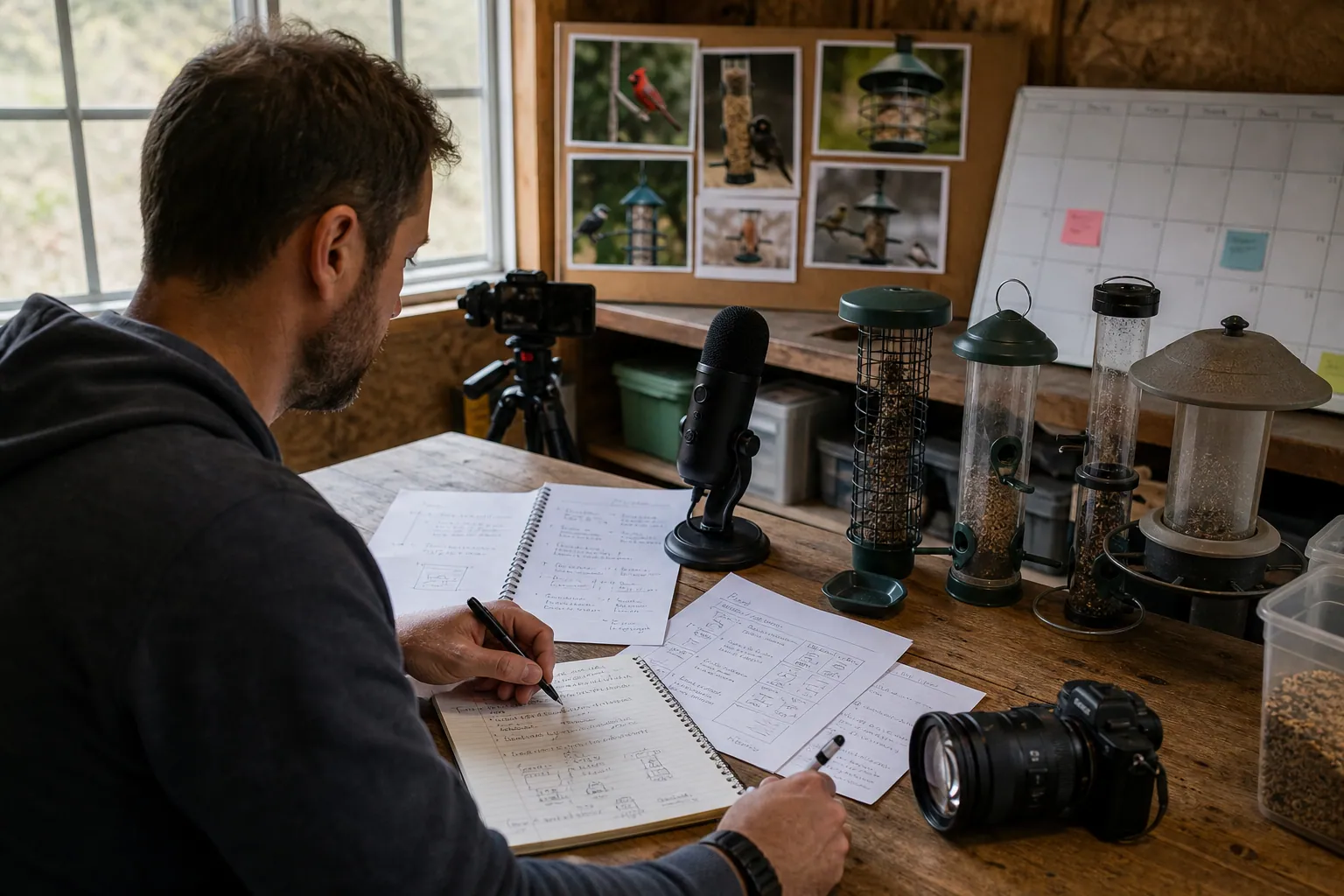
Strategy Memo: Pinterest SEO for Squirrel-Proof Bird Feeder Shops
A focused Pinterest SEO plan for bird feeder retailers: choose problem-solving content over generic bird inspiration, define useful metrics, and launch in 30 days.

Project Posts vs Plan Pages: What a Woodworking Plan Shop Should Link From Pinterest
Compare five Pinterest destinations for PDF woodworking plans—from direct product pages to cut lists—and choose the route that fits each searcher's build decision.

The Stitch-Guide Pinterest SEO Desk for Needlepoint Canvas Shops
Turn hard-to-search canvas names into Pinterest discovery assets with a weekly routine built around stitch questions, finishing decisions, and project-ready collections.

The Fit-Diagnosis Content Blueprint for Pants-Fitting Courses
Turn pants-fitting questions into an evergreen Pinterest content operation that sends serious sewists to free fit tools, lessons, and your paid course.

The AI Project-Question Pinterest Desk for Mineral Paint Brands
A practical AI-assisted Pinterest routine for mineral paint sellers turning verified product facts, customer questions, and project intent into catalog traffic.