Case Study: How a Podcasting Course Creator Turned Planning Pins Into Evergreen Enrollments
A composite teardown of a podcasting educator who replaced aesthetic creator Pins with planning resources that attracted more course-ready subscribers and buyers.

A podcasting educator can get plenty of Pinterest engagement without creating much course demand.
That was the problem for this composite creator: an experienced podcast producer selling a self-paced program for consultants, coaches, and small-business owners who wanted to launch a client-generating interview show.
Her account had attractive Pins about podcast cover art, recording corners, and microphone setups. They were saved often. But many visitors were hobbyists collecting inspiration—not people ready to plan a show, record episodes, or invest in training.
This teardown shows how she changed the Pinterest path from vague creator inspiration to practical launch decisions. The numbers are illustrative composite figures, but the decisions, assets, and measurement approach are designed to be used by a course operator today.
The baseline: popular Pins, weak enrollment intent
The course had a clear outcome: help an expertise-based business publish a focused podcast with a manageable production process and a reliable path from episode to offer.
The Pinterest account, however, communicated something much broader: “podcast aesthetics and ideas.”
Here is what the initial mix looked like:
| Existing Pin topic | Why people saved it | Why it did not reliably sell the course |
|---|---|---|
| Podcast cover art inspiration | Useful for visual brainstorming | Attracted people before they had a show concept or publishing plan |
| Home podcast studio setups | Aspirational and highly visual | Often reached gear shoppers and hobbyist creators |
| Microphone recommendations | High practical interest | Sent clicks toward a decision the course did not solve |
| Quotes about starting a podcast | Easy to share | Created attention without a defined next action |
| Direct course-sale Pins | Clear offer | Asked cold visitors to buy before they understood the course's relevance |
The founder had treated Pinterest as a place to generate awareness. Her actual buyer needed help with a nearer problem:
“I know a podcast could support my business, but I do not know what to publish first, how to structure the first month, or whether I can keep up with it.”
That distinction changed the content.
The decision that reset the account: publish for the planning moment
Instead of building topics around the word podcast, the creator used Pinterest keyword research to identify decisions that happen immediately before someone needs structured education.
She grouped search language into four planning moments.
1. The show-definition moment
Searches included:
- podcast topic ideas for business
- podcast niche ideas
- how to name a business podcast
- podcast audience worksheet
These searchers were not necessarily ready to enroll. But they had moved beyond “maybe I should start a podcast.” They were making foundational choices.
The creator built a short page called Choose a Podcast Topic That Supports Your Offer, including a downloadable topic filter and a small invitation to join the course waitlist or explore the program.
2. The launch-planning moment
Searches included:
- podcast launch checklist
- podcast launch timeline
- first podcast episode ideas
- podcast episode planning template
This was the strongest fit for the paid course. The course contained launch planning, episode architecture, and repeatable preparation lessons.
Rather than link every Pin to the checkout page, she created a useful launch checklist landing page. Visitors could use the checklist immediately, then choose between a free template and the full course.
3. The interview-prep moment
Searches included:
- podcast interview questions
- podcast guest outreach email
- how to prepare for a podcast interview
These visitors may already have a show—or may be close to launching one. The educator published a lesson page with a guest briefing template and a section explaining how the paid program helped students turn interviews into authority-building episodes.
4. The consistency moment
Searches included:
- podcast content calendar
- podcast episode ideas for coaches
- batch podcast recording
- podcast planning routine
This group did not need another motivational quote. They needed a realistic way to plan six episodes without giving up after week three.
That insight led to a six-episode planning spreadsheet and a Pin series focused on sustainable publishing rather than “daily content.”
Three destination types replaced the one-size-fits-all sales page
The course page remained important. It was no longer the only destination.
The creator assigned each Pin to one of three page types based on Pinterest search intent.
| Visitor intent | Best destination | Primary call to action |
|---|---|---|
| “I need a quick answer before I decide.” | Focused lesson or guide | Read the guide, then view the relevant course module |
| “I need a tool to get started.” | Template or checklist page | Download the resource and join the email series |
| “I am comparing training options.” | Course page | Review curriculum, fit, price, and enrollment details |
This reduced a common course-marketing mistake: forcing every visitor to act like a ready buyer.
A person searching “podcast launch checklist” could get immediate value from a checklist. A person searching “podcast course for coaches” could go directly to the course page. Both were served without pretending their intent was identical.
The landing-page detail that mattered
Each page named the audience near the top.
For example:
“For consultants, coaches, and service founders planning an interview-led podcast that supports their expertise.”
That line discouraged irrelevant traffic while helping qualified visitors recognize themselves. The creator also placed the course relationship plainly on the resource pages:
“This planning tool covers the first decision. The full course helps you shape the show, record efficiently, and build a repeatable episode process.”
It was not a hard sell. It was a useful next step.
The new Pins showed an outcome, not just an object
Next, the founder stopped creating one Pin per article. Each useful page earned a small family of Pins, each built around a distinct decision or obstacle.
Here is how one launch-checklist page became five Pinterest assets.
| Pin angle | Sample Pin title | Visual direction | Destination |
|---|---|---|---|
| Planning tool | Podcast Launch Checklist for Business Owners | Checklist preview with six visible steps | Checklist landing page |
| Time constraint | Launch a Podcast Without Recording 10 Episodes First | Simple 3-phase launch timeline | Checklist landing page |
| Offer alignment | How to Choose Podcast Episodes That Support Your Services | Episode-to-offer mapping graphic | Topic-planning lesson |
| Beginner anxiety | Your First Podcast Episode Does Not Need an Origin Story | First-episode outline preview | Lesson page |
| Direct training | Podcast Course for Coaches and Consultants | Course dashboard plus curriculum outcomes | Course page |
The Pin titles used the language people searched for, but the copy did not become robotic. Strong Pinterest descriptions clarified what was inside, who it served, and what the click would deliver.
For example:
Planning a business podcast? Use this podcast launch checklist to choose your first episodes, organize recording tasks, and avoid a rushed launch. Includes a free planning template for coaches and consultants.
Notice what it does not promise: downloads, audience growth, or client results. It promises a planning resource and describes its fit.
The email bridge did the patient work
The free six-episode planner brought in more relevant subscribers than broad “start a podcast” content. But the creator did not immediately send those subscribers a generic course discount.
She used a three-email bridge over seven days.
Email 1: Deliver the planner and frame the use case
Subject: “Your six-episode podcast planner”
The email showed how to choose one business question per episode and encouraged the subscriber to complete just the first two rows.
Email 2: Solve a likely obstacle
Subject: “What to record before you invite guests”
This email taught a small but meaningful concept: record one positioning episode before publishing interviews. It linked to a related lesson page.
Email 3: Make the paid course relevant
Subject: “If your planner is full but your recording calendar is empty”
The creator explained that planning topics and producing episodes are separate challenges. She introduced the course as structured support for the recording, interview, and publishing decisions that followed.
The sequence was short because the goal was not to manufacture urgency. It was to help a planner see whether the paid course solved the next problem.
What changed after eight weeks
The account did not suddenly become a high-volume publishing machine. The creator made two new Pin families per week, refreshed one older winner, and reviewed results every Friday.
The illustrative composite results below compare the old broad-inspiration mix with the revised planning-led mix.
| Signal | Before | After | What it meant |
|---|---|---|---|
| Saves per 1,000 impressions | Higher | Lower | Fewer aesthetic or hobbyist saves were not a failure |
| Outbound clicks per 1,000 impressions | 3.8 | 7.6 | More Pins gave people a concrete reason to visit |
| Resource-page email opt-in rate | 18% | 31% | The templates matched the promise made in the Pin |
| Subscriber-to-course-page visits | 18% | 33% | The email bridge connected the free resource to the next challenge |
| Pinterest-attributed enrollments in a 30-day window | 3 | 9 | Better intent mattered more than broad reach |
The key lesson is not that every account should expect a threefold enrollment increase. Course price, audience size, offer maturity, page quality, and seasonality all matter.
The useful lesson is that the creator accepted lower vanity engagement in exchange for a stronger path from search to planning resource to course consideration.
The reporting change: stop calling every save a win
The founder had previously checked saves and impressions first. After the rebuild, she kept those metrics, but added a weekly decision sheet.
For every Pin family, she reviewed:
- Outbound clicks: Did the Pin make a specific enough promise to earn a visit?
- Landing-page engagement: Did visitors scroll, download, or choose a next step?
- Email-source behavior: Did template subscribers open the first email and click a relevant lesson?
- Course-page visits: Did the topic lead people toward the offer?
- Enrollments and assisted enrollments: Did a Pinterest visitor buy now or return later through email, direct traffic, or another channel?
She tagged every destination with Pinterest UTM tracking. A naming pattern such as the following made the reports readable:
utm_source=pinterest
utm_medium=organic
utm_campaign=podcast_launch
utm_content=checklist_timeline_v1
The campaign described the planning topic. The content field identified the creative angle. This made it possible to see whether the checklist preview, the time-saving message, or the episode-mapping visual drove better Pinterest outbound clicks and downstream course interest.
For a small team, a tool like PinPinMe can also help keep approved URLs, creative variants, and scheduled publishing dates organized so reporting does not become a detective project later.
What the creator deliberately did not do
The overhaul worked partly because it avoided several tempting distractions.
She did not delete every inspirational Pin
A few visual Pins still supported brand discovery. They simply stopped receiving most of the production time.
She did not publish a separate blog post for every keyword
One substantial planning page could serve several closely related searches. The creator made new Pin angles before making new pages.
She did not hide the useful resource behind a vague opt-in
The landing page explained what the template contained and showed a preview. Trust improved when visitors could assess whether it was worth the email address.
She did not judge the course after two days
Pinterest discovery often has a delay. She used 30-day cohorts for downloads and enrollments, especially for Pins that introduced a planning process rather than a direct purchase.
Transferable lessons for any educational offer
A podcasting course is only one example. The same pattern applies to educators selling writing programs, technical training, craft classes, professional certification prep, and expert-led memberships.
1. Find the decision before the course
People rarely search for a course before they understand the problem they need help solving. Build assets around the decision immediately before your curriculum becomes valuable.
For a course on pottery glazing, that might be choosing a glaze combination. For a leadership course, it could be preparing for a first one-on-one. For a podcast course, it was planning the first six episodes.
2. Make the free resource complete—but bounded
A template should solve a real first step. It should not pretend to replace the entire paid program. The best resource creates clarity about the next problem your course legitimately helps solve.
3. Use Pin families to test a page before building more pages
A page can support different messages: speed, confidence, a checklist, a comparison, or a common mistake. Test the framing before concluding that the topic itself failed.
4. Match every Pinterest Pin to a truthful destination
If the visual promises a podcast launch checklist, the click should not land on a generic homepage or a checkout page with no checklist. Alignment improves trust and makes analytics more useful.
5. Measure course readiness, not only traffic
A lower-save Pin that brings template downloads, email clicks, and course-page views can be more valuable than a high-save Pin that attracts an audience outside your offer.
A 10-Pin test to run this month
If you sell an educational product and want to try the approach, do not rebuild your entire account first. Run a focused test.
- Choose one repeated learner question from sales calls, student feedback, or support emails.
- Build one useful page: a template, checklist, diagnostic, or short lesson.
- Write three Pin titles based on different angles: outcome, obstacle, and planning tool.
- Create two visual variants for each title.
- Make one direct-offer Pin for people already seeking training.
- Add clear UTM parameters to each destination.
- Publish the 10 Pins over two to three weeks rather than all at once.
- Check outbound clicks after seven days.
- Review landing-page actions and email engagement after 30 days.
- Create the next Pin family from the topic that produced the strongest course-ready behavior—not simply the most saves.
Pinterest can support evergreen course discovery when it behaves like a helpful first lesson. The goal is not to turn every searcher into a buyer on the first click. It is to give the right learner a practical next step, then make the path to your paid education feel like the natural continuation.

Case Study: A Cottage Food Course’s Pinterest Shift From Recipe Saves to Enrollments
A composite teardown of a cottage food educator who replaced recipe-heavy Pins with compliance, pricing, and preorder content that produced more course-ready leads.

The Grant-Calendar Pinterest Content Desk for Self-Paced Courses
Turn real grant-writing questions into accurate Pinterest resources, email signups, and course discovery with a weekly publishing desk built to stay current.

Research Logs vs Pedigree Charts: Pinterest Paths for Genealogy Course Creators
Compare five Pinterest destinations for genealogy educators, from research-log templates to direct enrollment pages, and choose a path that earns serious future students.

The Collection-to-Enrollment Pinterest Desk for Surface Pattern Design Courses
A copyable Pinterest content operation for surface pattern design educators who want sketchbook searches to become useful email subscribers and course enrollments.

Case Study: How Event Florist Proposal Software Turned Pinterest Templates Into Activated Trials
A composite teardown of an event florist SaaS team that replaced bridal-inspiration Pins with pricing, recipe, and proposal resources that attracted stronger trials.
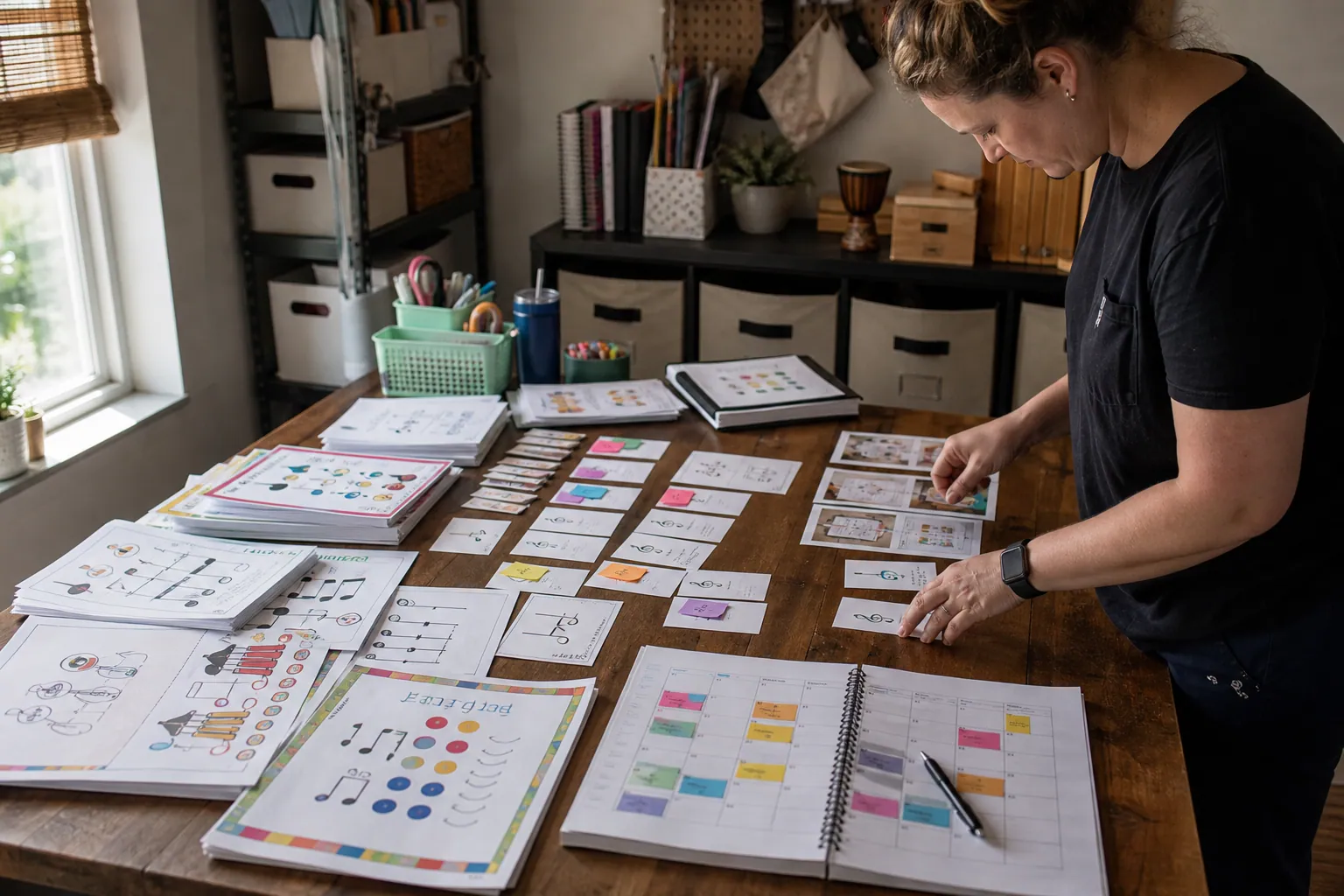
Case Study: How an Elementary Music Printable Shop Turned Pinterest Freebies Into Bundle Sales
A composite teardown of a music printable seller that stopped sending every Pinterest visitor to one freebie and built intent-led paths to bundle sales.