Strategy Memo: The Trip-Planning Pinterest Rebuild for a Kayak Tour Operator
An anonymized strategy memo for a seasonal kayak tour company: compare Pinterest content bets, define qualified metrics, and run a 30-day trip-planning rebuild.
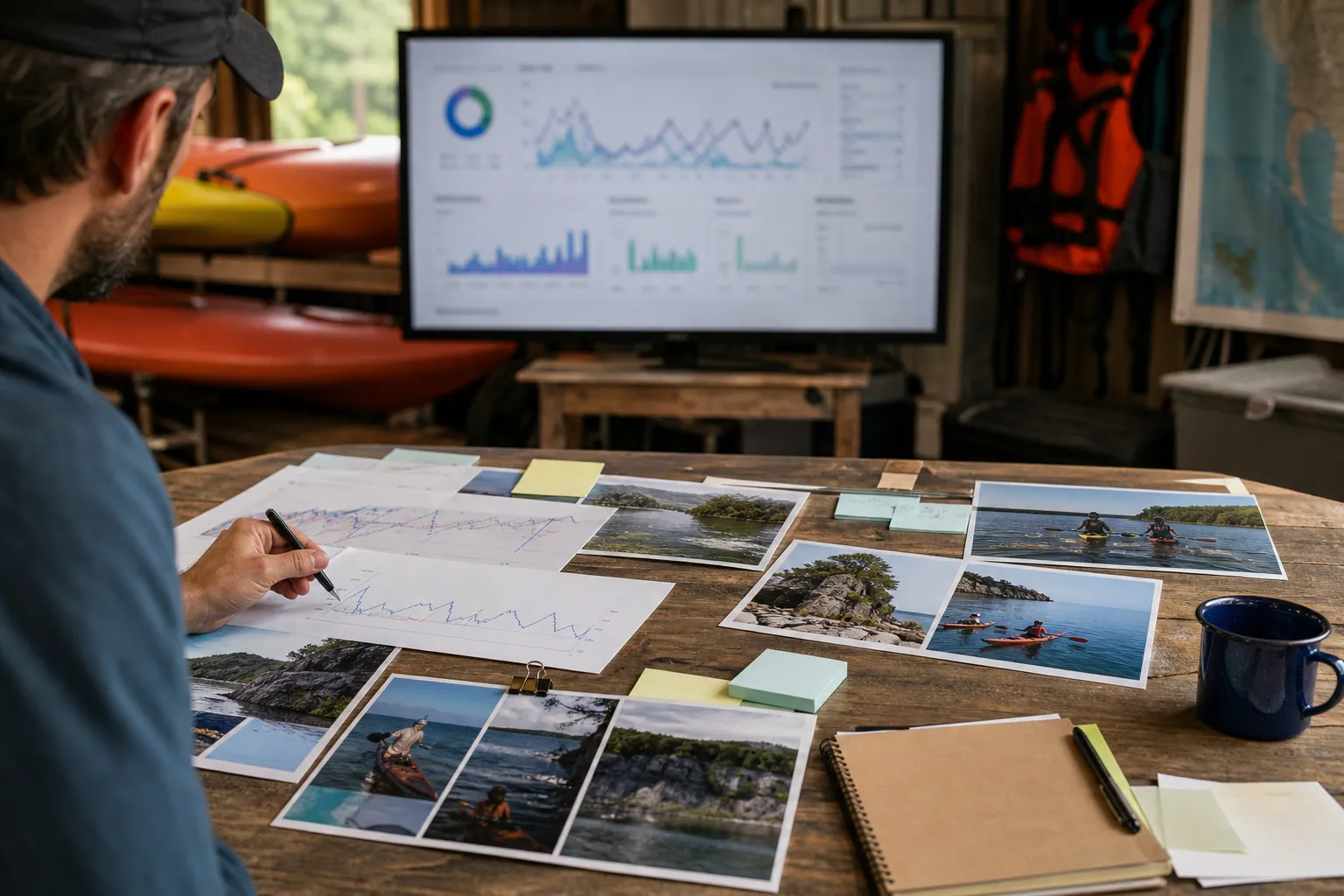
Strategic thesis: a local kayak tour operator should not treat Pinterest like a brochure for tours. It should use Pinterest as an early trip-planning channel that reaches people before they search “book kayak tour near me.”
For a seasonal adventure business, the best Pinterest traffic often starts with questions like:
- “things to do in Door County with kids”
- “what to wear kayaking in July”
- “romantic weekend in Traverse City”
- “beginner kayak tour Lake Michigan”
- “family lake vacation packing list”
Those searches are not as direct as a booking-page visit. But they happen earlier, they repeat every season, and they give a small operator a way to be useful before the traveler has chosen an activity.
This memo uses an anonymized operator I’ll call Harbor Paddle Co., a guided kayak tour company in a northern Great Lakes vacation town. The specifics are about kayaking, but the approach applies to other seasonal local services: bike tours, paddleboard rentals, fishing guides, rafting outfitters, trail-riding stables, and small travel experiences.
The operating problem
Harbor Paddle Co. had three marketing assets most local tour operators would envy:
- Strong customer photos from sunset paddles, family tours, and calm-water mornings
- Clear tour pages with dates, prices, and safety information
- A destination people already searched for during summer vacation planning
But the Pinterest account was acting like a photo archive.
Before the rebuild, most pins had titles like:
- “Sunset Kayak Tour”
- “Summer Paddle”
- “Lake Adventure”
- “Our Guided Tours”
Nearly every pin linked to the homepage. Boards were broad: “Kayaking,” “Summer,” “Travel,” and “Our Tours.” There were no Pinterest UTMs, no separation between saves and outbound clicks, and no way to know whether a pin helped a visitor move toward the booking calendar.
The owner’s question was not “Can Pinterest get millions of views?” It was more practical:
Can Pinterest bring more qualified trip planners to the site without adding another daily content chore?
That is the right question.
The choice set: five Pinterest paths for a tour business
A local operator usually has more Pinterest options than they think. The hard part is choosing which ones deserve attention first.
| Option | What it looks like | Upside | Limitation |
|---|---|---|---|
| Tour-page promotion | Pins for “sunset kayak tour,” “family kayak tour,” “private kayak tour” | Closest to revenue | Smaller search pool; can feel like an ad |
| Destination planning | “48 hours in [town],” “things to do near [lake],” “weekend itinerary” | Reaches travelers before they choose activities | Broader traffic; weaker immediate intent |
| Beginner confidence content | “What to wear kayaking,” “is kayaking hard for beginners?” | Builds trust and removes booking friction | Some readers may already have plans elsewhere |
| Occasion content | “date night ideas,” “family lake day,” “girls’ weekend itinerary” | Matches real trip motivations | Needs careful local qualification |
| Local partner content | Hotels, restaurants, beaches, parking, rainy-day swaps | Helpful and shareable | Can become too broad if not tied back to the tour |
The recommended mix for Harbor Paddle Co. was not to choose one path. It was to balance them:
- 45% destination planning pins to reach travelers early
- 30% beginner confidence pins to reduce hesitation
- 25% tour and occasion pins to capture higher-intent searches
That mix keeps Pinterest useful while still pointing toward bookings.
Recommendation: sell the trip before you sell the tour
The rebuild centered on one idea: the kayak tour is part of a trip, not the whole trip.
Most travelers are not planning in this order:
- I need a guided kayak tour.
- Which company should I book?
- What else should I do nearby?
They are more often planning like this:
- We’re going to the lake for two days.
- What can we do that feels memorable but not stressful?
- Can the kids handle it?
- What should we wear?
- Is there a sunset option?
- Where do we park?
- Can we book it before dinner?
Pinterest content should match that mental sequence.
Before-and-after setup
| Area | Before | After |
|---|---|---|
| Pin titles | Tour names and vague captions | Search-led titles with local and planning language |
| Destinations | Homepage for almost every pin | Specific tour pages, beginner guides, itinerary pages |
| Boards | Generic activity boards | Local planning boards and beginner-focused boards |
| Visuals | Pretty water shots only | Water shots plus packing, parking, maps, people, launch points |
| Measurement | Monthly views | Saves, outbound clicks, engaged sessions, booking-step clicks |
This is where many local businesses improve quickly. They already have the raw material. They just need to package it around the traveler’s questions.
Why not just pin the tour pages?
Direct booking pins matter. A tour operator should absolutely have pins that point to high-converting offer pages.
Examples:
- “Sunset Kayak Tour in [Town]: Calm Water Guided Paddle”
- “Beginner-Friendly Kayak Tour Near [Lake]”
- “Private Family Kayak Tour for Summer Vacation”
- “Guided Kayaking Near [Destination]: What to Expect”
The tradeoff is volume.
Fewer people search Pinterest with booking-ready language than with planning language. If the account only publishes direct tour pins, it may miss the larger group still assembling the trip.
The better approach is to let direct pins support the broader planning content. A traveler might find the itinerary pin first, save the beginner packing guide next, and click the sunset tour page later.
Why broad destination pins need boundaries
The opposite mistake is chasing every travel keyword in the region.
A kayak operator does not need to rank for every version of:
- “Michigan vacation ideas”
- “Lake house weekend”
- “summer travel bucket list”
- “best Midwest road trips”
Those can attract saves, but they may not attract people close enough to book.
Harbor Paddle Co. needed local qualifiers in the Pinterest SEO layer:
- Town name
- Nearby lake or bay
- Region name
- Drive-time cities
- Common vacation phrases
- Family, couple, and beginner modifiers
A broad pin title like “Summer Lake Vacation Ideas” became more useful as:
- “Lake Michigan Weekend Itinerary With a Sunset Kayak Tour”
- “Family Things to Do Near [Town] Before Dinner”
- “Beginner Kayaking in [Region]: What to Wear and Expect”
The second group may get fewer impressions. That is fine. The clicks are more likely to matter.
Beginner content is not fluff
Operators sometimes dismiss beginner content because it feels too basic.
But beginners are often the buyers.
They are the travelers asking:
- Will I tip over?
- Do I need special shoes?
- Can kids do this?
- What happens if it rains?
- Do I need upper-body strength?
- Can I bring my phone?
- Is sunset kayaking safe?
Every unanswered question is a reason to delay booking.
For Harbor Paddle Co., the best beginner pages were not long essays. They were practical planning pages with clear CTAs.
A strong beginner page included:
- Who the tour is for
- What to wear by month
- What the company provides
- What to leave in the car
- How parking and check-in work
- A simple difficulty explanation
- Photos of real guests, not only perfect landscape shots
- A “check available dates” button near the top and bottom
That page can support many Pinterest pin titles and descriptions without becoming repetitive.
The tradeoffs the owner needs to accept
Pinterest can be useful for local business growth, but it is not the same as paid search or a last-minute booking app.
1. Saves may precede bookings by weeks
Travelers save ideas while comparing dates, hotels, restaurants, and weather. A pin save is not revenue, but it can be a real planning signal.
The mistake is ignoring saves completely. The other mistake is treating saves as success by themselves.
For this account, saves mattered when they clustered around specific trip-planning topics. A saved “family lake weekend packing list” pin told us more than a saved generic sunset photo.
2. Local relevance beats raw reach
A pin that gets 20,000 impressions from people planning lake trips everywhere may be less valuable than a pin that gets 1,000 impressions from people searching your exact town and nearby attractions.
Pinterest analytics should be read with geography and landing-page quality in mind.
3. The landing page has to finish the job
Pinterest can bring the visitor to the right door. It cannot fix a vague page.
For Harbor Paddle Co., a planning pin needed a destination that answered the promise of the pin. If the pin said “what to wear kayaking in July,” the page could not dump people on a general booking calendar with no clothing advice.
4. Safety content must be useful without creating liability confusion
Adventure businesses should be careful with safety content. The goal is not to publish DIY route instructions for conditions the operator cannot control. The safer angle is guided-tour preparation:
- What guests should bring
- What the guide provides
- How weather decisions are handled
- What beginners can expect
- When to contact the operator with concerns
This builds confidence without pretending a pin can replace professional judgment.
Metrics: what counts as progress before bookings show up
The account needed a simple scorecard. Not a dashboard with 40 numbers. Just enough to separate visibility from qualified interest.
Track these for every pin batch
| Metric | Why it matters |
|---|---|
| Impressions | Shows whether Pinterest understands and distributes the topic |
| Saves | Indicates planning value and future intent |
| Outbound clicks | Shows movement from Pinterest to owned pages |
| Click rate by topic | Helps compare direct tour pins vs guides vs itineraries |
| Engaged sessions | Shows whether visitors stayed long enough to read or act |
| Booking-step clicks | Tracks clicks on “check dates,” “book now,” or “ask a question” |
| Assisted bookings | Best available revenue signal, even if imperfect |
UTMs are essential here. Use campaign names that reveal the content bet, not just the date.
For example:
utm_source=pinterest
utm_medium=organic
utm_campaign=beginner_kayak_july
utm_content=what_to_wear_blue_pin
or:
utm_source=pinterest
utm_medium=organic
utm_campaign=lake_weekend_itinerary
utm_content=family_48_hours_map_pin
This lets the owner compare topics later without guessing.
Decision rules for the first month
Do not judge the 30-day test only by booked tours. Pinterest often needs more time to compound.
Instead, use these decision rules:
- If a topic gets impressions but no saves or clicks, revise the visual promise and pin title.
- If a topic gets saves but weak clicks, make the pin more specific or more local.
- If a topic gets clicks but poor on-site engagement, improve the landing page.
- If a topic gets booking-step clicks, create more pins and a stronger page around it.
- If direct tour pins underperform, connect them to planning content instead of deleting them.
The goal is to find which planning moments produce qualified traffic.
The 30-day action plan
This plan assumes a small team: owner, admin, or marketing contractor. It does not require daily posting from scratch.
Days 1-3: choose three buyer moments
Pick three moments close enough to booking that they are worth building around.
For Harbor Paddle Co., the three were:
- Weekend trip planning: visitors deciding what to do in town
- Beginner reassurance: first-time paddlers wondering if they can handle it
- Occasion planning: couples, families, and friend groups looking for a memorable activity
Avoid starting with ten audiences. A narrow first month creates cleaner data.
Days 4-7: build or improve five landing pages
The operator did not need a huge blog. They needed five useful pages that matched Pinterest intent.
Recommended pages:
- Beginner Kayaking in [Town]: What to Expect on a Guided Tour
- What to Wear Kayaking in [Region] by Month
- 48 Hours in [Town]: A Waterfront Weekend Itinerary
- Family-Friendly Things to Do Near [Lake]
- Sunset Kayak Tour in [Town]: Best Times, Photos, and Parking
Each page should include:
- A short answer above the fold
- Real photos from the tour experience
- Local details: parking, timing, nearby landmarks, drive times
- Internal links to relevant tour pages
- A clear booking or inquiry CTA
- A short FAQ section using actual customer questions
The page does not need to be fancy. It needs to be specific.
Days 8-10: map Pinterest keywords to pages
Do Pinterest keyword research before designing pins.
For each page, create a small keyword cluster:
Beginner page
- beginner kayak tour
- kayaking for beginners
- first time kayaking tips
- what to expect kayaking
- guided kayak tour for beginners
What-to-wear page
- what to wear kayaking
- what shoes to wear kayaking
- kayaking outfit summer
- what to bring kayaking
- lake vacation packing list
Weekend itinerary page
- things to do in [town]
- [region] weekend itinerary
- lake weekend trip
- family things to do near [lake]
- romantic weekend in [region]
Then write pin titles and descriptions from these clusters.
Example pin titles:
- “What to Wear Kayaking in [Town] in July”
- “Beginner Kayak Tour Near [Lake]: What Actually Happens”
- “48 Hours in [Town] With a Sunset Paddle”
- “Family Lake Day Packing List Before a Guided Kayak Tour”
- “Romantic Weekend in [Region]: Dinner, Beach Walk, and Sunset Kayaking”
Example description style:
Planning a summer trip to [Town]? Use this beginner-friendly guide to learn what to wear kayaking, what to bring, where to park, and how a guided sunset tour works on [Lake].
That description is clear, local, and helpful. It does not stuff keywords into a sentence nobody would read.
Days 11-14: rebuild the board structure
Boards should reflect how travelers plan, not how the business organizes its services.
Replace broad boards with search-aware boards like:
- “[Town] Weekend Itinerary Ideas”
- “[Region] Family Vacation Ideas”
- “Beginner Kayaking Tips”
- “Lake Vacation Packing Lists”
- “Romantic Things to Do in [Town]”
- “Guided Kayak Tours in [Region]”
Write board descriptions that include the location and audience naturally.
Example:
Weekend travel ideas for [Town] and [Region], including family-friendly activities, lake day planning, beginner kayaking tips, sunset paddles, packing lists, and local things to do near [Lake].
This is basic Pinterest board strategy, but it matters. Boards help organize topical relevance, especially when a small account is trying to teach Pinterest what it is about.
Days 15-21: create the first 36-pin batch
The first batch should be big enough to compare topics, but not so big that the team loses quality control.
A practical split:
- 10 pins for the beginner page
- 8 pins for the what-to-wear page
- 8 pins for the weekend itinerary page
- 6 pins for the sunset tour page
- 4 pins for the family activities page
Use different visual angles, not just different text overlays on the same photo.
Good visual types for a kayak operator:
- Guest group at launch point
- Calm water with guide visible
- Shoes, dry bag, sunscreen, hat, water bottle flatlay
- Simple map-style graphic showing “beach, dinner, sunset paddle”
- Parent and child getting ready
- Golden-hour paddle photo with readable overlay
- Parking or meeting-point visual if it reduces anxiety
- Weather-ready clothing examples
If you batch work on one admin afternoon, a Pinterest-focused scheduler like PinPinMe can keep the queue, pin titles, descriptions, boards, and UTM-tagged URLs organized without turning publishing into a daily task.
Days 22-25: add local proof and partner angles
Travelers trust specifics.
Add pins that connect the tour to the real trip:
- “Kayak Before Dinner: Easy Evening Plan in [Town]”
- “Where to Stay Near a Sunset Kayak Tour in [Region]”
- “Beach Morning, Coffee Stop, Sunset Paddle: A Simple [Town] Day”
- “Rainy Morning, Clear Evening: Flexible Lake Day Ideas”
Be careful not to imply formal partnerships unless they exist. You can mention neighborhoods, public beaches, general dining areas, or “nearby coffee shops” without presenting a partner list.
Days 26-28: check the early signals
At the end of week four, the data will still be young. That is normal.
Look for directional signals:
- Which pin topics have the strongest save rate?
- Which topics earn outbound clicks earliest?
- Which landing pages hold visitors longest?
- Which pages get booking-step clicks?
- Are broad itinerary pins sending shallow traffic?
- Are beginner pins creating more engaged sessions?
Do not panic if direct tour pins are not the biggest traffic drivers. They often work better after a traveler has interacted with planning content.
Days 29-30: decide what to double down on
End the month with decisions, not vague reporting.
Use a simple keep, revise, stop list.
Keep
- Topics with clicks and engaged sessions
- Pins that earn saves and clicks, not saves alone
- Landing pages that generate booking-step clicks
Revise
- High-impression pins with weak clicks
- Pretty visuals with unclear local relevance
- Pages where visitors bounce quickly
Stop for now
- Generic lake quotes
- Unqualified travel bucket-list pins
- Pins that link to the homepage without a specific promise
- Boards that are too broad to support local intent
The next 30 days should create more around the strongest topic, not start over.
What this changes in the business
The practical win is not “Pinterest content.” The win is a better way to package the business for people who are already planning a trip.
After the rebuild, Harbor Paddle Co. had:
- Search-led pin titles instead of vague captions
- Landing pages that answered traveler hesitation
- A board structure built around local trip planning
- UTMs that separated topic performance
- A Pinterest publishing cadence the owner could maintain weekly
- A clearer bridge from inspiration to booking
That is the real case study lesson.
A local tour company does not need to become a travel publisher. It needs to own the few planning questions that sit closest to its booking decision.
For a kayak operator, those questions are simple:
- What should we do at the lake?
- Can beginners handle this?
- What should we wear?
- Is it good for kids, couples, or groups?
- How does it fit into the rest of our day?
Answer those questions with useful pages, specific pins, and clean analytics. That is how Pinterest becomes more than a place to post pretty water photos.

Case Study Memo: How a Murphy Bed Studio Replaced Room-Photo Pins With Fit-Plan Traffic
A composite case study for Murphy bed studios: compare room photos, sizing guides, catalog Pins, and local pages, then run a 30-day test for better design consultations.

Case Study: The Project-First Pinterest Rebuild for a Stained-Glass Supply Shop
A composite case study showing how a small stained-glass supply shop can turn workshop notes, inventory, and maker questions into a maintainable Pinterest content operation.

Case Study: A Residential Architect’s Pinterest Pivot to Feasibility Studies
A composite case study of a small residential architecture studio comparing portfolio, floor-plan, checklist, and feasibility pins to earn better renovation inquiries.

Case Study: How an Acoustic Panel Shop Turned Pinterest Planning Traffic Into Sample Kit Orders
A composite operator case study of an acoustic panel shop that replaced vague “soundproofing” Pins with accurate room-planning content and a sample-first path to purchase.

The Trip-Planning Pinterest SEO Desk for Family Travel Advisors
A copyable Pinterest content blueprint for Europe-focused family travel advisors: turn itinerary questions into accurate pins, useful pages, and better-fit planning calls.

AI Pinterest Content for Residential Architects: 5 Approaches Compared
Compare five ways residential architecture studios can use AI for Pinterest—without inventing project details, publishing stale plans, or attracting the wrong inquiries.