Pinterest Preorder Analytics for Limited-Run Knitwear Brands
A practical operator guide for knitwear founders who need Pinterest to forecast real preorder demand—not just generate autumn capsule saves.
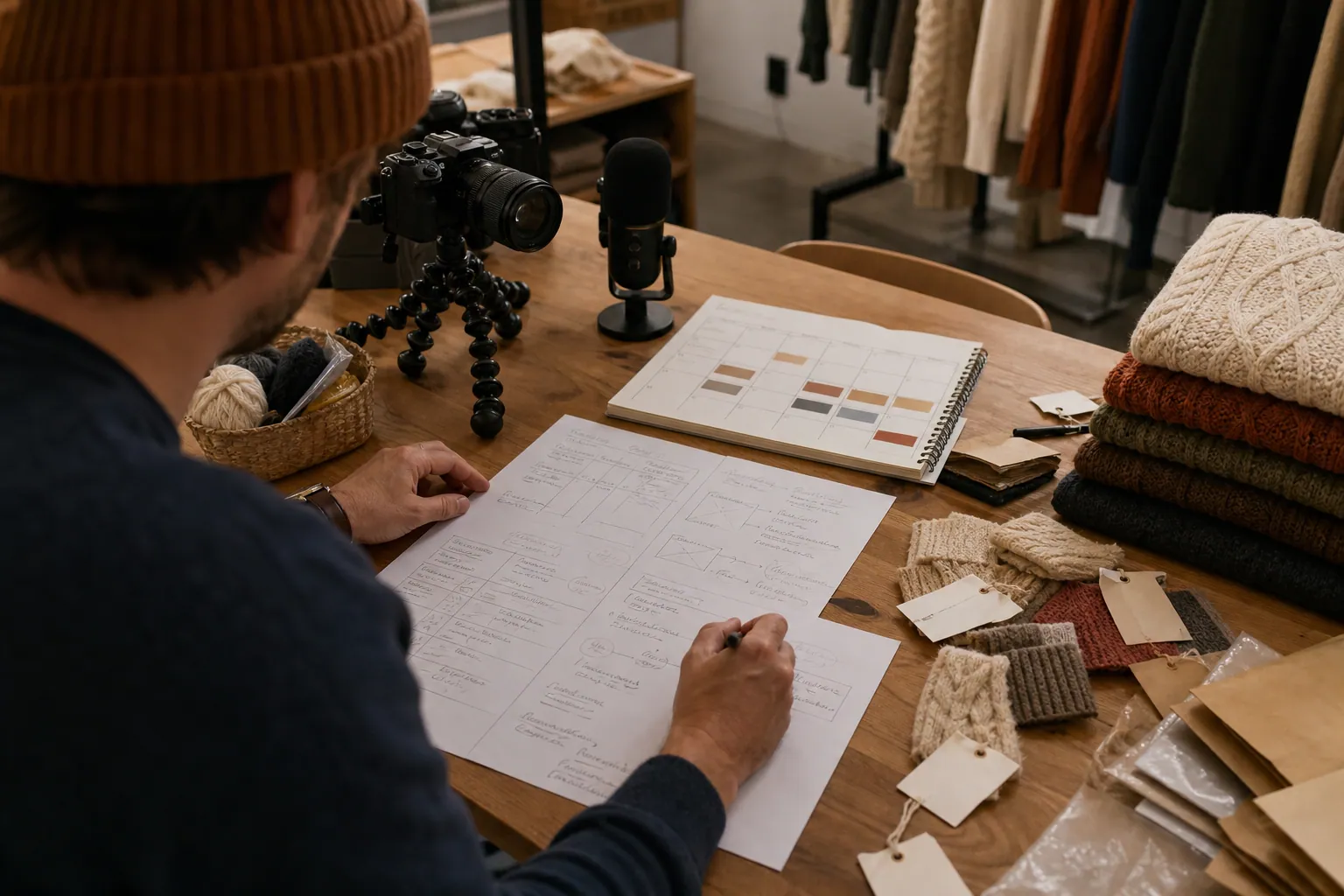
A knitwear founder opens fall preorders in three weeks. She can afford to reserve yarn for 180 cardigans, but not 260. Pinterest is already showing signs of life: a rust-colored outfit Pin has 420 saves, while a size-and-fit Pin has only 95.
Which signal should determine the yarn order?
Not saves alone. The decision needs a short reporting loop that connects each Pin to a measurable next step: a product-page visit, a size-guide interaction, a waitlist signup, and eventually a paid preorder. For limited-run apparel, that distinction protects cash, production capacity, and customer trust.
This operator playbook is for a small knitwear brand selling seasonal, made-to-order, or tightly stocked pieces through its own site.
Diagnose the gap before making another Pin
Start with the path a Pinterest visitor must take before she becomes useful demand:
Pin impression → outbound click → collection or product page → fit check → waitlist or preorder → paid order
Find the first stage that is underperforming. A Pinterest account can look active while the business is losing buyers at one quiet, fixable point.
Use four views of the same traffic
Review the last 30 days in Pinterest Analytics, your web analytics platform, ecommerce dashboard, and email tool. Use consistent Pinterest UTM tracking so the records can be joined. A simple naming format is enough:
utm_source=pinterest
utm_medium=organic
utm_campaign=fall-knitwear-preorder
utm_content=fit-cardigan-v1
Then put these numbers in one weekly sheet:
| Stage | What to measure | What it can tell you |
|---|---|---|
| Discovery | Impressions, saves, outbound clicks | Whether the topic reaches planners and earns attention |
| Traffic quality | Engaged sessions, product-page views, size-guide opens | Whether the Pin and destination make sense together |
| Intent | Waitlist joins, back-in-stock requests, email confirmations | Whether visitors would like to hear when buying is possible |
| Commercial outcome | Preorders, preorder revenue, refund or cancellation rate | Whether demand is viable for production decisions |
Calculate a few plain-language ratios rather than collecting every available metric:
- Outbound click rate = outbound clicks ÷ impressions
- Waitlist rate = confirmed Pinterest-attributed waitlist joins ÷ Pinterest sessions
- Preorder conversion rate = Pinterest-attributed paid preorders ÷ Pinterest sessions during the open window
- Revenue per 100 Pinterest sessions = attributed preorder revenue ÷ Pinterest sessions × 100
- Fit-assist rate = size-guide opens or fit-tool uses ÷ product-page sessions
A Pin with modest reach and a 12% waitlist rate is often more valuable than a broad outfit image with thousands of saves and a 1% rate.
Separate a content problem from a store problem
Use this diagnosis table before changing your Pinterest content plan.
| What you see | Likely issue | First action |
|---|---|---|
| Low impressions and low outbound clicks | The search angle, Pinterest pin titles, or creative promise is unclear | Test a more specific shopper question, such as petite cardigan fit or wool layer for office commute |
| High saves but weak outbound clicks | The image inspires without creating a reason to continue | Add a decision-led promise: fit notes, color comparison, styling formula, or preorder date |
| Strong clicks but few size-guide opens or signups | The landing page does not continue the Pin's promise | Put sizing, yarn details, delivery timing, and signup action above the fold |
| Strong waitlist joins but weak paid preorders | Timing, price, payment terms, or email follow-up may be the constraint | Survey waitlisters, review checkout friction, and segment the launch emails |
| Healthy preorders followed by returns or cancellations | The Pin may be setting inaccurate fit, color, or delivery expectations | Replace vague claims with measurement, modeled sizes, and a clear production calendar |
A useful rule: do not call a Pinterest campaign weak until the entire path has been checked. Traffic is not the only variable.
The weekly preorder reporting rhythm
This routine takes about two hours a week once the tags, pages, and sheet exist. Its purpose is not to optimize every Pin daily. It is to make one defensible production or publishing decision each week.
Monday: read cohorts, not lifetime totals
Pull Pins published 7, 14, and 28 days ago into separate groups. Pinterest content can gather momentum after publication, so comparing a two-day-old Pin to a two-month-old Pin produces bad conclusions.
For each cohort, record:
- Pin ID or name
- publish date
- search phrase or topic
- creative angle
- destination page
- UTM content value
- saves, outbound clicks, and outbound click rate
- engaged sessions, waitlist joins, and preorders
Add a one-line note for anything that changed: stock status, an email send, a pricing update, a cold snap, or the preorder window opening. Those events explain performance that a dashboard cannot.
Tuesday: inspect the destination as a customer
Open the top three Pinterest landing pages on a phone. Answer these questions without using internal knowledge:
- Can I tell whether this is ready to ship, a preorder, or a waitlist?
- Can I find the garment measurements and modeled sizes quickly?
- Does the yarn composition appear before I am asked to sign up?
- Is the preorder close date clear?
- Does the page deliver the exact answer promised in the Pin?
For example, a Pin about choosing between cropped and classic cardigan lengths should land on a comparison section, not a generic fall collection page. Good Pinterest landing pages reduce the gap between curiosity and confidence.
Wednesday: create one controlled test family
Choose one bottleneck from Monday's review. Then make a small family of Pins that tests one message while holding the destination steady.
If the bottleneck is weak click quality, test the reason someone clicks:
- fit certainty
- color coordination
- warmth and layering
- fiber and care
- limited production timing
Keep the product page, UTM campaign, and visual format consistent where possible. Do not change the Pin creative, title, offer, destination, and email incentive all at once. You will learn nothing reliable.
A light publishing tool can help keep test labels and URLs intact. For example, PinPinMe is useful when a small team needs to queue a named group of Pins without losing the link between the Pin, its UTM, and the weekly report.
Thursday: publish with inventory context
Before scheduling, check three facts with the person responsible for fulfillment:
- colors still available for promotion;
- realistic ship or knitting dates;
- maximum preorder capacity by style.
Do not send Pinterest traffic to a colorway that is effectively gone, and do not imply that a garment will arrive in time for an event unless the production schedule supports it. For a limited-run brand, accurate availability is part of conversion optimization.
Friday: make one decision, then document it
End the week with a decision written in the sheet. Examples:
- Scale fit-led Pins for the moss cardigan because their 14-day waitlist rate is more than double outfit-led Pins.
- Keep outfit imagery as discovery content, but direct it to a capsule styling page with an email signup rather than the preorder page.
- Pause promotion of the oat color because production capacity is nearly allocated.
- Rewrite the care-guide Pin because it earns clicks from existing knitwear owners but produces almost no new waitlist demand.
This short note prevents the team from repeating the same discussion next Monday.
Four Pin examples and how to read them
Imagine a brand is testing one cardigan collection for two weeks. These are illustrative results, not universal benchmarks.
| Pin angle | 14-day saves | Outbound clicks | Confirmed waitlist joins | What the operator should conclude |
|---|---|---|---|---|
| Five ways to style a rust cardigan | 310 | 84 | 5 | Excellent inspiration signal; weak immediate purchase intent |
| Cropped vs classic cardigan: compare lengths | 110 | 210 | 31 | The fit question attracts shoppers closer to a decision; make more variants |
| Is merino worth it for an everyday layer? | 92 | 116 | 18 | Strong education-to-intent bridge; test it for different yarn blends |
| Fall cardigan preorder closes Sunday | 38 | 66 | 14 | Small audience but high urgency; reserve for the real closing period |
The first Pin is not a failure. It may reach future customers earlier in their planning cycle, and saves can support later discovery. But it should not receive the same production forecast weight as the fit comparison Pin.
A practical way to forecast is to separate near-term orders from preorder interest:
Expected Pinterest-assisted orders =
confirmed Pinterest waitlist joins × historical waitlist-to-order rate
+ direct Pinterest preorder conversions
If this is the brand's first preorder, use a conservative range rather than one precise forecast. For example, model 10%, 20%, and 30% of confirmed waitlisters converting. Make the yarn commitment against the cautious case, not the most flattering case.
Mistakes that make knitwear reporting misleading
Treating every save as a vote to buy
Pinterest saves frequently represent moodboarding, gift ideas, or a plan for another season. Keep saves in the report because they reveal creative resonance, but pair them with clicks and downstream behavior before increasing a production run.
Measuring only last-click revenue
A shopper may save a cardigan Pin, return through an email launch message, and place an order days later. Last-click reporting would give all credit to email. Use UTMs, email subscriber source fields, and a simple post-purchase question such as Where did you first find us? to understand assisted demand.
Do not force perfect attribution. Look for agreement across signals.
Mixing organic, paid, and creator traffic
If the brand also runs ads, works with creators, or uses affiliate links, label each source separately. A paid campaign or creator mention can alter branded searches and make organic Pinterest look stronger or weaker than it is.
Testing during a moving inventory event
A test cannot be interpreted cleanly if one color sells out, the price changes, and an influencer posts during the same week. Log the disruption, wait for the next comparable batch, and avoid treating the result as a permanent rule.
Sending all Pins to a single collection page
Collection pages are useful for broad outfit or capsule searches. They are poor destinations for specific questions about length, itchiness, care, or sizing. Build a small set of durable answer pages and connect each one to the relevant collection or preorder item.
Declaring a winner before it has enough time
A Pin published yesterday may be too new to judge. Use the same 14- or 28-day review window for comparable families, and favor repeated patterns over a single spike.
Short operating checklist
Before the next preorder decision, confirm that:
- Every active Pin has a readable UTM campaign and content label.
- Pinterest performance is reviewed in 7-, 14-, and 28-day cohorts.
- The reporting sheet includes clicks, engaged sessions, waitlist joins, and paid preorders.
- Top Pinterest entry pages show fit, fiber, production timing, and a clear next action.
- Each new batch tests one primary message rather than five changes at once.
- Promotion matches available colors and real knitting capacity.
- The team records one weekly decision and the evidence behind it.
For a limited-run knitwear business, Pinterest analytics should answer a practical question: which customer concerns predict orders we can responsibly make? When the report is built around that question, it becomes a production tool—not a collection of vanity metrics.

The Pinterest Margin Test Desk for Personalized Ornament Shops Before Q4
A practical Pinterest testing desk for personalized ornament sellers: map catalog inputs, test buyer intent, publish with discipline, and protect holiday profit.

Which Pinterest Report Should a Fruit Tree Nursery Trust Before Preorders?
Late-summer Pinterest clicks often become bare-root orders months later. Compare five reporting models and build a scorecard that protects inventory decisions.

Strategy Memo: Measure Pinterest’s 21-Day Sales Lag for Holiday Card Shops
Holiday card shoppers often save today and order after photo selection. Use a 21-day Pinterest measurement model to separate discovery value from empty traffic.

Strategy Memo: Which Pinterest Pins Actually Book Home Staging Consultations?
Home staging studios should test seller intent—not chase before-and-after saves. Compare four Pinterest routes, track qualified consults, and run a focused 30-day test.

The AI Preorder Content Desk for Bare-Root Fruit Tree Nurseries
A practical AI-assisted Pinterest operating system for fruit tree nurseries that need accurate, inventory-aware preorder traffic before spring shipping.
Strategy Memo: Pinterest SEO for Squirrel-Proof Bird Feeder Shops
A focused Pinterest SEO plan for bird feeder retailers: choose problem-solving content over generic bird inspiration, define useful metrics, and launch in 30 days.