Case Study: How a Permanent Jewelry Studio Found the Pinterest Pins That Booked Private Parties
A composite teardown of a permanent jewelry studio that separated pop-up traffic from party leads and used booking-quality data to choose which Pinterest Pins to scale.
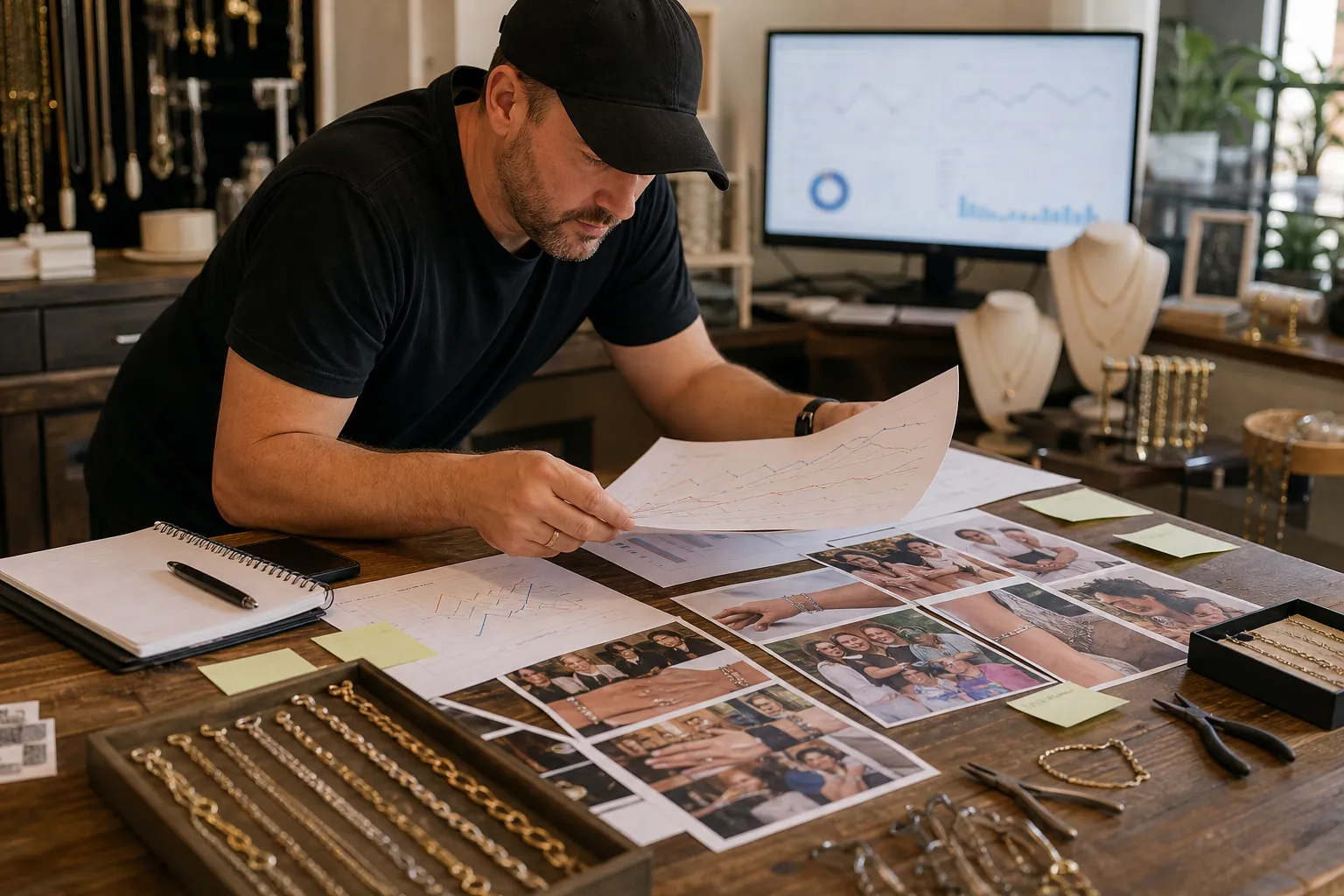
A permanent jewelry studio can have a Pinterest account full of saves and still have an empty private-party calendar.
That was the problem for this two-person mobile studio in a mid-sized metro area. It sold walk-in bracelets at markets, booked private parties, and offered bridal permanent jewelry appointments. Going into the holiday season, the owners assumed their best Pinterest content would be sparkly bracelet close-ups and event recaps.
Those Pins did travel. They just did not consistently create the kind of bookings the business needed most.
This composite case-study teardown shows how the studio separated event discovery from high-value party demand, repaired its tracking, and made decisions using inquiry quality rather than saves alone.
The starting problem: popular Pins, unclear revenue
Over eight weeks, the account produced respectable surface-level engagement:
| Signal | Eight-week baseline | Why it was misleading |
|---|---|---|
| Impressions | 186,000 | Broad jewelry inspiration reached people outside the service area. |
| Saves | 3,940 | Many saves came from style boards with no booking intent. |
| Outbound clicks | 1,126 | Every Pin led to the same general booking page. |
| Booking form submissions tagged Pinterest | 19 | The form did not distinguish pop-up shoppers from party hosts. |
| Held private-party dates | 3 | The team could not tell which Pin, page, or campaign started them. |
The original destination page presented three equal choices: book a private party, find a pop-up, and ask about bridal services. It was tidy, but it forced visitors with different needs to sort themselves out.
The larger issue was reporting. A Pinterest visitor who saw a holiday pop-up graphic, attended an event two weeks later, and then booked a private party after seeing the studio on Instagram looked like a vague direct booking in the calendar.
The team had data, but not a decision-ready record.
First repair: define the conversion that matters
The studio did not treat every form completion as a win. A useful inquiry had to meet three conditions:
- It requested a private party, bridal appointment, or corporate activation.
- Its date was available or flexible enough to book.
- It met the minimum guest count or event spend threshold.
They created three separate Pinterest landing pages:
- Holiday pop-up page: dates, neighborhood, walk-in expectations, and a calendar reminder option.
- Permanent jewelry private party page: host requirements, guest-count guidance, location radius, deposit policy, and inquiry form.
- Bridal and bachelorette page: bridal permanent jewelry options, timing, group-size guidance, and a consultation request.
Each Pin used a consistent UTM structure:
utm_source=pinterest
utm_medium=organic
utm_campaign=q4_party_bookings
utm_content=party_host_checklist_v1
The final parameter identified the exact creative and intent angle. This made Pinterest UTM tracking useful in both web analytics and the booking export.
The form also captured a hidden first-visit source and a visible question: How did you first find us? The visible answer was imperfect, but valuable when an inquiry had a long consideration period or crossed channels.
A metric stack that matched the business
The weekly sheet stopped opening with impressions. It opened with these measures:
| Metric | Formula | What it answered |
|---|---|---|
| Qualified inquiry rate | Qualified inquiries ÷ Pinterest landing-page sessions | Is this traffic the right fit? |
| Held-date rate | Held dates ÷ qualified inquiries | Are the inquiries actually bookable? |
| Booked event value per 100 sessions | Confirmed event revenue ÷ sessions × 100 | Which content creates commercial value? |
| Pop-up attendance proxy | Calendar reminders plus event-page directions clicks | Are local event Pins helping fill a market? |
| Lead-time median | Median days from first visit to booking | How long should the team wait before judging a Pin? |
For this studio, a Pin could have a low save rate and still be a success if it brought two $650 private-party bookings from 100 sessions. Conversely, a gorgeous bracelet board could generate lots of engagement and have no local commercial effect.
The decision that changed the test: stop mixing four intents
The team had previously published all jewelry imagery as though it served one audience. It actually spoke to at least four different Pinterest search intents:
| Intent | Search behavior | Best next page | Business outcome |
|---|---|---|---|
| Style inspiration | Bracelet stack ideas, permanent jewelry inspiration | Gallery or collection page | Awareness, weak immediate booking signal |
| Local event planning | Permanent jewelry pop-up, holiday shopping event | Pop-up calendar | Foot traffic |
| Host planning | Permanent jewelry private party, girls night activity | Party-host page | Private-party inquiry |
| Wedding planning | Bridal permanent jewelry, bachelorette party activities | Bridal group page | Higher-value consultation |
The owners chose to test one message family for each intent instead of publishing variations of the same bracelet photo.
This matters for Pinterest search intent. Someone looking for permanent jewelry party ideas is not necessarily deciding which bracelet chain to wear. They may be trying to solve entertainment, guest experience, budget, or booking logistics for an event they are organizing.
The four-week Pin test
The studio tested 16 Pins over four weeks: four per intent family. Every family used a dedicated landing page. To reduce noise, each family used the same service area, similar vertical layout, and comparable publishing cadence.
They did not run all possible changes at once. Within each family, the landing page and offer remained stable while the visual and Pin title changed.
The creative families
1. Pop-up utility Pins
- Title angle: Holiday permanent jewelry pop-up dates
- Visual: Date, neighborhood, walk-in note, simple chain close-up
- Destination: Event calendar
- Call to action: Find a nearby pop-up
2. Party-host planning Pins
- Title angle: How to host a permanent jewelry party at home
- Visual: A host checklist with guest-count and setup cues
- Destination: Private-party details page
- Call to action: Check your date
3. Bridal group Pins
- Title angle: Permanent jewelry for a bachelorette weekend
- Visual: Group wrist shot, booking timeline, small planning callout
- Destination: Bridal group page
- Call to action: Plan your group appointment
4. Style-led Pins
- Title angle: Delicate bracelet stack ideas for everyday wear
- Visual: Close-up stack photography
- Destination: General booking page
- Call to action: Explore permanent jewelry
The team scheduled the batch far enough ahead that operations would not interrupt testing. A PinPinMe publishing queue helped keep naming and UTM fields consistent while the owners were working weekend events, but the meaningful improvement came from the landing-page split and the follow-up data.
What changed after 28 days
The results were not a declaration that one creative format always wins. They were a clear indication that different content served different commercial jobs.
| Pin family | Saves per 1,000 impressions | Outbound click rate | Qualified inquiries per 100 sessions | Held dates | Booked event value per 100 sessions |
|---|---|---|---|---|---|
| Pop-up utility | 17.8 | 1.9% | 0.4 | 0 | $0 from tracked parties |
| Party-host planning | 8.1 | 2.7% | 5.6 | 6 | $1,740 |
| Bridal group | 12.4 | 2.2% | 3.9 | 3 | $1,260 |
| Style-led | 29.6 | 0.8% | 0.7 | 1 | $310 |
The style-led Pins were the save leaders by a wide margin. They were not useless; the team retained them for audience building and visual proof. But they were poor candidates for a private-party booking objective.
The party-host Pins had less than one-third of the style Pins' save rate. Yet their visitors were more likely to read the host requirements, submit an inquiry, and hold a date.
That was the decision point: saves described interest, while qualified inquiry rate described commercial fit.
An unexpected result: event Pins were working, just not as party Pins
At first, the pop-up content looked like a failure because it did not create private-party leads.
But calendar reminder taps, direction requests, and in-person event check-ins rose around the locations featured in those Pins. The studio started tagging checkout transactions with a short optional source field, including Pinterest pop-up calendar.
This revealed that pop-up Pins had a different role. They were local event-discovery assets, not lead-generation assets.
The studio separated the reporting lines:
- Pop-up content: calendar reminders, directions, event attendance, same-day sales.
- Party content: qualified inquiries, held dates, deposits, event revenue.
- Bridal content: consultation requests, group size, booked date, average event value.
Without that split, the team might have shut off useful holiday pop-up marketing because it failed an inappropriate metric.
The landing-page detail that lifted inquiry quality
The first private-party page had a short form and a gallery. It attracted submissions, but too many were outside the travel radius or below the minimum group size.
The revised page put decisions before the form:
- Typical group-size range
- Service radius and travel-fee note
- Whether guests or hosts pay
- Deposit timing
- Approximate appointment duration
- Whether minors can participate, based on the studio policy
- A small photo of the actual at-home setup
Then the form asked for date, neighborhood, estimated guest count, and party type.
Form completions fell from 14 in the first two weeks to 10 in the next two weeks. Qualified inquiries rose from 43% to 80%.
That is a win. Fewer unworkable leads meant fewer messages, faster responses for real hosts, and a cleaner calendar.
Why Pinterest attribution looked smaller than reality
Permanent jewelry party planning is rarely a one-session purchase. The average lag from first Pinterest visit to deposit was 16 days in this case. Bridal groups took longer, often because someone needed approval from a bride, venue, or group organizer.
To avoid declaring a Pin unsuccessful too early, the studio used two review windows:
- Seven days: evaluate delivery quality, outbound clicks, landing-page engagement, and form starts.
- Thirty-five days: evaluate qualified inquiries, held dates, deposits, and booked event value.
They also kept a simple monthly assisted-booking review. If a customer said Pinterest introduced them to the studio but the final click came from a branded search or Instagram profile, the booking was marked Pinterest-assisted rather than direct.
This did not manufacture precision. It simply prevented last-click reporting from erasing a channel that had started the research process.
What the owners stopped doing
Three activities were retired after the test.
Publishing every event recap as a booking Pin
A recap image can demonstrate social proof, but it is rarely a strong local event listing. For future pop-ups, the team created a date-specific utility Pin before the event and a recap Pin afterward only when the footage could support a future party or bridal decision.
Sending all Pinterest visitors to one page
A generic booking page is convenient for the operator and costly for the visitor. Pinterest landing pages worked better when they continued the exact decision introduced in the Pin.
Recreating high-save visuals without a reason
The team kept style content in rotation, but capped it at roughly one in every four new Pins. The other three had a defined job: local event discovery, private-party hosting, or bridal group planning.
Transferable lessons for appointment-based businesses
This case applies beyond permanent jewelry marketing. Mobile beauty teams, party rental companies, floral-preservation studios, photographers, and other local services often face the same measurement problem: Pinterest content can create discovery long before a person fills out a form.
Take these lessons into your next test.
- Name the conversion before you publish. A walk-in sale, consultation, private event, and corporate activation should not share one success metric.
- Route each intent to a matching page. A Pin about bachelorette party activities deserves a different destination than a Pin announcing a neighborhood pop-up.
- Put qualification information before the form. The goal is not the most inquiries. It is the most workable inquiries.
- Use Pin-level UTMs. Track the creative concept, not merely Pinterest as a channel. Pinterest conversion tracking becomes actionable only when you can connect it to a real booking outcome.
- Review saves as a diagnostic, not a verdict. High saves may indicate visual appeal, future consideration, or broad inspiration. They do not prove local purchase intent.
- Give event bookings time to mature. Choose a review window that reflects your actual lead-time median, then make scale-or-stop decisions after that window closes.
- Keep separate scorecards for separate jobs. A content asset that fills a holiday pop-up may still be the wrong asset to judge by private-party deposits.
The useful question is not Which Pin performed best? It is Which Pin moved the specific customer decision this business needs next? Once the studio asked that question, its Pinterest reporting became much simpler—and its content choices became much easier to defend.

Case Study: How a Chimney Sweep Turned Fireplace Saves Into Inspection Bookings
A composite Pinterest teardown for chimney sweep operators: replace fireplace-decor saves with tracked, service-area inspection requests before heating season.

Case Study: How a Merino Sock Shop Found Its Best Pinterest Pins by Tracking Net Revenue
A composite teardown of a merino sock shop that stopped treating saves as success and used UTMs, return reasons, and 21-day cohorts to identify Pinterest Pins that sold.

Strategy Memo: Test Pinterest Demand for Custom Recipe Books Before Holiday Cutoffs
A 30-day Pinterest testing plan for custom recipe book shops that measures completed, production-safe holiday orders—not sentimental saves alone.

The Holiday Pop-Up Pinterest Tool Stack for Permanent Jewelry Studios
A practical Pinterest tool audit for permanent jewelry studios that need holiday party and pop-up searches to become bookable, well-tracked events.
The AI Pinterest Desk for Wedding Invitation Studios
A practical weekly desk for invitation designers using AI to turn verified FAQs, portfolio assets, and print details into Pinterest Pins that earn better consult inquiries.

Case Study: A Cottage Food Course’s Pinterest Shift From Recipe Saves to Enrollments
A composite teardown of a cottage food educator who replaced recipe-heavy Pins with compliance, pricing, and preorder content that produced more course-ready leads.