Case Study: How a Chimney Sweep Turned Fireplace Saves Into Inspection Bookings
A composite Pinterest teardown for chimney sweep operators: replace fireplace-decor saves with tracked, service-area inspection requests before heating season.
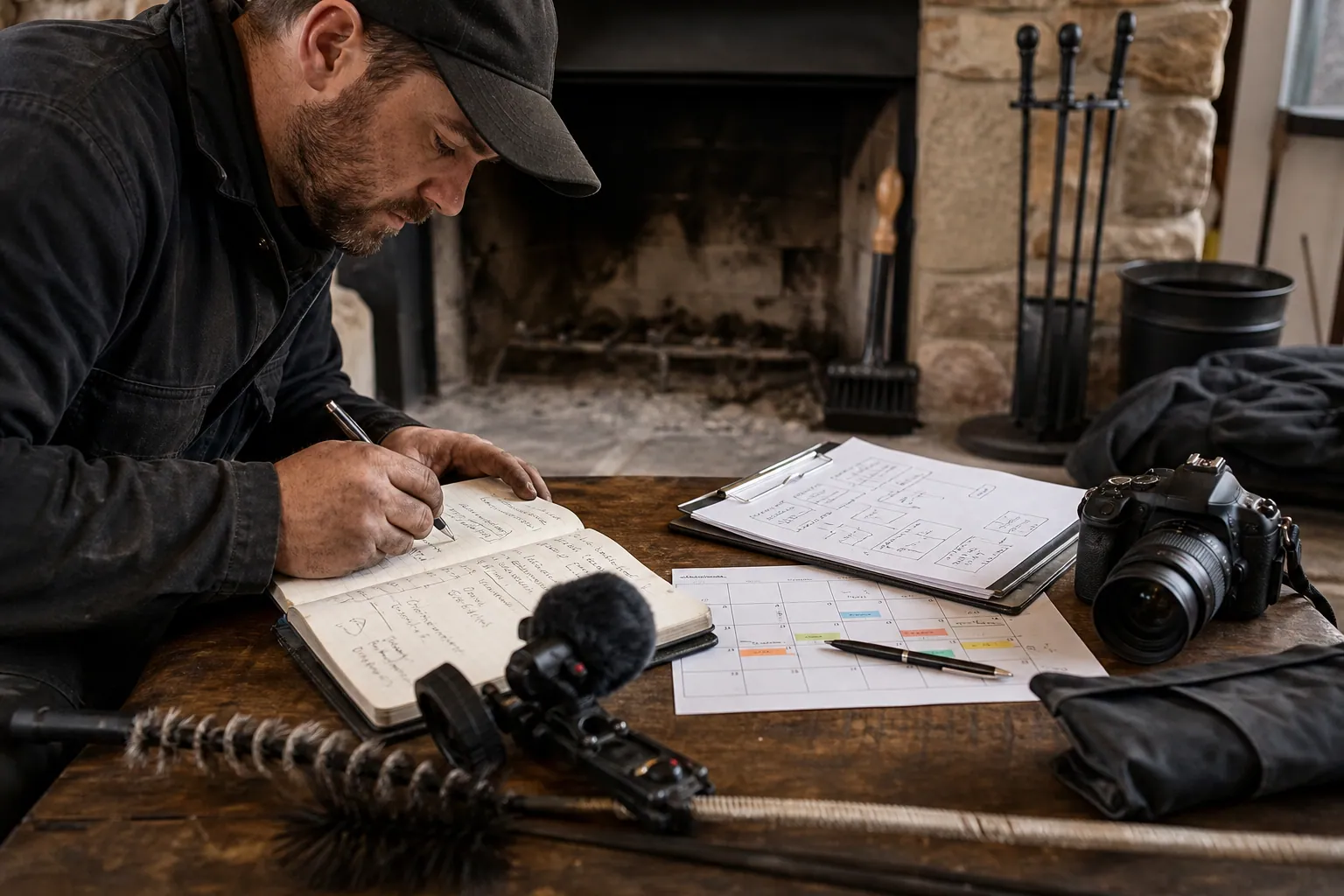
A fireplace photo can make a Pinterest account look busy while the dispatch calendar stays empty.
That was the central problem for this composite case study: a two-truck chimney sweep serving suburban homeowners within 25 miles of its shop. In late summer, the company’s Pinterest profile had plenty of seasonal appeal—mantels, cozy hearths, and before-and-after cleanings—but almost no reliable way to tell whether Pinterest produced inspection work.
The team did not need more visibility. It needed booked inspections that were in its service area, matched its offered services, and could be scheduled before the winter rush.
The baseline: impressive saves, weak commercial evidence
Over eight weeks, the account produced the following top-line figures:
| Signal | Baseline result | Why it was misleading or incomplete |
|---|---|---|
| Impressions | 226,000 | Most came from fireplace styling and holiday-decor audiences. |
| Saves | 4,800 | A save indicated future inspiration, not a local service need. |
| Outbound clicks | 338 | The click rate was low, and every Pin used a different destination. |
| Pinterest-attributed form starts | 9 | The general contact form did not capture service area or job type. |
| Confirmed, serviceable inspection bookings | 1 | This was the metric that actually mattered. |
The business had been treating Pinterest saves as its leading KPI. But the dispatcher’s notes told a different story: many inquiries came from outside the service radius, wanted a repair the company did not provide, or did not respond after the initial request.
The owner made one useful rule change:
A Pinterest conversion would count only after the dispatcher confirmed the ZIP code, requested service, and appointment slot.
That definition shifted the project from generic local Pinterest marketing to a measurable demand-generation effort.
First, the team built a booking trail—not a prettier report
Pinterest native analytics was still useful for spotting distribution and outbound clicks. It could not, on its own, answer whether a click became an inspection on the calendar.
The team added four connected tracking points:
- A distinct UTM structure for every Pin family
- A service-area view event on every Pinterest landing page
- A request form with hidden UTM fields plus visible ZIP and appliance-type fields
- A dispatcher outcome field in the CRM: booked, out of area, unsupported request, duplicate, or no response
Their naming convention stayed plain enough for an owner to audit:
utm_source=pinterest
utm_medium=organic
utm_campaign=fall_inspections
utm_content=first-fire_checklist_v2
The utm_content value identified the exact Pin angle and creative version. The campaign named the business moment, not the calendar month.
For calls, the site recorded a phone-click event with the same UTM values. The dispatcher still asked, “Where did you find us?” on every call. This was not perfect attribution; it was a practical way to catch cases where a homeowner clicked, left, and called later from a different device.
The key diagnosis: the Pins answered the wrong question
The original account centered on questions such as:
- “How can I decorate my fireplace for fall?”
- “What does a clean fireplace look like?”
- “Cozy living room fireplace ideas”
Those topics could earn reach, but they did not reveal whether someone needed a local professional.
The revised content focused on a narrower Pinterest search intent: a homeowner preparing to use a fireplace and trying to decide what to do before the first cold week.
The team retired only the lowest-intent decor Pins. It did not delete the entire archive. Older room imagery still had a role as supporting visual proof on service pages and boards. It simply stopped being the primary acquisition route.
The four routes the team tested
Instead of publishing dozens of loosely related Pins, the operator ran four small content groups. Each group had three creative variations: a checklist layout, a photo-plus-overlay design, and a short question-led graphic.
The important constraint: each group used one matching Pinterest landing page and one clear next step.
| Route | Pin promise | Destination | Primary success signal |
|---|---|---|---|
| First-fire planning | “Before your first fire: 6 questions to settle first” | First-fire preparation page | Service-area checks |
| Visit expectations | “Chimney inspection vs. cleaning: what homeowners should ask” | Service explainer page | Form-start rate |
| Cost readiness | “What affects the cost of a chimney appointment?” | Local cost-factors page | Qualified booking rate |
| Problem awareness | “Smoke, odor, or draft concerns? When to call a local professional” | Concern-and-next-steps page | Phone clicks and qualified bookings |
The goal was not to make every Pin a direct booking ad. A homeowner with a basic “what happens at an inspection?” question may not be ready to fill out a form. But that page should still help them understand the visit, verify the service area, and request a slot when ready.
A small but consequential landing-page change
The original Pins all landed on the home page. The rebuilt pages used the same practical elements:
- Cities and ZIP areas served near the top of the page
- A clear statement of the services the company did and did not offer
- A short explanation of what happens after a request
- Recent project imagery only where permission and relevance were clear
- A request form asking for ZIP, fireplace or stove type, preferred timing, and contact method
- A visible phone option for urgent scheduling questions
This made the Pinterest landing pages do some qualification before the dispatcher picked up the lead.
What changed after the 14-day cohort review
Pinterest content often has a slower discovery curve than paid search. Rather than declaring a winner after 48 hours, the team evaluated every Pin group 14 days after publication and compared equal cohorts.
The figures below are illustrative composite results from the eight-week rebuild.
| Metric | Old mixed-content cohort | Rebuilt planning cohort | Operational meaning |
|---|---|---|---|
| Outbound click rate | 0.15% | 0.42% | More people understood why they should leave Pinterest. |
| Service-area page views per 100 clicks | 26 | 44 | Pins brought more locally relevant visitors. |
| Form starts per 100 clicks | 2.7 | 5.9 | Pages set better expectations before the form. |
| Confirmed bookings per 100 clicks | 0.30 | 1.53 | The traffic was substantially more bookable. |
| Save rate | 2.12% | 0.83% | Saves fell—and the team accepted that tradeoff. |
The cost-readiness Pins received the fewest saves. They also produced the highest proportion of qualified requests.
The first-fire planning Pins generated the most service-area checks and became the best top-of-funnel asset. The team kept them in rotation, but did not mistake their traffic role for the cost page’s conversion role.
Meanwhile, the problem-awareness Pins produced a meaningful number of phone clicks but also the highest share of unsupported repair requests. The business kept these Pins, added a clearer service-scope notice, and trained the dispatcher to tag those calls consistently.
That is what a useful test looks like: not “this Pin won,” but “this route earns a specific next action, with a known operational cost.”
The weekly report that changed decisions
The owner stopped reviewing a long dashboard once a month. Every Friday, the marketing coordinator and dispatcher spent 20 minutes on one shared sheet.
The scorecard
| Metric | Question it answers | Decision it supports |
|---|---|---|
| Outbound clicks by Pin family | Which promise makes people leave Pinterest? | Refresh titles, visuals, and descriptions. |
| Service-area check rate | Are visitors plausibly local? | Improve local qualifiers or pause broad topics. |
| Form-start rate | Does the page make a request feel reasonable? | Fix page clarity, timing, or form length. |
| Qualified booking rate | Does traffic turn into work the team can deliver? | Scale, hold, or retire the route. |
| Out-of-area share | Is distribution broader than the service footprint? | Add city names, ZIP language, and local pages. |
| No-response share | Are inquiries merely curious? | Improve appointment expectations and follow-up. |
They reviewed absolute counts alongside rates. A Pin that sends four clicks and one booking is promising, but it is not proof that the company should rebuild its account around it. The team waited for enough volume to spot a pattern, then refreshed the creative without changing the landing page.
A lightweight publishing calendar helped maintain the test queue. The team used PinPinMe to keep approved creative, destinations, UTM labels, and publish dates visible in one place, which reduced the common mistake of sending a new Pin to an old seasonal page.
Decisions the operator made—and did not make
The data led to several unglamorous but profitable choices.
They scaled cost-factor content carefully
The cost page had the best qualified booking rate, so the team made three more Pins around preparation, access, and questions to ask before requesting service.
They did not publish fixed-price claims. Pricing depends on location, appliance, access, condition, and local business policies. The page explained those factors and invited a specific request instead.
They kept decor content as supporting material
The team did not conclude that fireplace imagery was worthless. A well-composed hearth image still made the planning Pins more visually compelling.
What changed was the overlay text and destination. “Cozy fireplace ideas” became “Before the first fire: local appointment planning.” The photo supported the decision; it no longer was the entire message.
They stopped calling saves a failure or a win
A save can be an early signal for evergreen planning content. It is not an inspection booking.
The team retained saves as a diagnostic metric, especially for the first-fire checklist. But it judged commercial success through qualified requests, confirmed slots, and eventual completed jobs.
They did not over-credit Pinterest
Some homeowners saw a Pin, later searched the company name, and booked through another channel. The business recorded self-reported source, UTM data, and CRM outcomes side by side rather than forcing every booking into a single-source report.
This is particularly important for local service businesses, where a household decision may involve two people and several devices.
Transferable lessons for seasonal local services
A chimney sweep is a specific business, but the measurement approach applies to many appointment-based operators—roof inspectors, chimney repair specialists, fireplace installers, home organizers, and renovation consultants.
Choose an operational conversion, not a vanity metric. For this company, that was a serviceable, confirmed inspection—not a save, impression, or generic form fill.
Test the decision moment. Pinterest searchers often plan ahead. Build content around the moment a customer needs to understand timing, scope, cost factors, or readiness.
Connect Pin, page, and dispatcher record. Pinterest UTM tracking is only the first layer. Without form fields and outcome tags, you cannot distinguish valuable inquiries from noise.
Use cohort windows that fit Pinterest behavior. Review a defined period after publication, then compare like with like. Weekly totals alone blur together old Pins, new Pins, and seasonal demand.
Let low-save content earn its place. A practical cost or scheduling Pin may be less shareable than decor content and far more useful to the business.
Put service-area qualification on the page early. This protects staff time and improves Pinterest qualified inquiries without needing a hard-sell Pin.
The final operating principle is simple: a Pinterest account should not be judged by how much it inspires people in general. It should be judged by whether it helps the right people take the next useful step with your business.

Case Study: How a Merino Sock Shop Found Its Best Pinterest Pins by Tracking Net Revenue
A composite teardown of a merino sock shop that stopped treating saves as success and used UTMs, return reasons, and 21-day cohorts to identify Pinterest Pins that sold.

The Pinterest Test Ledger for Specialty Hot Sauce Gift Boxes Before Q4
Build a Pinterest testing operation for hot sauce gift boxes that measures recipient intent, margin, inventory, and delayed orders—not just holiday saves.

Strategy Memo: Test Pinterest Demand for Custom Recipe Books Before Holiday Cutoffs
A 30-day Pinterest testing plan for custom recipe book shops that measures completed, production-safe holiday orders—not sentimental saves alone.

The Pinterest Ticket Test for Pumpkin Patches: Measure Weekday Visits, Not Fall Saves
A practical Pinterest testing routine for pumpkin patch operators who need October Pins to fill lower-demand ticket windows—not simply collect autumn saves.
Case Study: How a Garage Floor Coating Contractor Turned Pinterest Saves Into Site Visits
A composite teardown of a garage floor coating company that traded broad inspiration Pins for planning content, local pages, and more estimate-ready Pinterest traffic.
Case Study: How a Pond Kit Shop Turned Waterfall Saves Into Kit Orders
A composite Pinterest teardown of a backyard pond retailer that replaced pretty-waterfall traffic with sizing, planning, and kit-selection content that produced stronger carts.