Case Study Teardown: A Spanish Pronunciation Coach’s Pinterest Rebuild
How a Spanish pronunciation coach moved from launch-only course sales to evergreen discovery using search-led lesson pages, pins, UTMs, and email follow-up.
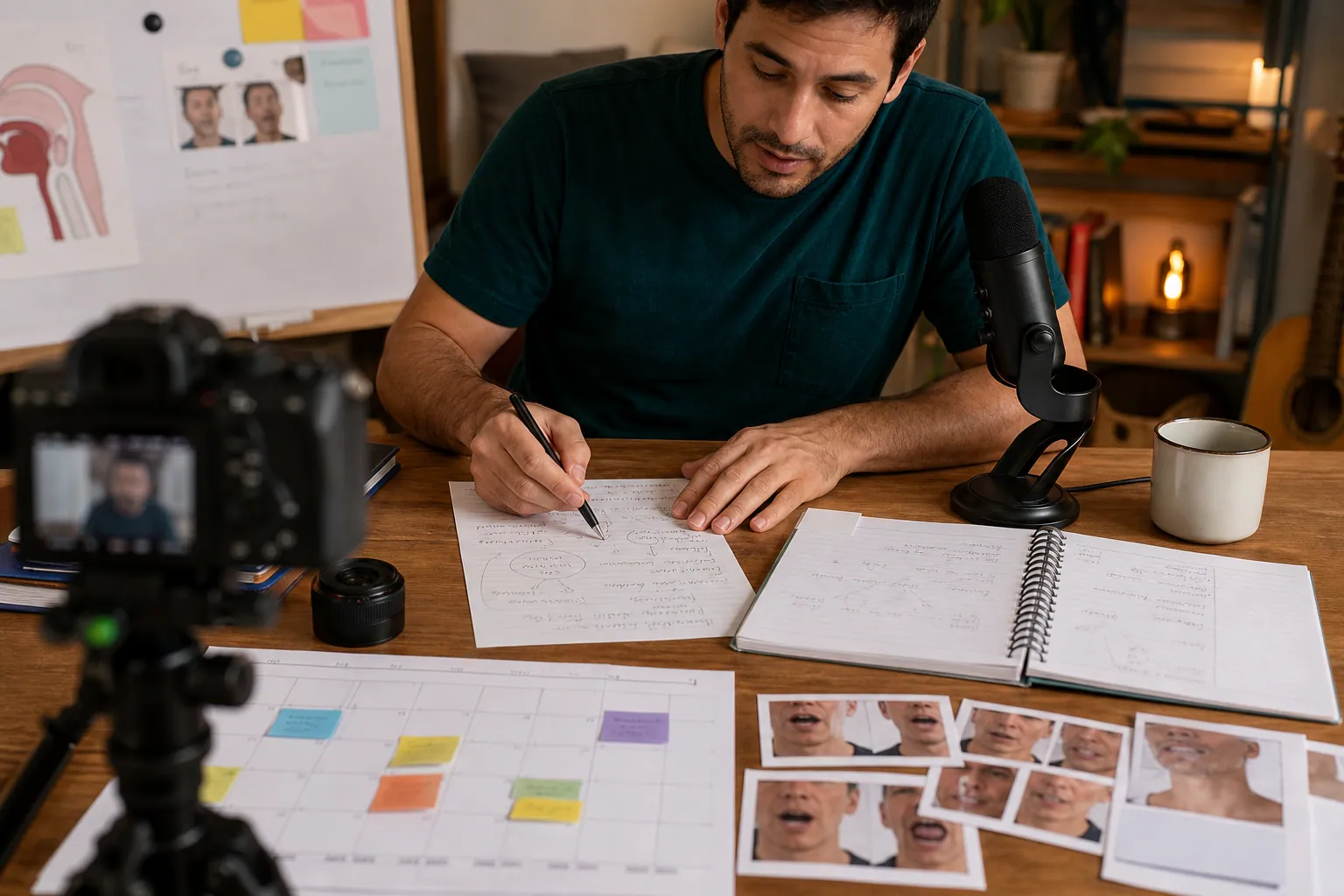
In week two of the rebuild, the coach was not asking for more content ideas.
She already had plenty: 200 short videos, a self-paced course, a small audience on Instagram, and years of student questions about rolling Rs, vowel sounds, and speaking confidence.
Her problem was quieter and more common: sales only happened when she was launching.
This teardown follows an anonymized Spanish pronunciation coach I will call Lena. The product names and numbers are rounded, but the operating decisions are the useful part. Her offer was simple:
- A free 5-minute Spanish pronunciation routine
- A $29 rolling-R workshop
- A $197 self-paced pronunciation course for adult beginners
Pinterest became useful only after she stopped treating it like a place to promote the course and started using it as a search path into one specific learner problem.
The baseline: good teaching, weak discovery
Lena’s course helped adults who could read basic Spanish but froze when speaking out loud. Her best students were not total beginners. They had used apps, watched YouTube lessons, and maybe taken a few classes.
They were embarrassed by pronunciation and wanted private practice before speaking with a tutor or native speaker.
That was a strong offer. Her Pinterest account, however, did not make that clear.
| Area | Before the rebuild |
|---|---|
| Pinterest content | Sporadic pins made from course graphics and Instagram quotes |
| Main destination | Homepage, sales page, and a few old blog posts |
| Boards | Broad boards like Spanish Tips, Language Learning, Study Motivation |
| Pin titles | Mostly branded or generic, such as Learn Spanish With Confidence |
| Tracking | No Pinterest UTMs, no separation between pin types |
| Funnel | Directly from pin to course page, with little warm-up |
| Sales pattern | 1 to 2 course sales per month between launches |
The issue was not that Pinterest was wrong for the business. It was that the account skipped the learner’s immediate question.
Someone on Pinterest usually does not search for a $197 pronunciation course first. They search for things like:
- how to roll your r in Spanish
- Spanish vowel sounds chart
- Spanish pronunciation practice for beginners
- why do I sound bad speaking Spanish
- Spanish speaking practice plan
Those are not just keywords. They are moments of frustration.
The first decision: narrow the promise to one stuck moment
The tempting move would have been to build around the broad topic of learning Spanish. That would have put Lena against every language app, teacher, worksheet seller, and travel phrase account.
Instead, she chose a smaller beachhead: adult beginners who understand more than they can say.
That narrowed her Pinterest SEO work immediately. Pinterest keyword research focused on pronunciation, mouth placement, speaking practice, and confidence rather than every grammar topic.
A useful filter emerged:
- Is the searcher trying to fix a speaking problem?
- Can the pin lead to a short practice session?
- Does the page naturally connect to the paid course?
- Would a beginner feel helped before being sold?
If the answer was no, the idea went into a later bucket.
That meant skipping attractive but diluted topics like Spanish travel phrases, cute study notes, general grammar tips, and language-learning aesthetics. They might earn saves, but they were unlikely to produce qualified course interest.
The second decision: build lesson pages before making more pins
Lena’s old pins had nowhere specific to send people. A pin about pronunciation led to a homepage with multiple offers. A pin about rolling Rs led to the course sales page. A pin about Spanish vowels led to a blog archive.
The rebuild started with four durable destinations.
| Destination page | Search intent | Primary action | Why it worked |
|---|---|---|---|
| Spanish Pronunciation Practice for Adult Beginners | Broad beginner pronunciation help | Download the 5-minute routine | Matched the main free offer |
| How to Roll Your R in Spanish | Specific frustration | Watch a drill, then see the $29 workshop | Strong problem-to-offer fit |
| Spanish Vowel Sounds Chart | Visual reference search | Join email list for audio examples | Good for saves and repeat visits |
| 14-Day Spanish Speaking Practice Plan | Practice planning | Start free routine, then course sequence | Best bridge to the $197 course |
Each page taught one thing clearly before mentioning the offer.
The rolling-R page, for example, did not open with a pitch. It included:
- A short explanation of why the sound feels difficult
- Three beginner drills
- A simple practice schedule
- Common mistakes
- An audio example
- A next step for people who wanted more help
That structure mattered. Pinterest can send early-stage visitors, but early-stage does not mean low-value. It means the page needs to earn the next click.
The third decision: create pin families, not random designs
Once the pages existed, Lena did not create one pin per page and hope. She made small pin families around each learner problem.
This gave her variety without drifting into unrelated content.
Pin family 1: symptom pins
These named the feeling the learner already had.
Example pin title:
You Can Read Spanish but Freeze When Speaking: Try This 5-Minute Routine
Example Pinterest description:
Build beginner Spanish speaking confidence with a short pronunciation routine for adults who understand more Spanish than they can say out loud.
These pins worked well for the 14-day speaking plan and the main pronunciation practice page.
Pin family 2: drill pins
These were more tactical and often led to the rolling-R page or vowel chart.
Example pin title:
How to Roll Your R in Spanish: 3 Starter Drills for Beginners
Example Pinterest description:
Practice the Spanish r sound with three beginner-friendly drills, common mistakes, and a simple daily routine for clearer pronunciation.
Drill pins drove stronger outbound clicks because they promised a concrete fix.
Pin family 3: reference pins
These looked like charts, mini checklists, or practice cards.
Example pin title:
Spanish Vowel Sounds Chart for Adult Beginners
Reference pins earned saves, especially from learners building study boards. They were not always the fastest converters, but they expanded reach into relevant organic Pinterest traffic.
Pin family 4: myth-busting pins
These challenged a belief that stopped people from practicing.
Example pin title:
Rolling Your R Is Not a Talent: A Beginner Spanish Drill
These were useful when the visual had a strong before-and-after message. They also performed better than generic motivational pins because they still tied back to a search problem.
The fourth decision: rebuild boards around learner jobs
The old board strategy was too broad. Spanish Tips could hold anything, which made it less useful for both the operator and the visitor.
Lena rebuilt her Pinterest board strategy around what the learner was trying to do:
- Spanish Pronunciation Practice
- Spanish Speaking Practice for Adults
- Beginner Spanish Study Plan
- Spanish Vowel Sounds and Accent Marks
- Rolling R Practice in Spanish
- Spanish Listening and Speaking Confidence
The board names were plain on purpose. Clever names can be fun for an audience you already have. Search-led boards need to be understandable.
Board descriptions also became more specific. Instead of saying that a board had Spanish learning inspiration, the descriptions mentioned pronunciation drills, beginner speaking practice, adult learners, and simple study plans.
The fifth decision: stop judging pins by saves alone
Before the rebuild, Lena looked at impressions and saves because those were easy to see. But saves did not tell her whether the traffic was moving toward a course sale.
The new review used Pinterest analytics plus UTMs.
A typical URL looked like this:
/roll-r-in-spanish?utm_source=pinterest&utm_medium=organic&utm_campaign=spanish_pronunciation&utm_content=r_drill_static_01
The important part was not the exact naming convention. It was consistency.
She tracked:
- Impressions by keyword theme
- Saves by pin family
- Pinterest outbound clicks by destination page
- Email signup rate by page
- $29 workshop purchases
- Course sales attributed by UTMs and checkout survey
She kept the first version in a spreadsheet. If that starts to become messy, a Pinterest-focused planner such as PinPinMe can help keep destination URLs, pin titles, Pinterest descriptions, boards, and UTMs together before scheduling.
What changed after 90 days
This was not a viral story. The account did not explode overnight, and the first few weeks mostly showed leading indicators.
By the end of the third month, the shape of the business looked different.
| Metric | Before | After 90 days |
|---|---|---|
| Fresh pins published | Irregular | 8 to 12 per week |
| Monthly Pinterest outbound clicks | 58 | 490 |
| Email signups from Pinterest | 6 per month | 71 per month |
| Average opt-in rate on new lesson pages | 4.2% | 11.8% |
| $29 workshop sales from Pinterest traffic | 0 to 2 per month | 19 in month three |
| Course sales between launches | 1 to 2 per month | 6 in month three |
The point is not that every pronunciation coach should expect those numbers. The point is that the traffic started matching the offer.
Three patterns mattered most.
The rolling-R page brought the fastest buyers
The rolling-R content had the clearest pain. People who clicked were actively trying to fix something. That made the $29 workshop feel like a natural continuation, not a surprise pitch.
This page did not produce the most saves. It produced the clearest revenue path.
The 14-day speaking plan produced better course prospects
The speaking plan had fewer clicks than the rolling-R page, but visitors spent more time on the page and were more likely to open the follow-up emails.
That made sense. Someone searching for a practice plan is already thinking about consistency, not just one sound.
The vowel chart earned reach but needed email support
The vowel chart was saved often. It looked useful and visual, which suits Pinterest.
But a chart alone did not sell the course. It worked best when the page invited people to get audio examples by email. That moved the visitor from passive reference collecting into active practice.
What did not work
The failures were just as useful.
Direct-to-checkout pins underperformed
Pins that led straight to the $197 course page had weak conversion. The visitors were not skeptical of Lena. They were simply too early.
They needed a small win first.
Study-aesthetic pins attracted the wrong attention
Pretty desk photos, notebook layouts, and general language-learning motivation earned saves from broad study audiences. They did not bring many email subscribers or buyers.
This is a common trap for creator businesses on Pinterest: visually popular does not always mean commercially relevant.
Generic promise pins blended in
Pins with titles like Learn Spanish Fast or Speak Spanish With Confidence were too vague. They could describe an app, a tutor, a book, or a course.
The stronger pins named a specific learner obstacle.
Too much text lowered clicks
Some early designs tried to fit an entire mini lesson onto the image. They were useful but crowded.
The better version gave one clear promise on the pin and let the landing page do the teaching.
The operating rhythm that made it sustainable
Lena could not spend full days on Pinterest. The final routine was intentionally small.
Every week, she did five things:
- Choose two destination pages to support.
- Create 8 to 12 fresh pins across the four pin families.
- Write search-led pin titles and descriptions before designing final graphics.
- Assign each pin to the most specific relevant board.
- Review the previous month’s pins, not just the previous week’s pins.
That last point is important. Pinterest often needs time. A pin that looks quiet in week one can become useful later if the keyword, board, and destination page are aligned.
She also refreshed winners instead of constantly inventing new topics. The rolling-R page eventually had multiple angles:
- beginner drill
- common mistake
- mouth placement cue
- daily practice schedule
- adult learner reassurance
- workshop bridge
Same destination, different search angles.
Transferable lessons for course creators
You do not need to teach Spanish for this to apply. The same logic works for many educational offers.
1. Find the search before the sale
Most course buyers do not begin with the course name. They begin with a problem they can describe.
For a pronunciation coach, that problem is rolling Rs or freezing while speaking. For a writing teacher, it might be memoir prompts. For a running coach, it might be a beginner half marathon training plan. For a spreadsheet instructor, it might be a budget template or pivot table mistake.
Your Pinterest content planning should start with that moment.
2. Make the landing page teach one useful thing
A Pinterest visitor should not have to understand your full offer immediately.
Give them a drill, checklist, plan, chart, script, calculator, or lesson. Then show the next step.
The bridge matters more than the pitch.
3. Separate saves from buying intent
Saves are useful, especially for visual references and planning content. But saves are not the same as revenue.
Track Pinterest outbound clicks, email signups, low-priced purchases, course sales, and assisted conversions. If you only watch impressions, you may keep making pins that look successful while the business stays flat.
4. Use boards as shelves, not buckets
A board called Tips is a bucket. A board called Spanish Pronunciation Practice is a shelf.
Shelves help you decide what belongs, help Pinterest understand the context, and help visitors find related content.
5. Refresh the winner before chasing a new topic
If one page converts, build more pin angles for it. Change the hook, visual format, and keyword variation. Do not abandon a proven destination just because you already pinned it once.
A practical exercise for today
If you sell a course or digital product, do this before making your next batch of pins:
- Write down one sentence your buyer says when they are stuck.
- Search that phrase, or a shorter version of it, on Pinterest.
- List 10 autocomplete suggestions or related searches.
- Choose one search that can become a helpful lesson page.
- Create five pin titles that promise a specific outcome, not a broad transformation.
- Add UTMs before you publish.
- Review clicks and signups after 30 days, then again after 60.
The best Pinterest strategy for a course creator is rarely more promotion. It is making the learner’s first small problem easier to find, easier to solve, and easier to continue from.

Strategy Memo: Pinterest for Beginner Cake Decorating Courses
A 30-day Pinterest strategy for cake educators who want holiday-baking discovery to become qualified email subscribers and evergreen course enrollments.

The Fit-Diagnosis Content Blueprint for Pants-Fitting Courses
Turn pants-fitting questions into an evergreen Pinterest content operation that sends serious sewists to free fit tools, lessons, and your paid course.

The Pre-Season Pinterest Operator Playbook for Cut-Flower Garden Courses
Help aspiring cut-flower growers plan now, learn all winter, and enroll before spring with Pinterest content tied to real garden decisions.

Pinterest Funnel Comparison for Beekeeping Course Creators
Compare five Pinterest paths for beekeeping educators, from winter-readiness worksheets to direct course enrollment, then choose a September funnel that fits learner intent.

Case Study Memo: How a Murphy Bed Studio Replaced Room-Photo Pins With Fit-Plan Traffic
A composite case study for Murphy bed studios: compare room photos, sizing guides, catalog Pins, and local pages, then run a 30-day test for better design consultations.

Strategy Memo: AI Pinterest Triage for Vintage Furniture Sellers
A 30-day plan for vintage furniture sellers using AI to turn fast-moving, one-of-a-kind inventory into accurate Pinterest discovery without leaving shoppers on sold-out listings.