The Holiday-Bake Pinterest Content Line for Silicone Bakeware Shops
A copyable Pinterest operating rhythm for silicone bakeware brands turning product facts, recipes, and holiday baking questions into durable catalog traffic.

A silicone bakeware shop can have dozens of useful products and still look interchangeable on Pinterest: another red muffin cup, another gray baking mat, another generic cookie photo.
The fix is not posting more isolated product images. It is treating every item as evidence in a baking decision: Will this pan fit my recipe? Will the cake release cleanly? Do I need liners? Can I make this ahead for a cookie exchange?
This blueprint is for a small ecommerce team entering the September-to-December baking season with a finite catalog, limited photography time, and a real need to keep Pins pointed at in-stock products.
The output is a small, repeatable Pinterest content line: one that turns verified product information, recipe testing, and customer questions into useful Pin families and catalog traffic.
Start with one merchandising promise
Choose one seasonal promise your store can actually fulfill. For this example, use:
Help home bakers make, transport, and gift holiday treats with less sticking, waste, and last-minute scrambling.
That promise creates several durable Pinterest search pockets:
- cookie exchange baking ideas
- mini loaf cakes for gifts
- how to keep cookies from sticking
- make-ahead holiday desserts
- silicone baking mat vs parchment paper
- cupcake liners for holiday baking
- mini muffin pan recipes
Notice the difference between these phrases and “silicone bakeware.” The first set describes a job a shopper is trying to complete. Your products are part of the answer, not the whole answer.
A good operating rule: one Pin should resolve one baking decision and lead to the page that continues that decision.
For example:
| Shopper question | Pin angle | Best destination |
|---|---|---|
| “What can I bake for neighbor gifts?” | 3 mini loaf formats for gifting | Mini loaf pan collection with capacity and care details |
| “Why are my cookies spreading?” | Baking-mat setup checks before blaming the recipe | Educational article with relevant mat collection module |
| “Do I need paper liners?” | When silicone muffin cups work—and when liners still help | Comparison guide and muffin-cup product page |
| “What should I bring to a cookie swap?” | A pack-and-carry checklist for 24 cookies | Giftable baking bundle page |
This is Pinterest search intent applied to merchandising. It keeps the account from becoming either a disconnected recipe feed or a wall of catalog images.
Build a source tray before anyone opens Canva
Most content delays happen because the marketer has to chase facts from product, operations, and customer support after a Pin has already been designed. Avoid that by building a weekly source tray.
Every Tuesday, collect five inputs in one shared sheet or project board.
1. Inventory and availability
Your operations lead should flag:
- items with enough stock to support seasonal promotion
- colors or sets that are discontinued or nearly gone
- bundles that can ship on time
- replenishment dates that affect where Pins should link
- products with high return rates or recurring confusion
A Pin can circulate for weeks or months. Do not build a holiday campaign around a pan that has 11 units left unless its destination is an in-stock alternatives page.
2. The product fact card
Make a short fact card for each promoted product. It should contain only details your team can verify:
- internal and usable dimensions
- cavity count or capacity
- compatible recipe formats
- manufacturer-approved temperature range
- care instructions
- what is included in the box
- material and certification language approved by the business
- the product page URL and collection URL
This card is the source of truth for designers, writers, and anyone using AI for drafting. It prevents the common mistake of inventing a capacity, claiming universal nonstick performance, or showing a recipe that the pan cannot hold.
3. Customer-question exports
Pull the recurring questions from support tickets, reviews, chat logs, and post-purchase email replies. Tag each one as:
- before purchase: “Will this fit my toaster oven?”
- during use: “Do I grease silicone molds?”
- after use: “How do I remove a butter smell?”
- seasonal: “Can I bake mini loaves ahead for teachers?”
The first and fourth groups usually make the strongest commercial Pins. The second and third groups earn trust and reduce support friction, but may need a care-guide destination rather than a product page.
4. Recipe-test assets
Ask the recipe tester or content creator for a compact asset package, not a pile of unlabelled images:
- one overhead finished-treat photo
- one in-use photo showing scale
- one result detail, such as a cleanly released brownie edge
- recipe name, yield, pan used, and bake conditions
- a note on whether the result is repeatable
The phrase “tested in a 12-cavity mini muffin pan” is materially more useful than “perfect for holiday baking.”
5. Search and on-site language
Once each month, review Pinterest keyword research alongside site search terms and Google Search Console queries. Save the exact nouns shoppers use: mini loaf, candy mold, cookie tray, baking mat, cupcake cups.
Use that vocabulary in Pinterest pin titles and descriptions, but do not force every term onto every Pin. A mini-loaf gift Pin does not need to rank for cookie sheet ideas.
Turn one product decision into a three-Pin family
A small team does not need 40 unrelated concepts every week. It needs a reliable way to extract multiple honest angles from one destination.
Take a six-cavity mini loaf pan collection. Create three Pins that each serve a different decision.
The occasion Pin
On-image message: “Mini loaf cakes for holiday host gifts”
Destination: mini loaf collection or a gift bundle page.
Visual: three wrapped loaves, with the pan visible in a secondary image or carousel frame.
This is the discovery asset. It earns attention from planners who are gathering gift ideas.
The fit Pin
On-image message: “Choose a mini loaf pan by batter capacity”
Destination: a practical size guide featuring the actual pan dimensions and a route to the collection.
Visual: measured pan cavities beside a filled, baked loaf.
This asset meets a buyer closer to purchase. It makes comparison easier and gives your product page a reason to exist beyond a product grid.
The process Pin
On-image message: “Make-ahead mini loaves: cool, wrap, freeze”
Destination: a recipe or preparation guide with a relevant product module.
Visual: a three-step preparation sequence.
This Pin may create fewer immediate orders, but it creates a useful return path for people planning ahead. Tag it separately so you can see whether it assists later purchases.
Each Pin uses the same product and a single recipe shoot. Yet the pins do not compete for exactly the same click because each makes a different promise.
Use a four-week production rhythm that a lean team can sustain
The calendar below assumes a shop has one marketer, one designer or contractor, and light access to product and recipe expertise. Adjust volume before you reduce quality.
| Week | Primary task | Deliverable |
|---|---|---|
| Week 1 | Select the next four buyer decisions | Four destination briefs and product fact cards |
| Week 2 | Shoot or collect recipe/product assets | One labeled asset package per decision |
| Week 3 | Write and design Pin families | 12 to 16 Pins, grouped by destination |
| Week 4 | Publish, inspect, and review | Scheduled queue, issue log, next-month decisions |
Monday: choose destinations, not just topics
At a 25-minute planning meeting, choose four destinations for the following month. Give every destination an owner and one measurable purpose.
For example:
- Holiday mini loaf collection: outbound clicks and add-to-carts
- Silicone mat comparison guide: qualified clicks to a high-margin category
- Cookie exchange bundle: bundle conversion rate
- Care guide: reduction in pre-purchase support questions and assisted revenue
If the destination is slow, broken, out of stock, or not mobile-friendly, it does not enter the batch. Pinterest landing pages deserve review before design begins.
Tuesday: write the brief in a decision-first format
A usable Pin brief fits on one screen:
- audience moment
- exact query or phrase cluster
- one claim the Pin can support
- destination URL
- product facts required on the visual or page
- asset needed
- CTA expectation
- UTM label
For a cookie-exchange bundle, the brief might be:
Moment: Host is planning 3–4 dozen cookies for a December exchange.
Question: What baking supplies make bulk cookies easier?
Promise: A reusable mat, cooling setup, and storage-friendly tools reduce repeat prep.
Destination: Cookie exchange bundle, with individual components and availability.
UTM:utm_source=pinterest&utm_medium=organic&utm_campaign=holiday_bake&utm_content=cookie_exchange_bundle
The UTM naming convention matters more than the exact words. Keep it stable enough that your ecommerce analytics can compare Pin families later.
Wednesday: design for the saved decision
Design should help a scroller recognize the decision in under a second. For this product category, the strongest image types are usually:
- finished bake plus a visible use moment
- a labeled side-by-side comparison
- a simple three-step process
- a measured product-scale image
- a giftable finished result
Avoid making every creative a product cutout on a colored background. Catalog imagery still has a role—especially for shoppers who know what they need—but it will not carry all discovery work.
Use product pins for feed-connected items where available, then add curated Pins for comparisons, recipes, and planning ideas that a catalog feed cannot explain.
Thursday: run the accuracy and shopper-path review
Give one person authority to stop a Pin. Their review checklist should cover:
- Is the item currently available at the linked destination?
- Does the visual show the actual pan, liner, or mat—not a lookalike?
- Is every capacity, temperature, and material statement verified?
- Does the recipe yield match the product shown?
- Does the Pin title say what the image promises?
- Does the destination load well on a phone?
- Is the tracking label correct?
- Is the board relevant rather than merely broad?
This is where many seasonal batches fail. A lovely Pin that goes to a generic bakeware category makes shoppers work too hard. A precise Pin that leads to an expired holiday bundle quietly wastes months of potential traffic.
Friday: publish in small, balanced batches
Publish at a pace your team can inspect. For most small shops, three to five fresh Pins per week is more useful than a one-day dump of 30 near-duplicates.
A balanced weekly batch could include:
- one occasion-led Pin
- one fit or comparison Pin
- one recipe or process Pin
- one catalog-forward Pin for a proven product or bundle
Schedule content against relevant boards, but do not create boards for every SKU. Boards should reflect browsing decisions such as Holiday Cookie Baking, Homemade Food Gifts, Mini Dessert Recipes, and Baking Tips and Care.
A publishing queue like PinPinMe can help a small team organize approved batches and maintain a consistent cadence, but it cannot replace the availability and claims check before scheduling.
Give each Pin a 21-day review window
Holiday content needs enough time to find planners, but it cannot be left unattended. Review each batch at 7, 21, and 45 days.
At seven days: catch execution issues
Check for:
- broken links or incorrect UTMs
- out-of-stock destinations
- a mismatch between title and landing-page headline
- Pins receiving impressions but almost no outbound clicks
Low clicks this early can indicate an unclear promise, an unhelpful first image, or a query mismatch. Do not call it a failure yet.
At 21 days: compare intent, not vanity metrics
For every Pin family, record:
- impressions
- saves
- outbound clicks
- outbound click rate
- sessions from the UTM
- add-to-cart rate
- revenue or assisted revenue, where your attribution supports it
- support questions or return patterns connected to the product
A recipe Pin with high saves and modest direct revenue may still be worth maintaining if shoppers later buy baking mats through its tagged path. Conversely, a high-save “holiday cookie ideas” Pin that sends visitors to a generic category and produces no product interaction needs a better destination, not another design variation.
At 45 days: decide what gets expanded
Use only three labels:
- Scale: Create two new visual or query angles for the same destination.
- Repair: Keep the underlying topic but change the landing page, Pin promise, or creative.
- Retire: Stop investing because the offer, inventory, or intent fit is wrong.
This prevents endless creative churn. You are not trying to save every idea; you are building a maintained library of useful entry points.
Maintain the library after the holiday rush
Pinterest content can keep driving traffic after a promotion ends, so maintenance needs a calendar slot—not a vague intention.
Weekly, for 15 minutes
- pause Pins leading to sold-out or discontinued products
- check the top 10 Pinterest landing pages for stock and mobile experience
- flag comments or questions that should inform a new guide
- confirm current bundles still match the Pin creative
Monthly, for 60 minutes
- review the top outbound-click Pins by destination
- replace expired holiday creative with evergreen alternatives where possible
- update seasonal collection links
- promote a successful Pin family into a new format or related query
- audit Pinterest UTM tracking for inconsistent names
After the season
Do not delete everything with “holiday” in the title. Sort it into three groups:
- Reusable next year: cookie swaps, edible gifts, and make-ahead baking.
- Evergreen with edits: silicone mat care, muffin cup comparisons, and mini loaf capacity guides.
- Expired: dated promotions, unavailable bundles, and old shipping deadlines.
This is how a small catalog becomes more valuable over time. The next Q4 starts with tested decision pages and proven Pin angles rather than a blank content calendar.
The operating standard to keep
For a silicone bakeware shop, a strong Pinterest presence is not a stream of pretty desserts. It is a maintained connection between what bakers are planning, what your products can genuinely do, and where they can buy the right item while it is available.
Build the source tray. Choose four real baking decisions each month. Produce three useful angles per decision. Review claims and destinations before publishing. Then let the 21-day data tell you whether to scale, repair, or retire.
That discipline turns a seasonal rush of recipe photos into a catalog-growth asset you can reuse long after the last cookie exchange.

The In-Stock Pinterest Playbook for Small-Space Storage Shops
A practical Pinterest routine for storage ecommerce teams that need renter and dorm-room traffic to reach in-stock collections—not discontinued shelf configurations.

Strategy Memo: Pinterest for HVAC Filter Shops Before Winter
A September Pinterest strategy for replacement air-filter stores: use size, MERV, and change-schedule content to turn seasonal research into compatible orders.

Catalog Pins vs Cat Wall Plans: Pinterest Routes for Modular Cat Furniture Shops
Compare four Pinterest routes for modular cat-wall retailers, then choose the mix that turns room ideas and mounting questions into kit and component sales.

The AI Project-Question Pinterest Desk for Mineral Paint Brands
A practical AI-assisted Pinterest routine for mineral paint sellers turning verified product facts, customer questions, and project intent into catalog traffic.
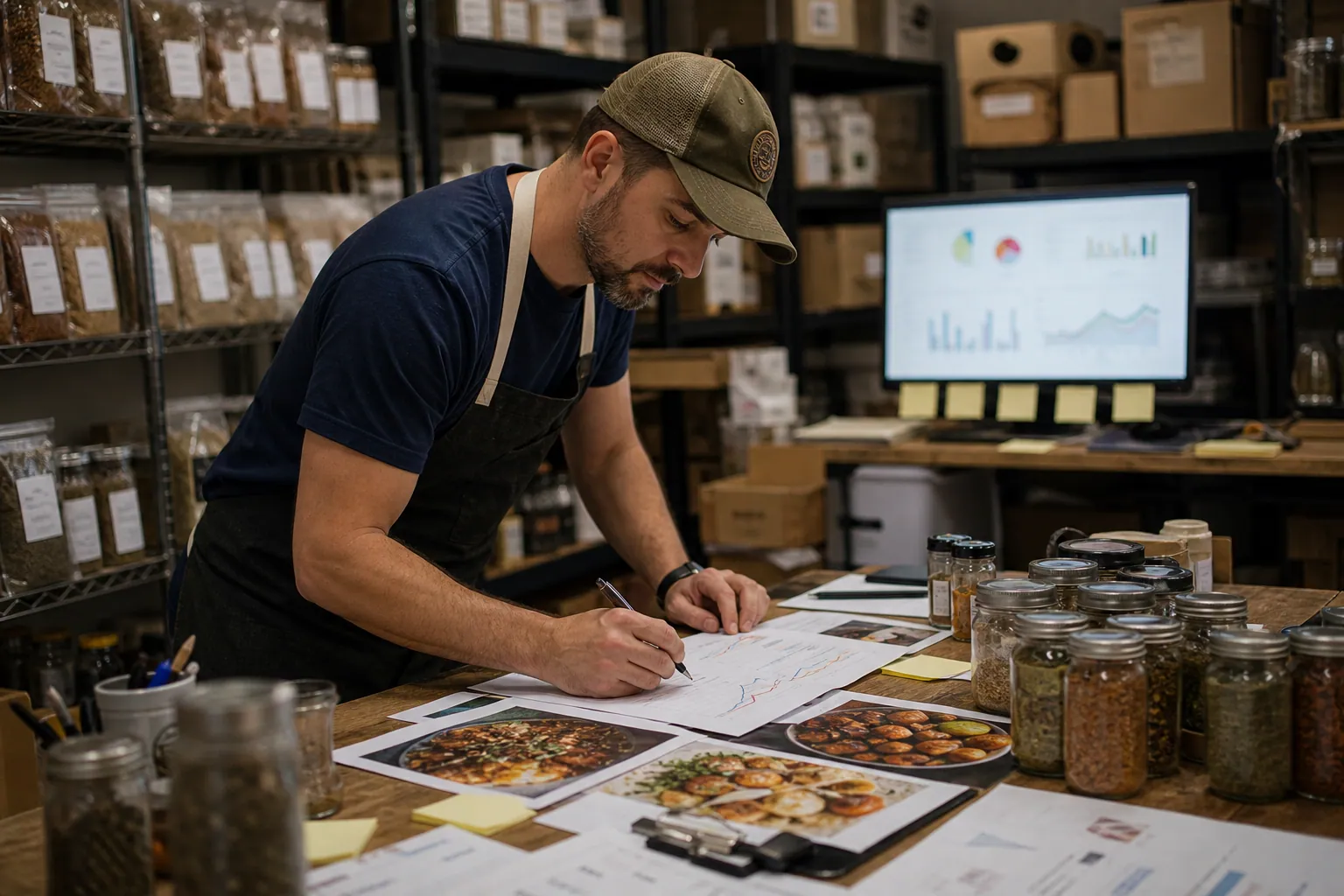
The Weeknight Flavor Planner Funnel for Small-Batch Spice Shops
Turn Pinterest dinner searches into sampler orders and repeat spice buyers with a practical flavor-planner funnel, a weekly pin cadence, and a maintenance routine.

The Pinterest Margin Test Desk for Personalized Ornament Shops Before Q4
A practical Pinterest testing desk for personalized ornament sellers: map catalog inputs, test buyer intent, publish with discipline, and protect holiday profit.