Case Study: How a Cabinet Hardware Shop Turned Kitchen Saves Into Sample Kits and Project Orders
A composite teardown of a cabinet hardware retailer that replaced generic kitchen Pins with sizing, finish, and project-planning routes that produced more sample-led orders.
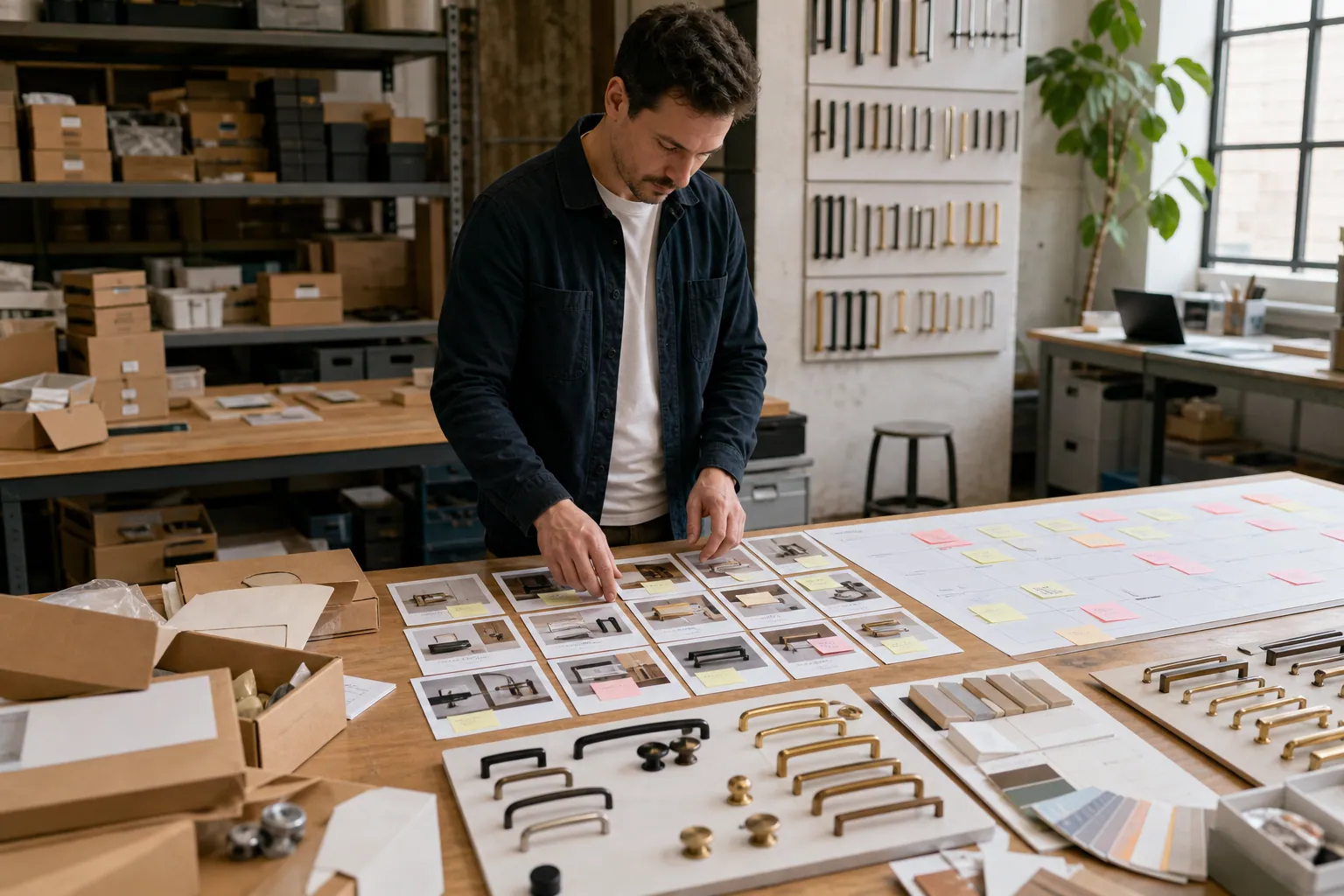
The team did not have a Pinterest reach problem. It had a decision problem.
Its kitchen images were being saved into renovation boards, especially images featuring brass pulls on warm-white cabinets. But the store sold hardware, not mood boards. Shoppers still needed to answer practical questions: Will these pulls cover my existing drill holes? Which finish works with my faucet? How many do I need for a 24-drawer kitchen?
This composite case study follows a direct-to-consumer cabinet hardware shop with roughly 600 sellable style-and-finish combinations. The business and figures are anonymized composites, built from common ecommerce operating patterns rather than presented as a client-performance promise.
The useful lesson is not “make prettier Pins.” It is how the retailer made Pinterest content useful at the point where a renovation shopper needed to make a product decision.
The baseline: plenty of inspiration, too little purchase confidence
Before the rebuild, almost every Pin came from one of two sources:
- A catalog feed creating Product Pins for individual handles and knobs.
- Cropped project photography with broad titles such as “Modern Kitchen Hardware Ideas.”
The catalog did its job for shoppers who already knew the exact SKU. The project images earned saves. Neither path did much for the buyer stuck between a 96 mm and 128 mm pull, or between polished nickel and satin nickel.
Over the six weeks before the change, the shop saw this pattern:
| Signal | What it suggested |
|---|---|
| Kitchen-photo Pins had high saves but modest outbound clicks | The image was useful for visual research, but not enough to prompt a product decision. |
| Product Pins got clicks on a small set of hero finishes | Shoppers wanted specificity, but individual product pages asked them to choose too much too soon. |
| Support emails repeatedly mentioned drill-hole spacing and finish matching | Customer questions were a better content brief than trend predictions. |
| Returns and exchanges included “wrong size” and “not the finish I expected” | Traffic quality mattered after the initial sale, not only at checkout. |
The team had also made a common merchandising mistake: it sent a person searching for “brushed brass cabinet pulls for white kitchen” to a single product detail page. That page contained dimensions, but it did not help the shopper compare lengths, see related knobs, order a finish sample, or calculate a whole-room order.
The clue was hiding in the sample cart
The retailer already sold a small finish sample ring, but it was buried in a footer collection. When the team reviewed 90 days of orders, customers who found samples before ordering had three useful traits:
- They placed larger first orders.
- They made fewer finish-related exchange requests.
- They were more likely to return for matching bathroom or laundry-room hardware.
That did not mean every Pinterest visitor should be forced into a sample purchase. A customer replacing two broken pulls often needs a direct SKU page. A homeowner planning a full kitchen may need a comparison page before choosing a sample.
So the shop split traffic by the decision being made, not by a generic “top of funnel” label.
Four decisions that changed the Pinterest route
1. It built landing pages around renovation questions
The first new destination was a cabinet pull measurement guide. It explained center-to-center hole spacing, showed where to measure existing holes, and linked to filtered collections for the available sizes.
The page did not promise that one pull length was right for every cabinet. Instead, it showed examples and prompted shoppers to confirm their own measurements before ordering.
Next came a finish comparison page with controlled-lighting images, a note that screen and batch variation can occur, and a visible route to the finish sample ring. Finally, the team created project collections such as:
- Black cabinet hardware for a small kitchen refresh
- Brushed brass pulls and matching knobs
- Hardware for Shaker-style cabinets
- Bathroom vanity hardware by hole spacing
These were not blog posts padded with product links. They were Pinterest landing pages that answered one question and made the next action obvious.
2. It created Pin families instead of repeating one kitchen image
A single finished kitchen could now yield several Pins, but each one had a different promise and destination.
| Shopper question | Pin concept | Example Pinterest pin title | Destination |
|---|---|---|---|
| “Will this fit my current holes?” | Close-up image with measurement overlay | How to Measure Cabinet Pull Hole Spacing Before You Order | Measurement guide |
| “Which length looks right?” | Drawer-width comparison graphic | Cabinet Pull Length Ideas for Kitchen Drawers | Size comparison collection |
| “What brass tone should I pick?” | Side-by-side finish photography | Brushed Brass vs Champagne Bronze Cabinet Hardware | Finish comparison and sample ring |
| “How much hardware do I need?” | Simple room checklist | Kitchen Cabinet Hardware Checklist for a Remodel | Project collection with pack options |
| “Can I buy the exact look?” | Finished kitchen with product callouts | Warm White Kitchen With Brushed Brass Cabinet Pulls | In-stock style collection |
The team used direct language in Pinterest pin titles. It avoided titles such as “Kitchen Inspiration You’ll Love,” which say little about what the shopper will learn or buy.
Its Pinterest descriptions added context without trying to rank for every imaginable decor phrase. A sizing Pin mentioned center-to-center measurement, existing drill holes, drawer pulls, and the linked guide. A finish Pin mentioned the actual finishes shown and pointed to samples.
3. It treated the sample kit as product merchandising, not a lead magnet
A sample ring was not framed as a vague “freebie.” It cost enough to cover fulfillment and included a credit toward a qualifying hardware order.
That mattered for two reasons:
- It filtered out low-intent curiosity clicks.
- It gave the store a measurable bridge between Pinterest discovery and a later project order.
The sample page also answered questions that could otherwise become support tickets: sample size, included finishes, dispatch timing, credit terms, and whether the retailer could guarantee an exact match to another brand’s faucet or light fixture. It could not, so it did not imply that it could.
4. It stopped sending Pinterest visitors to fragile SKU URLs
The shop carried seasonal finishes and occasionally retired styles. A Pin linking directly to a discontinued 128 mm pull created a dead end, even if the Pin was still being discovered months later.
For Pinterest, the team reserved direct product links for stable best sellers. Most visual Pins linked to a durable collection or guide that could remain useful even as individual items changed.
When a hero finish went low in stock, the merchandising lead either paused related Pins or updated the collection to show in-stock alternatives. That is a small discipline, but it protects catalog trust.
What changed after the rebuild
The team published the first batch over two weeks, then allowed time for Pins and renovation decisions to mature. It compared the six-week baseline with weeks five through ten after launch, using consistent UTM naming.
The directional change looked like this:
| Metric | Before rebuild | After rebuild | Why it mattered |
|---|---|---|---|
| Pinterest-attributed qualified landing sessions | 410 | 760 | More visitors reached a page built around a real buying decision. |
| Sample-ring orders from Pinterest-tagged visits | 5 | 28 | The sample route became discoverable rather than hidden. |
| Full hardware orders within 45 days of a Pinterest visit | 11 | 24 | The team allowed for a renovation planning lag instead of reading same-day revenue alone. |
| Average first order from sample-credit users | Higher than direct SKU shoppers | Remained higher | Samples supported larger, more considered project carts. |
| Size- and finish-related support contacts per 100 Pinterest orders | Fell | Fell further | Better pre-purchase education reduced avoidable uncertainty. |
The team did not claim every later order was caused by Pinterest. A homeowner may see a Pin, ask a designer, compare sites, and return by branded search two weeks later. Instead, it treated tagged sessions, sample credit redemption, assisted orders, and customer survey responses as a group of signals.
It also resisted a tempting wrong conclusion: its best kitchen-image Pin still produced many saves. That did not make it the strongest sales Pin. The measurement and finish Pins generated fewer saves but produced a higher rate of sample orders and full-project carts.
The operating detail that kept the rebuild alive
A content strategy only survives if someone can maintain it alongside stock updates and customer service.
The retailer added a 75-minute weekly review:
- Check stock and discontinued finishes. Flag Pins and collections that could now create a poor experience.
- Read five recent support conversations. Add repeated questions to the next Pin batch only when the site can answer them accurately.
- Review clicks by Pin family, not only account totals. Measurement, finish, project, and catalog Pins solve different jobs.
- Inspect sample-to-order behavior. Track sample credit redemptions in a 30-, 45-, and 60-day window.
- Refresh one aging winner. Keep the search intent, update the photo, and confirm the landing page remains current.
For the publishing queue, a small team can use PinPinMe to schedule approved Pin variants while keeping the inventory check and destination review with the retailer. Scheduling is useful; it should not be the mechanism that publishes unavailable products.
Their UTM pattern was intentionally simple:
utm_source=pinterest
utm_medium=organic
utm_campaign=kitchen_hardware_q1
utm_content=finish_compare_brass_white_kitchen
The utm_content field identified the Pin family and creative angle. That made it possible to compare a finish guide with a direct catalog Pin in ecommerce analytics without guessing from a thumbnail months later.
The choices that made the biggest difference
This was not a story about publishing more. The shop actually reduced broad decor Pins that had no durable shopping destination.
The changes that mattered most were:
- Teach the measurement before offering the product. Compatibility anxiety often blocks a cart more than price does.
- Give visual shoppers a low-risk next step. A sample helps when finish confidence is the barrier; it is unnecessary when the shopper already knows the exact replacement SKU.
- Use room photos as evidence, not as the whole strategy. A beautiful kitchen earns attention. A labeled, accurate kitchen image can help someone choose.
- Build around stable destinations. Collection and guide pages outlive fast-changing individual inventory.
- Measure net outcomes. Track exchanges, sample credits, and delayed project orders alongside outbound clicks and add-to-carts.
Transferable lessons for product retailers
The same pattern applies to ecommerce products that depend on fit, finish, compatibility, or project planning: lighting, tile, paint, hardware, flooring, storage, garden kits, and many more.
Before publishing the next product Pin, ask four questions:
- What decision must this shopper make before the product becomes useful?
- Can the destination answer that decision without hiding the product?
- Is the product, collection, and price route likely to remain available when the Pin resurfaces?
- Which post-purchase signal would reveal that the Pin brought the wrong customer: a return, support ticket, cancellation, or low repeat rate?
When Pinterest content removes a real buying uncertainty, it can do more than send catalog traffic. It can send shoppers into the store with a clearer idea of what belongs in their project—and why.
The Tree-Ready Pinterest Operator Playbook for Christmas Tree Skirt Shops
A practical October routine for tree-skirt shops that turns Pinterest holiday inspiration into size-confident collection visits, carts, and seasonal orders.

The Fit-First Pinterest Operator Playbook for Sofa Slipcover Shops
A practical Pinterest routine for slipcover retailers that turns room inspiration into fit-confident collection visits, fewer wrong orders, and stronger catalog revenue.

The Gift-Deadline Pinterest Operator Playbook for Loose-Leaf Tea Shops
A practical November Pinterest routine for tea retailers: turn gifting, sampler, and hosting searches into in-stock collection visits without creating fulfillment problems.

Case Study: How a Handmade Tile Shop Found the Pinterest Pins That Led to Sample Kits—and Projects
A composite teardown of a handmade tile retailer that stopped celebrating saves and used sample, quote, and deposit data to find its highest-value Pinterest routes.
Case Study: How a Custom Lampshade Studio Turned Room Saves Into Swatch Kit Orders
A composite Pinterest teardown of a made-to-order lampshade studio that replaced generic room inspiration with sizing and fabric decisions that led to more swatch-kit orders.
Case Study: How a Seed-Starting Light Shop Turned Pinterest Questions Into Kit Sales
A composite teardown of a seed-starting light retailer that replaced catalog-only Pins with setup and troubleshooting content that sold more complete kits.