Strategy Memo: Pinterest SEO for Squirrel-Proof Bird Feeder Shops
A focused Pinterest SEO plan for bird feeder retailers: choose problem-solving content over generic bird inspiration, define useful metrics, and launch in 30 days.
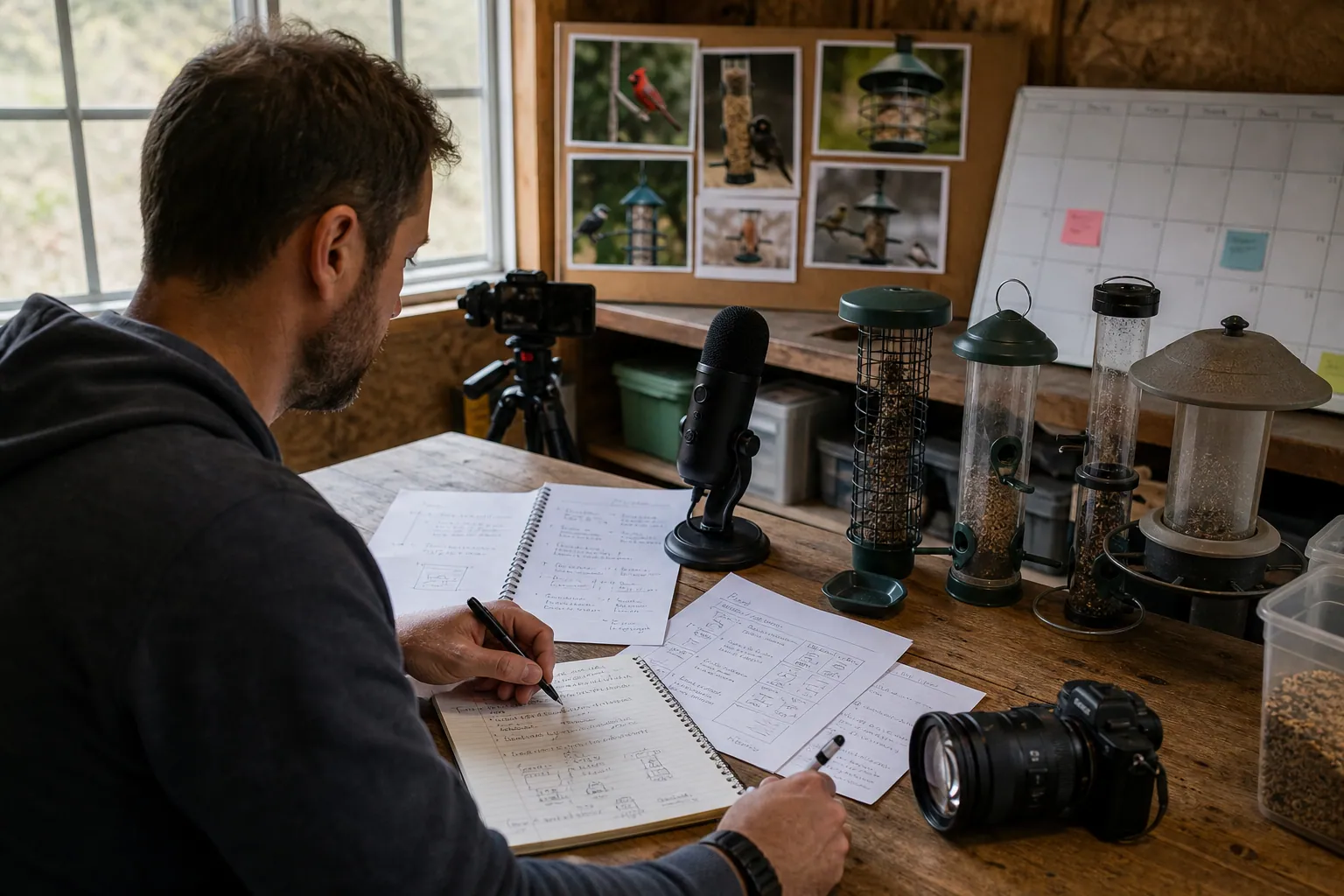
Strategic thesis
For a direct-to-consumer bird feeder shop, the strongest Pinterest SEO opportunity is rarely a beautiful photo of a cardinal at a feeder.
It is the moment a homeowner realizes that squirrels are emptying the feeder, seed is ending up on the patio, or they bought the wrong feeder for their small yard.
Those are solvable shopping problems. They also create durable Pinterest search intent.
The strategic choice is to build a small library of decision content around feeder placement, pest pressure, feeder formats, and cleanup—then connect each page to a relevant collection or product. This is more useful than publishing a wide stream of generic bird images, and more durable than sending every Pin straight to a single SKU.
A practical allocation for a small shop is:
- 60% problem-and-decision Pins linking to useful guides
- 25% collection and comparison Pins linking to stable category pages
- 15% Pinterest product pins for in-stock hero products, bundles, or seasonal offers
That mix gives shoppers a reason to trust the shop before they are ready to buy, while keeping commercial paths visible.
The choice in front of the operator
A bird feeder retailer usually has three plausible Pinterest routes. Each works in a different situation.
| Route | Typical Pin topic | Strength | Tradeoff | Best use |
|---|---|---|---|---|
| SKU-first | “Squirrel-resistant tube feeder with metal ports” | Short path to a product page | Breaks when inventory, price, or variants change | Proven bestsellers and catalog coverage |
| Inspiration-first | “Backyard bird feeding station ideas” | Can earn broad saves | Attracts planners who may never need your product | Brand awareness and visual merchandising |
| Problem-first SEO | “How to keep squirrels out of a bird feeder” | Matches an active frustration and supports multiple products | Requires genuinely useful landing pages | Core acquisition content |
The third route should lead the account.
A shopper looking for backyard bird feeding station ideas may be collecting a future project. A shopper asking how to stop squirrels from stealing birdseed has a current problem, a visible cost, and a reason to compare feeder mechanisms. That does not guarantee an order, but it creates a much better next click.
Do not confuse a broad keyword with a strategic keyword
Broad phrases such as backyard birds or bird watching may produce impressions. They can also create a reporting trap: a growing audience of readers looking for species identification, photography, or decor rather than feeder equipment.
Prioritize a phrase only when you can answer all four questions:
- What is the searcher trying to decide or fix?
- Can the shop publish a credible answer without overstating a product claim?
- Does a stable collection, guide, or product destination exist?
- Can the shopper take a sensible next step from that destination?
For example:
| Search pocket | Searcher need | Suitable destination | Commercial fit |
|---|---|---|---|
| squirrel proof bird feeder | Compare ways to reduce seed loss | Buyer’s guide plus squirrel-resistant collection | High |
| bird feeder placement guide | Avoid mess, predators, or poor visibility | Placement checklist with feeder-type links | Medium to high |
| tube feeder vs hopper feeder | Select a feeder format | Comparison page and two collections | High |
| bird seed mess under feeder | Reduce cleanup | Cleanup guide, trays, and compatible accessories | Medium |
| fall bird feeding | Plan seasonal yard routines | Regionalized seasonal guide, where accurate | Medium |
Use Pinterest search suggestions and the current search results as research inputs, not as a mandate to make a page for every phrase. A phrase belongs in the plan only after the destination and product connection are clear.
The content architecture: one question, one useful destination
The common failure mode is a Pin title that promises help and a product page that forces the visitor to do all the research alone.
Instead, create two or three substantial pages that can support multiple Pin angles. This is more maintainable than building dozens of thin keyword pages.
Page 1: The squirrel-pressure guide
Working title: How to Choose a Bird Feeder When Squirrels Empty It
The page should cover the real decision variables:
- Feeder mechanism and material
- Placement considerations
- Seed spill and cleanup constraints
- Yard layout and mounting options
- What a shopper should verify before buying
- A transparent explanation of what each product can and cannot help with
Do not claim a feeder is completely squirrel-proof unless you can substantiate that claim under normal use. Stronger copy is specific: explain the feature, the setup conditions, and the limitation.
At the end, link to a curated collection such as Feeders for High Squirrel Pressure, not a catch-all catalog page with 80 items.
Page 2: The placement checklist
Working title: Bird Feeder Placement Checklist for Small Backyards
This page can serve apartment patios, compact suburban yards, and homeowners managing a messy feeding area. Use diagrams or annotated photos showing practical setup choices, but avoid giving universal wildlife-safety rules where local guidance varies. Encourage readers to check relevant local wildlife recommendations.
The commercial handoff can include compatible poles, trays, weather covers, or feeder formats. The guide earns the click; the curated collection makes the next decision easier.
Page 3: The feeder-format comparison
Working title: Tube Feeder vs. Hopper Feeder: A Buyer’s Comparison
Comparison content is especially valuable when the catalog contains several formats. It converts product attributes into shopper language:
- Smaller seed capacity versus refill frequency
- Easier cleanup versus seed capacity
- Covered feeding area versus open access
- Hanging, pole-mounted, or railing-compatible setup
Use an honest comparison table. If the answer depends on the buyer’s setup, say so. The goal is not to force one winner; it is to help the visitor select the right category.
Turn each page into a Pin family, not a single Pin
A guide should create several distinct Pins because different searchers frame the same problem differently. That does not mean making near-identical duplicates with swapped colors.
For the placement checklist, one Pin family could include:
| Pin angle | Sample Pinterest pin title | Visual direction | Destination |
|---|---|---|---|
| Small-yard constraint | Bird Feeder Placement Checklist for Small Backyards | Overhead yard diagram with labeled zones | Placement guide |
| Cleanup constraint | Where to Put a Bird Feeder to Reduce Seed Mess | Patio or deck photo with concise annotations | Placement guide |
| Buying decision | Tube Feeder vs. Hopper Feeder for Compact Spaces | Side-by-side product-format comparison | Comparison page |
| Squirrel problem | 4 Feeder Setup Choices When Squirrels Keep Winning | Feature callouts, not a dramatic wildlife image | Squirrel-pressure guide |
Keep Pinterest pin titles literal. A searcher should know what they will get before clicking.
Descriptions can add qualifiers and supporting terms without becoming a keyword list. For example:
Choosing a bird feeder for a compact yard? Use this placement checklist to compare cleanup, mounting options, feeder style, and squirrel pressure before you buy.
That description reinforces Pinterest search intent, sets expectations, and makes no unsupported promise.
A creative rule that prevents weak Pins
Every Pin needs one primary job:
- Teach a selection criterion
- Show a comparison
- Solve a placement constraint
- Present an in-stock product collection
Do not combine all four jobs in one crowded graphic. The viewer should understand the topic at phone size in under a second.
What to measure—and what not to celebrate too early
Pinterest saves and impressions are useful distribution signals. They are not proof that the shop has found commercial demand.
Use four metric layers so the team can diagnose the actual bottleneck.
1. Search coverage
Track how many validated search pockets have all of the following:
- One useful destination page
- Three or more genuinely different Pins
- An appropriate board assignment
- A working UTM link
- An in-stock product or collection handoff
This is an execution metric. It prevents the account from publishing random ideas while its most valuable topics have no depth.
2. Pin-level click quality
For each Pin, track:
- Impressions
- Saves
- Outbound clicks
- Outbound click rate, using the same calculation throughout reporting
A save-heavy Pin with very few outbound clicks may still have a role in awareness. It should not automatically receive more production time than a modest-reach Pin that repeatedly sends buyers to a high-performing guide.
3. Destination behavior
In analytics, separate traffic to guides from traffic to collection pages. Review:
- Engaged sessions or a comparable quality signal
- Guide-to-collection click rate
- Product views per session
- Add-to-cart rate
- Checkout starts and orders
If a placement guide earns clicks but few visitors reach a collection, improve the internal handoff before creating new Pins. Add a clear category recommendation after each decision section rather than burying product links at the bottom.
4. Revenue and delayed conversion
Use consistent Pinterest UTM tracking. A simple structure might look like:
utm_source=pinterest&utm_medium=organic&utm_campaign=feeder_problem_seo&utm_content=placement_small_yard_diagram
The campaign identifies the topic family. The content value identifies the creative. Do not put changing board names or personal data into the URL.
Report revenue per 100 Pinterest landing sessions by topic family, along with assisted orders where your analytics setup supports them. Review 7-day and 30-day cohorts; homeowners may save a guide, measure their yard later, and return through another channel.
Do not declare a Pin a failure after 20 visits. But do set a review threshold in advance. For a small shop, that might be 100 tagged landing sessions per destination or a full 30 days of publishing, whichever gives a more credible sample.
The 30-day action plan
This plan assumes one operator, a small catalog, and limited design time. The goal is a useful search foothold, not daily publishing for its own sake.
Days 1–5: Select the search territory
- Export the current catalog with product type, stock status, margins, compatible accessories, and claim restrictions.
- Collect 20–30 candidate phrases from Pinterest search suggestions, customer support tickets, site search, reviews, and sales conversations.
- Score each phrase for problem clarity, page fit, product fit, and durability.
- Choose three clusters only: squirrel pressure, feeder placement, and feeder format comparison.
- Identify products that are reliably in stock before selecting any featured items.
Deliverable: a one-page topic sheet listing the query, destination, product handoff, allowed claims, board, and UTM campaign.
Days 6–12: Improve destinations before publishing
Build or revise the three core pages. Start with the squirrel-pressure guide if that is the shop’s clearest product advantage.
For every page, check:
- The first screen states the problem and what the page will help decide.
- Product links appear where the recommendation becomes relevant.
- Collections are filtered and easy to scan on mobile.
- Featured products are available and correctly priced.
- The page does not make absolute wildlife, performance, or species claims that cannot be supported.
Deliverable: three destinations that are worth sending paid or organic visitors to.
Days 13–21: Produce 18 purposeful Pins
Create six Pins per topic cluster. Use three visual treatments per destination:
- A labeled photo or diagram
- A concise comparison graphic
- A product-in-context image with a decision-led headline
Write the title before designing the graphic. If the title is vague, the visual will usually be vague too.
A lightweight publishing queue such as PinPinMe can help keep approved creative, destination URLs, and UTM variants together while the operator batches the month’s Pins.
Deliverable: 18 Pins with unique titles, descriptions, destinations, boards, and tagged URLs.
Days 22–30: Publish, inspect, and make one decision
Publish the first group across relevant boards without dumping every variant on the same day. Then run a short weekly review.
At the review, answer these questions:
- Which topic has the strongest outbound click rate?
- Which destination sends the largest share of visitors onward to products?
- Which product category earns add-to-carts after Pinterest visits?
- Are any Pins drawing attention for a topic the shop cannot monetize or answer well?
- What one variable will change next: headline, visual treatment, or landing-page handoff?
Change one major variable per topic family. If the placement diagram drives qualified clicks but the comparison graphic does not, make more placement-oriented variations before expanding to a new keyword cluster.
Deliverable: one keep, one fix, and one stop decision for the next month.
The decision to make after month one
Do not ask whether Pinterest generated enough impressions. Ask whether the shop found a repeatable connection between a backyard problem, a useful page, and a product category.
Scale the cluster when it produces qualified outbound clicks and downstream product engagement. Repair the destination when Pins earn clicks but visitors do not reach products. Pause a topic when it attracts an audience the shop cannot serve profitably.
For squirrel-proof bird feeder shops, Pinterest SEO becomes manageable when content is built around the decisions customers already need to make—not around the maximum number of bird-related keywords the team can publish.

Project Posts vs Plan Pages: What a Woodworking Plan Shop Should Link From Pinterest
Compare five Pinterest destinations for PDF woodworking plans—from direct product pages to cut lists—and choose the route that fits each searcher's build decision.

The Stitch-Guide Pinterest SEO Desk for Needlepoint Canvas Shops
Turn hard-to-search canvas names into Pinterest discovery assets with a weekly routine built around stitch questions, finishing decisions, and project-ready collections.

The Trip-Planning Pinterest SEO Desk for Family Travel Advisors
A copyable Pinterest content blueprint for Europe-focused family travel advisors: turn itinerary questions into accurate pins, useful pages, and better-fit planning calls.

The AI Project-Question Pinterest Desk for Mineral Paint Brands
A practical AI-assisted Pinterest routine for mineral paint sellers turning verified product facts, customer questions, and project intent into catalog traffic.

Strategy Memo: AI Pinterest Triage for Vintage Furniture Sellers
A 30-day plan for vintage furniture sellers using AI to turn fast-moving, one-of-a-kind inventory into accurate Pinterest discovery without leaving shoppers on sold-out listings.

The Pinterest Margin Test Desk for Personalized Ornament Shops Before Q4
A practical Pinterest testing desk for personalized ornament sellers: map catalog inputs, test buyer intent, publish with discipline, and protect holiday profit.