Case Study: Nib Guides vs Gift Pins for a Fountain Pen Shop
A composite case study of a fountain pen retailer comparing product, gift, nib-guide, and handwriting Pins to find the Pinterest path that drives starter-kit orders.
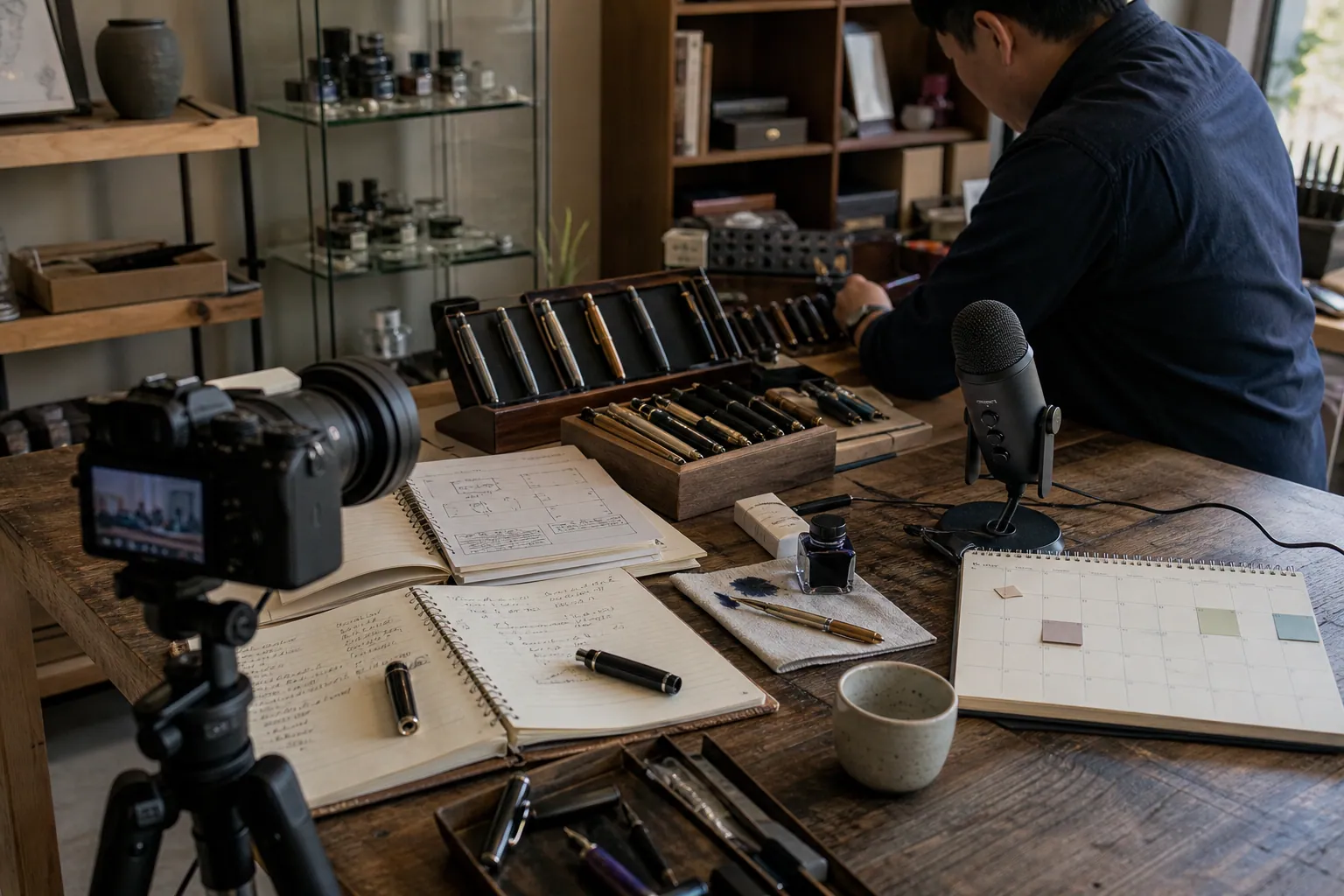
A fountain pen retailer can make beautiful Pins all day and still attract the wrong kind of attention: desk-aesthetic saves from people who will never choose a nib, ink, or starter set.
This composite case study follows a small online fountain pen shop with 34 pens, six ink collections, and a modest email list. Its Pinterest account leaned heavily on single-product images: a pen beside a notebook, a close-up of a colorful ink bottle, and the occasional holiday gift graphic.
The shop was getting saves. It was not getting a reliable number of first-time orders.
The fix was not simply publishing more. The team compared four Pinterest routes that represented very different shopper decisions: buying a pen, choosing a gift, selecting a nib, and starting a handwriting habit.
A note on the data: This is a composite operator scenario. The normalized results below are illustrative, based on common ecommerce patterns rather than a claim about one identifiable retailer.
The starting problem: a catalog organized around items, not decisions
The original Pins used titles such as “Sage Green Fountain Pen” and “New Shimmer Ink.” Those phrases described inventory accurately, but they did little for a person searching for:
- best fountain pen for beginners
- fine vs medium fountain pen nib
- fountain pen gift for a writer
- how to start writing with a fountain pen
- fountain pen handwriting practice
The mismatch showed up after the click. Individual product pages asked visitors to understand nib widths, converter compatibility, and ink options before they had enough context to decide.
The retailer needed to learn which route could create a confident first order without requiring a giant education library.
Four Pinterest routes, tested against one buying question
Rather than change every Pin at once, the team made four small content groups. Each group had three fresh Pins, a distinct landing page, and a consistent visual treatment: large readable headline, one hero product or writing sample, and no more than two supporting elements.
Route 1: Individual product Pins
Pin promise: “Fine Nib Fountain Pen in Moss Green”
Destination: The exact product detail page.
This is the simplest route. It fits a shopper who already knows what a fountain pen is, wants a particular color or style, and is comfortable selecting options.
The shop kept these Pins because they are useful for in-stock catalog coverage and specific product searches. But they were a weak primary acquisition route. New visitors often bounced once they saw several technical choices.
Route 2: Occasion-led gift Pins
Pin promise: “A Fountain Pen Gift for the Writer Who Has Everything”
Destination: A gift collection with three price bands, a short recipient guide, and a shipping cutoff.
Gift traffic produced a higher average order value because shoppers chose boxed sets, ink pairings, and gift wrap. It also proved seasonal. The same Pins were strongest from late October through mid-December and around graduation periods.
The tradeoff: gift searchers are not always future refill customers. The retailer treated gift Pins as a merchandising channel, not evidence that its beginner education was working.
Route 3: Nib-comparison Pins
Pin promise: “Fine vs Medium Fountain Pen Nibs: Which Should a Beginner Choose?”
Destination: A practical nib chooser showing line examples, paper recommendations, left-handed considerations, and three starter-kit recommendations.
This route answered the exact question blocking a first purchase. Instead of asking someone to decode a product page, the page made a recommendation and explained why.
This was the most commercially useful content in the test, particularly when the destination featured a beginner starter kit as the recommended next step rather than an endless product grid.
Route 4: Handwriting-practice Pins
Pin promise: “7 Days of Fountain Pen Handwriting Practice”
Destination: A printable practice sheet with an email opt-in, followed by a beginner ink-and-pen lesson.
This group earned the most email signups per visit, but not the most immediate orders. It attracted people interested in journaling, lettering, and improving handwriting—some of whom owned pens already.
That does not make it a failed route. It simply needs a measured follow-up sequence: paper choice, beginner nibs, ink cleanup, then a starter-kit offer. Pinterest attribution should include assisted purchases over at least 30 days for this path.
What the comparison revealed
To keep the choice honest, the shop reviewed results per 100 outbound clicks rather than comparing raw totals. Different Pins received different distribution, so normalized outcomes were more useful than impressions alone.
| Pinterest route | Best for | Immediate order tendency | Assisted value | Main weakness | Scale when |
|---|---|---|---|---|---|
| Individual product Pin | Known-item and color shoppers | Moderate | Low | Too much choice for newcomers | A product has stable stock and strong visual appeal |
| Gift Pin | Seasonal and occasion shoppers | Moderate | Low to moderate | Demand is calendar-dependent | Gift sets have healthy margin and shipping capacity |
| Nib-comparison Pin | First-time buyers choosing a pen | High | Moderate | Needs accurate guidance and maintained recommendations | Starter-kit conversion and returns are healthy |
| Practice-sheet Pin | Email growth and longer consideration | Low initially | High | Can collect hobbyists with no buying plan | Email sequence produces second-session purchases |
In the composite result, the nib guide delivered roughly 2.5 times more first orders per 100 outbound clicks than a single-product page. The practice printable generated the most leads, but only became economically useful after the team added a short, specific email sequence.
The important finding was not “guides beat products.” It was narrower:
For a shop selling to first-time fountain pen users, a decision guide is a better first destination than a SKU page when the shopper has not yet chosen a nib.
The landing-page change that made the guide sell
The first version of the nib guide was informative but overly neutral. It explained fine, medium, broad, stub, and flex nibs with no recommendation. Visitors learned, then left.
The revised page added three conversion elements:
A two-question selector
- Small handwriting or detailed notes → Fine
- Everyday journaling and smoother flow → Medium
Real writing samples on two paper types
- One smooth notebook paper
- One ordinary office-paper example
A clear starter-kit match
- “Choose this fine-nib starter kit”
- “Choose this medium-nib starter kit”
- Both included converter guidance and one compatible ink option
This is a useful distinction for Pinterest landing pages: the page does not need to explain every possibility. It needs to help the visitor complete the decision implied by the Pin.
Pin details that improved click quality
The team did not use vague copy such as “Pen lover must-haves.” Instead, every Pin title used a real question or selection task. Better Pinterest pin titles included:
- Fine vs Medium Fountain Pen Nib for Everyday Writing
- Best Fountain Pen Starter Set for Journal Writers
- Fountain Pen Gift Set for a College Graduate
- Beginner Fountain Pen Handwriting Practice Sheet
Descriptions added specifics without becoming a product catalog. For example:
Compare fine and medium nibs with writing samples, paper notes, and beginner-friendly starter sets. Find the right fountain pen for journaling, notes, or small handwriting.
This approach supports Pinterest SEO because it pairs a clear search phrase with the next decision a shopper needs to make. It also protects the team from stuffing every product attribute into every description.
The tracking setup: separate route, message, and destination
The shop used a simple UTM structure to avoid confusing gift demand with beginner-guide demand:
utm_source=pinterest
utm_medium=organic
utm_campaign=beginner_nib_test
utm_content=fine-vs-medium_writing-sample_a
Each route received its own utm_campaign, while utm_content identified the specific Pin. In ecommerce reporting, the team reviewed:
- Pinterest outbound clicks
- landing-page engagement or selector completion
- add-to-cart rate
- first order rate
- average order value
- email signup rate for the practice-sheet route
- 30-day assisted revenue from email subscribers
- return or exchange rate by nib recommendation
That final metric mattered. A guide that drives more sales but causes more unsuitable-nib returns is not a winner.
For a small team, a publishing queue such as PinPinMe can help keep the four test groups labeled, scheduled, and traceable without treating every Pin as the same campaign.
What each approach is actually for
A useful comparison is not about naming one universal winner. Use the route that matches the commercial job in front of you.
Choose individual product Pins when inventory is the advantage
Use product Pins for a distinctive colorway, limited-edition ink, or a product that shoppers already recognize. Send traffic to the exact item only if the page makes options, stock status, and compatibility obvious.
Choose gift Pins when margin and fulfillment are ready
Gift Pins fit Q4, graduation, retirement, and writer-focused occasions. Build a collection page by recipient and price point. Do not send “gift for a writer” traffic to a generic pen category with 34 choices.
Choose nib guides when acquisition is the goal
If most buyers are beginners, create the guide first. It can also inform product page copy, customer support macros, and post-purchase education. This is the strongest choice when shoppers need confidence before they need color options.
Choose practice content when you can nurture it
A printable can grow a useful audience, but it needs an honest offer path. Send the first email with the download. Then teach one small thing at a time before presenting a starter set. Do not judge this route by same-day orders alone.
A 21-day next step plan for a fountain pen operator
Days 1–3: Audit the first-purchase friction
Read ten recent support tickets and ten product reviews. List the questions that appear before purchase: nib size, ink filling, paper bleed-through, left-handed writing, or cleaning. Pick one question that appears repeatedly.
Days 4–7: Build one decision page
Start with a fine-versus-medium nib guide. Use your own writing samples and products you can keep in stock for at least 45 days. Include one clear starter-kit recommendation for each path.
Days 8–10: Make a controlled Pin set
Create six Pins:
- two nib-comparison Pins
- two starter-kit Pins
- one handwriting-practice Pin
- one gift-set Pin
Keep the destination matched to the promise. A Pin about line width should not land on a holiday gift grid.
Days 11–21: Publish, annotate, and review
Add UTMs before publishing. Record the Pin’s question, title, board, destination, and publication date in one sheet. After two weeks, review outbound clicks and landing-page behavior; after 30 days, review orders and assisted revenue.
Scale the route that produces profitable, low-return first orders—not the route with the prettiest save count.
The operator takeaway
The shop’s original Pinterest approach treated the catalog as the content. The test showed that Pinterest works better when it helps a new shopper make one concrete choice.
For this category, a nib guide earned its place because it reduced uncertainty at the exact moment a beginner was ready to buy. Product Pins and gift Pins still mattered, but they played supporting roles: catalog coverage and seasonal merchandising.
Before creating the next batch, ask one question: What choice is the person behind this search trying to make? Build the Pin and the destination around that choice, then let tracked revenue—not saves—decide what stays.

Case Study: The Project-First Pinterest Rebuild for a Stained-Glass Supply Shop
A composite case study showing how a small stained-glass supply shop can turn workshop notes, inventory, and maker questions into a maintainable Pinterest content operation.

Case Study Memo: How a Murphy Bed Studio Replaced Room-Photo Pins With Fit-Plan Traffic
A composite case study for Murphy bed studios: compare room photos, sizing guides, catalog Pins, and local pages, then run a 30-day test for better design consultations.

Case Study: How an Acoustic Panel Shop Turned Pinterest Planning Traffic Into Sample Kit Orders
A composite operator case study of an acoustic panel shop that replaced vague “soundproofing” Pins with accurate room-planning content and a sample-first path to purchase.

Strategy Memo: Pinterest 45-Day Value Test for Kombucha Starter Kits
A Pinterest starter-kit sale is only the first signal. Test direct kit, first-batch guide, and flavor content against activation and 45-day refill value—not saves alone.

Project Posts vs Plan Pages: What a Woodworking Plan Shop Should Link From Pinterest
Compare five Pinterest destinations for PDF woodworking plans—from direct product pages to cut lists—and choose the route that fits each searcher's build decision.

The Pinterest Margin Test Desk for Personalized Ornament Shops Before Q4
A practical Pinterest testing desk for personalized ornament sellers: map catalog inputs, test buyer intent, publish with discipline, and protect holiday profit.