Case Study: How a Needle-Felting Kit Shop Used AI to Make Gift-Ready Pinterest Pins Without Inventing Product Claims
A composite teardown of a craft-kit retailer that used AI for faster Pinterest production while protecting product accuracy, inventory, and beginner-buyer trust.
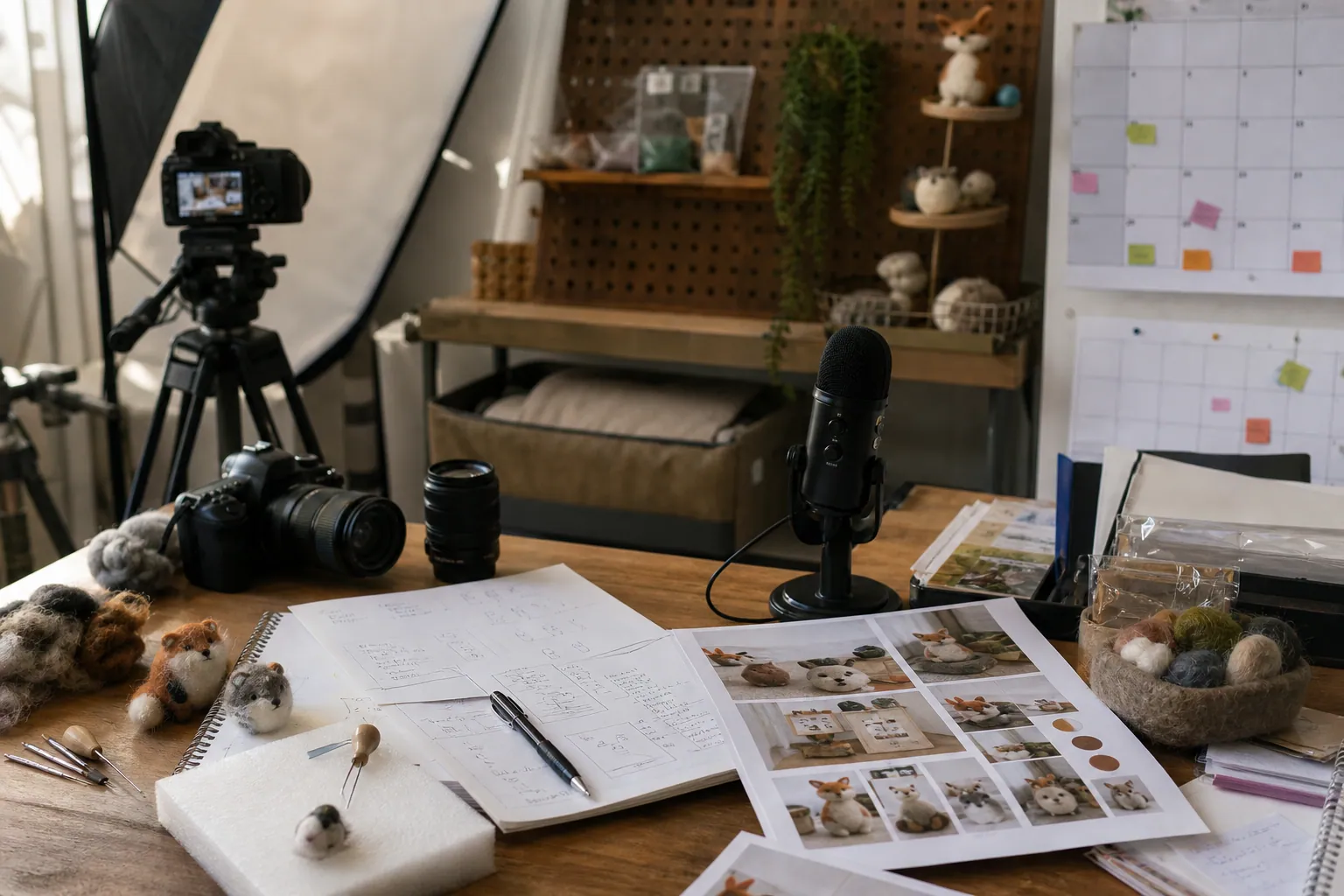
This is a composite case study based on common operating patterns among small craft-kit retailers. The figures show a representative six-week test, not a guaranteed outcome.
Early November created a familiar problem for this needle-felting kit shop: gift searches were rising, but the founder could only make Pins when she had a quiet afternoon between customer support, packing, and supplier orders.
The shop had 86 kits, from small animal projects to beginner bundles. Its Pinterest account looked polished enough: finished foxes, mushrooms, and sheep against clean backgrounds. But it was doing very little to help a first-time buyer answer the questions that determine whether they purchase:
- What actually comes in a beginner needle-felting kit?
- Is this a sensible craft gift for a person who has never tried it?
- Why is the wool not holding its shape?
- Which project is manageable as a first attempt?
The team did not need AI to make more generic craft imagery. It needed AI to turn verified product facts and repeated customer questions into useful, reviewable Pins.
The baseline: pretty projects, weak buying paths
For six weeks before the rebuild, the store published an average of two to four Pins a week. Most used a product photo, a short label such as Needle Felted Fox Kit, and a link directly to a single SKU.
Here is what the operator found when she reviewed Pinterest Analytics, Shopify, and tagged sessions together.
| Signal | Before the rebuild | What it suggested |
|---|---|---|
| New original Pins per fortnight | 4 | Production depended entirely on the founder |
| Outbound click-through rate | 0.7% | Finished-project imagery earned attention, not enough product research clicks |
| Pinterest sessions reaching a product page | 63% | Most traffic landed too early in the buying decision |
| Add-to-cart rate from Pinterest sessions | 3.1% | Visitors still had unanswered fit and difficulty questions |
| Orders from tagged Pinterest sessions | 10 | Useful, but too small to know which content deserved more effort |
The biggest misconception was that saves represented gift demand. Pins showing adorable finished animals collected saves, but the people who clicked were often looking for inspiration rather than a kit.
Meanwhile, a modest blog post explaining why wool fails to felt brought fewer saves but more visits to the beginner collection. The clue was clear: Pinterest content had to meet a decision, not just display an outcome.
The decision that changed production: AI could draft, never verify
The owner had tried a general AI prompt before: Write 20 Pinterest descriptions for my craft kits. The output sounded fluent, but it created problems immediately.
It described a kit as a one-hour project when that was not documented. It called an intermediate project beginner-friendly. It implied an age recommendation the shop had not approved. And it casually omitted the fact that needle felting uses sharp tools.
Those are not harmless copy errors for a craft retailer.
Instead of asking AI to invent marketing, the shop built a small source sheet. Every kit that could appear in a Pin needed a current record before copy could be drafted.
| Required field | Example use in a Pin |
|---|---|
| SKU and collection URL | Stops the wrong kit being linked |
| Inventory status | Keeps low-stock or discontinued projects out of scheduled content |
| Included materials | Supports an accurate what-is-in-the-box Pin |
| Difficulty wording approved by the shop | Prevents casual beginner claims |
| Store-approved sharp-tool guidance | Keeps safety language consistent |
| Project theme and recipient occasion | Helps distinguish gift intent from maker intent |
| Available photos and instruction steps | Prevents AI-generated visuals from misrepresenting the kit |
The working rule was simple: if a fact was not in the source sheet, the draft had to say [VERIFY] rather than guess.
That rule turned AI from an unreliable copywriter into a fast first-pass assistant.
Three Pin routes replaced the one-SKU approach
The owner read 90 days of support tickets, product reviews, and onsite search terms. Then she used AI to cluster the questions into themes. A human selected the final themes and destinations.
Three routes emerged.
1. The first-project route
This route served people searching for beginner needle felting and those unsure whether they could complete a kit.
Instead of sending every visitor to a fox SKU, Pins went to a beginner collection page with plain-language comparisons: project size, included materials, approved difficulty wording, and a link to tool guidance.
Example Pin angle:
What Comes in a Beginner Needle-Felting Kit?
See the materials to check for before choosing your first small project.
The destination did more than list products. It answered the question behind the search.
2. The gift-confidence route
Gift buyers do not always search for a craft by name. They search by recipient, occasion, budget, or the kind of activity they want to give.
The shop created a gift collection that grouped in-stock kits by recipient type and project feel, not unsupported promises about completion time. Product pages retained the full detail, while the collection helped a buyer narrow a crowded catalog.
Example Pin angle:
A Creative Gift for Someone Who Likes Small Handmade Projects
Browse needle-felting kits with materials included and clear project details.
This was also the right place to use seasonal messaging. The team avoided a broad holiday gift guide that mixed every item in the store. A focused page made Pinterest landing pages easier to understand and easier to measure.
3. The troubleshooting route
The best discovery content did not always lead straight to a cart. Some Pins answered a problem, then introduced an appropriate starter option only when it genuinely fit.
Example Pin angle:
Why Is My Needle-Felting Wool Not Holding Together?
Check fiber preparation, needle condition, and the shape underneath before starting again.
This content pointed to a practical guide, which included a beginner-kit collection below the answer. It was not disguised as a sales page.
That distinction mattered. Helpful troubleshooting Pins built a retargetable audience and assisted later orders, even when their direct conversion rate was lower.
What AI produced—and what people still owned
Once the routes were chosen, the shop used AI for repetitive transformations rather than strategy.
For each approved source record, AI generated:
- five search-led title options tied to one clear intent;
- two short descriptions using only approved facts;
- on-image text suggestions for a designer;
- a suggested destination and UTM naming convention;
- a note identifying any missing fact that required review.
It did not choose inventory, set product difficulty, write safety guidance from scratch, generate fake customer results, or decide which Pins to publish.
The designer worked from existing project photos, packaging photography, and genuine instruction-step images. Rather than use AI-created images of a finished felt animal, which could misrepresent what a buyer can make from a specific kit, the team used AI to create a shot list for the next product shoot.
A typical brief looked like this:
Intent: beginner needle-felting kit
Product fact: materials included are confirmed in source record
Visual: hands opening the actual kit beside labeled contents
On-image text: What is inside a beginner needle-felting kit?
Destination: beginner collection page
Do not claim: completion time, age suitability, or tool safety beyond approved wording
This was slower than pressing a button to generate 50 Pins. It was also fast enough to scale without creating a future cleanup problem.
The review gate was the actual automation win
Every draft moved through a compact approval table before publishing.
| Check | Owner | Pass condition |
|---|---|---|
| Product facts | Founder or product lead | Every claim exists in the source sheet |
| Image accuracy | Designer | The image shows the actual kit or a clearly labeled general technique |
| Destination | Ecommerce lead | URL is live, relevant, and mobile-friendly |
| Stock exposure | Operations | Item is in stock or the Pin leads to a durable collection |
| Tracking | Marketing | UTM source, medium, campaign, and content fields are present |
The team assigned an expiry review date to every seasonal gift Pin. If the specific kit sold through, the destination could remain useful because it led to a gift collection rather than a dead product page.
Approved Pins were released gradually instead of in one holiday burst. The owner used PinPinMe to keep approved drafts, destinations, and publishing status in one queue, which made it easier to pause content when inventory changed.
What changed after six weeks
The shop did not suddenly need hundreds of Pins. It published 24 intentional Pins across the three routes, with several creative variations around the strongest buyer questions.
| Signal | Before | Six weeks after | Why it mattered |
|---|---|---|---|
| New original Pins per fortnight | 4 | 14 | The founder approved content in batches rather than writing from a blank page |
| Outbound click-through rate | 0.7% | 1.4% | Pins gave people a reason to research further |
| Add-to-cart rate from Pinterest sessions | 3.1% | 5.2% | Collection pages reduced beginner and gift-buyer uncertainty |
| Orders from tagged Pinterest sessions | 10 | 23 | More sessions arrived with a clearer purchasing purpose |
| Share of Pinterest orders from collection pages | 18% | 47% | Fewer visitors were forced into a single-SKU decision |
The team did not treat this as proof that AI doubled sales. Several conditions changed at once: landing pages improved, content matched buyer questions, and the store had enough stock to serve demand.
But the post-test review was useful:
- What comes in a kit Pins delivered the best direct-order rate.
- Gift Pins drove the most revenue per click during the November period.
- Troubleshooting Pins produced fewer immediate orders but a meaningful share of later assisted conversions.
- Finished-project imagery still earned saves, but was retained as supporting creative rather than the core Pinterest catalog strategy.
The operator also tracked returns and support contacts. A higher conversion rate is not a win if AI-driven copy causes buyers to expect the wrong thing. No increase in expectation-related contacts appeared during the test, which was an important quality check.
The one mistake worth copying: kill unsupported claims early
The team’s first batch had to be revised because the language model kept reaching for familiar ecommerce phrases:
- perfect for beginners;
- a quick weekend project;
- a relaxing gift for all ages.
Each phrase sounds harmless. Each can mislead unless the store has defined and approved it.
The fix was not a better adjective prompt. The fix was a controlled vocabulary in the source sheet.
For example, the store permitted starter-friendly kit with included materials only for products it had internally designated that way. It did not allow time estimates unless a tested, documented estimate was available. For sharp tools, it used one approved line consistently rather than allowing a model to improvise safety advice.
Lessons a small ecommerce team can transfer
A needle-felting shop has unusual product details, but the underlying approach applies to many catalog businesses.
Automate translation, not truth. AI is excellent at turning one verified product record into title variations, descriptions, visual briefs, and tracking labels. It should not become the source of product facts.
Build Pins around a buyer decision. For this shop, the useful decisions were first project, gift confidence, and troubleshooting. Your store might need compatibility, sizing, shade selection, or delivery timing instead.
Use durable collection pages for volatile inventory. Pinterest can keep sending traffic after a single SKU sells out. A well-maintained collection protects the visitor experience and the value of older Pins.
Separate direct revenue from assisted discovery. Use Pinterest UTM tracking, ecommerce analytics, and a simple Pinterest cohort analysis. A help-focused Pin may earn its value after the first visit, not in a same-session sale.
Review ecommerce net contribution, not only orders. Watch margin, refunds, support load, and stock availability alongside Pinterest outbound clicks and conversion tracking.
Put a human gate before publication. One person needs authority to reject invented claims, outdated URLs, inaccurate images, and unavailable products.
A 90-minute version to run this week
If you sell craft kits or another detail-heavy product, start smaller than this shop did.
- Export the 20 products you can confidently promote this month.
- Gather 30 recent support questions and group them into three buyer decisions.
- Create one approved fact card for each product or collection.
- Ask AI for three title-and-description drafts per decision, with a
[VERIFY]rule for missing facts. - Design six Pins using real product or process imagery.
- Add UTMs, publish over two weeks, and review results after enough time for Pinterest discovery to mature.
The valuable outcome is not an endlessly automated Pin machine. It is a calmer production process that turns the knowledge already sitting in your product pages and customer inbox into accurate discovery content buyers can use.

The AI Pinterest Desk for Wedding Invitation Studios
A practical weekly desk for invitation designers using AI to turn verified FAQs, portfolio assets, and print details into Pinterest Pins that earn better consult inquiries.

The AI Compliance-Question Pinterest Desk for Hood Cleaning Companies
Use AI to turn real restaurant-owner questions into accurate Pinterest Pins that earn service-area-qualified hood cleaning inquiries—without inventing code claims.

The AI Class-Calendar Pinterest Desk for Cooking Schools
A practical AI-assisted Pinterest routine for cooking class studios that need seasonal Pins to fill real seats without publishing stale dates, menus, or availability.

Case Study: How a Jigsaw Puzzle Shop Found the Pinterest Pins That Sold Holiday Gifts
A composite Pinterest analytics teardown for puzzle shops: separate cozy saves from gift-ready traffic, test landing paths, and scale Pins by net sales per click.
Case Study: How a Home Climbing Hold Shop Turned Pinterest Wall Ideas Into Starter-Set Orders
A composite operator teardown for climbing hold retailers: turn Pinterest inspiration saves into safer, better-qualified starter-set traffic with planning content and catalog routes.
Which Pinterest Pins Earn a November Production Slot? A Testing Playbook for Paint-by-Number Kit Shops
A practical Pinterest testing routine for paint-by-number shops deciding which gift, beginner, and custom-photo Pins deserve scarce Q4 production capacity.