Case Study: How a Home Energy Audit Company Turned “Cold Room” Pins Into Booked Assessments
A composite Pinterest teardown for home energy auditors who need draft and comfort searches to become local, serviceable assessment requests—not generic eco-home saves.
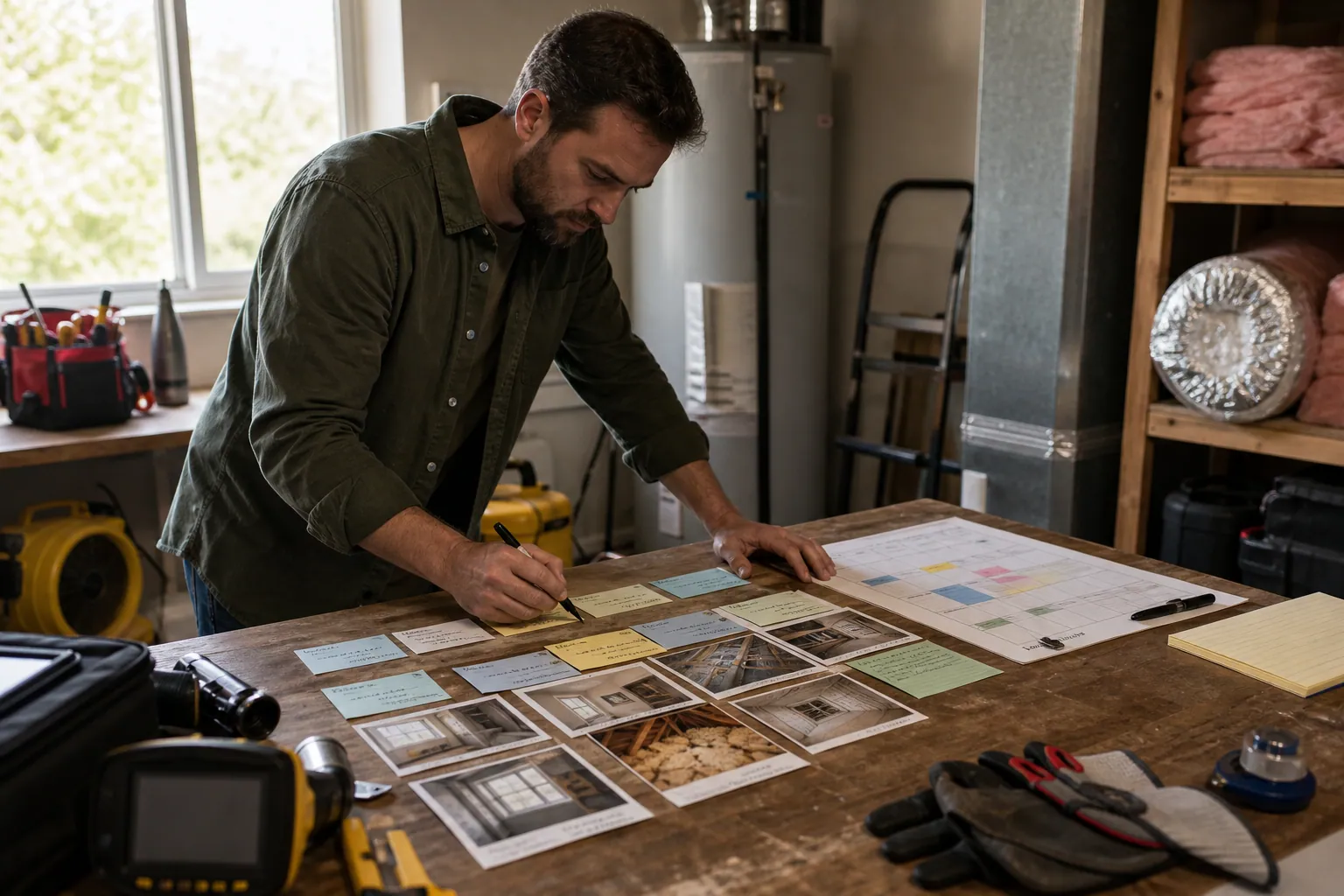
A homeowner who searches Pinterest for “why is my bedroom colder than the rest of the house” is not necessarily looking for an energy audit today. But they are much closer to a service decision than someone saving a beautiful solar-paneled home.
That distinction became the center of this composite teardown of a regional home energy audit company. The company had an experienced field team, solid customer reviews, and useful diagnostic knowledge. Its Pinterest account, however, mostly collected saves on broad energy-saving graphics.
The change was not posting more often. It was repositioning Pinterest around the homeowner’s problem before the project.
Composite case note: The business, numbers, and results below combine common patterns from service-business Pinterest accounts. They are illustrative, not a report on one named company.
The starting point: good expertise, vague Pinterest intent
The company served homeowners within roughly 50 miles of a mid-sized city. Its paid offering was an in-home assessment covering comfort complaints, insulation and air-leak priorities, and heating-planning questions. It did not sell solar panels, windows, or HVAC equipment directly.
Its original account had three broad boards:
- Energy Saving Ideas
- Sustainable Home Inspiration
- Cozy Home Upgrades
Most Pins used stock photos of bright kitchens, blankets, or exterior homes with text such as “Simple Ways to Save Energy at Home.” The Pins earned occasional saves but created an awkward mix of visitors:
- Renters seeking cheap DIY changes
- Homeowners outside the service area
- People collecting general inspiration with no defined problem
- A small number of local homeowners who could not tell whether the firm solved their issue
The team’s 60-day baseline looked like this:
| Signal | Baseline result | Why it was not enough |
|---|---|---|
| Published Pins | 31 | Most pointed to a generic services page |
| Outbound clicks | 74 | Clicks had no clear problem or location context |
| Assessment form starts | 3 | The form asked only “How can we help?” |
| Serviceable requests | 1 | No ZIP or homeowner-status filter |
| Booked assessments attributed to Pinterest | 0 | No UTM tracking or source field |
The team had a content problem, but it was really a positioning problem. “Energy efficiency” was too broad to guide a homeowner toward one next step.
The strategic decision: own the diagnosis stage
The company chose not to compete for every sustainable-home search. Instead, it focused on searches that signal a homeowner is trying to understand a comfort, moisture, or replacement decision.
That led to a simple positioning statement:
We help homeowners investigate comfort problems before they spend money on major upgrades.
This was more useful than “local energy efficiency experts,” because it matched a real planning moment. Someone may not know they need an audit. They do know that one room is cold, the upstairs is stuffy, or a furnace replacement quote feels premature.
The board rebuild followed homeowner questions
The company archived nothing that had historical value, but stopped adding to its broad inspiration boards. It created five working boards based on decisions people make before calling a contractor.
| Board | Job it serves | What belongs there |
|---|---|---|
| Cold Rooms, Drafts, and Uneven Temperatures | Diagnose a comfort complaint | Room-by-room symptom checklists, real field observations, planning pages |
| Attic Insulation and Air-Sealing Questions | Prepare for a scope conversation | Attic-access checklists, quote questions, misconception explainers |
| Heating Replacement Planning | Avoid replacing equipment without context | Pre-replacement checklists, heat-pump planning questions, home-comfort factors |
| Older Home Comfort Projects | Help owners of older houses assess tradeoffs | Moisture-aware planning, preservation considerations, project sequencing |
| Home Energy Assessment Resources | Clarify the service itself | What an assessment includes, how to prepare, anonymized findings examples |
Notice what is missing: a board for every nearby city and a catch-all “green living” board. The account was organized around durable search intent, not internal service categories or an inflated local SEO footprint.
Three changes that moved Pins closer to bookings
1. Every Pin named a symptom, not an aspiration
The old creative centered on outcomes: a cozy home, lower bills, efficient upgrades. The new Pins started with a recognizable condition and led to a bounded planning resource.
Examples:
- One Room Is Colder Than the Rest? What to Note Before You Call a Pro
- Replacing a Furnace Soon? Check These Home-Comfort Factors First
- Attic Insulation Quote Checklist: 8 Questions to Ask
- Drafty Windows or Air Leaks? How to Tell Which Conversation You Need
- What a Home Energy Assessment Can—and Cannot—Tell You
These titles did not promise savings percentages or diagnose a house from a graphic. They gave the homeowner language for the next conversation.
The visual treatment changed as well. Rather than publishing generic “before and after” comfort claims, the team used:
- Simple annotated room diagrams
- Original, consented field photos with identifying details removed
- Checklist-style graphics with five to seven readable points
- Images of real diagnostic tools only when paired with an explanation of their limits
- A clear footer naming the region served, when relevant
This made the Pins less decorative and more credible.
2. The destination matched the question exactly
The former approach sent nearly every visitor to a homepage with a large “Book an Audit” button. That asks too much from a person still trying to name the problem.
The rebuild created three focused Pinterest landing pages:
- Cold Room Planning Guide for uneven-temperature searches
- Before You Replace Heating Equipment for replacement-planning searches
- Attic and Air-Sealing Quote Questions for insulation research
Each page had the same basic shape:
- Explain what the symptom can and cannot indicate.
- Offer safe observations a homeowner can collect without opening walls, entering unsafe spaces, or working on equipment.
- Identify when a professional assessment is appropriate.
- Explain the company’s local service boundary and process.
- Offer a short request form.
The request form changed from one open text field to five useful qualifiers:
- ZIP code
- Do you own the home?
- Primary concern: cold room, drafts, high bills, replacement planning, or other
- Home type and approximate age range
- Desired timing
That is not a barrier for the right person. It prevents the operations team from spending time sorting national DIY questions and requests beyond the service area.
This same destination discipline applies to Pinterest landing pages in almost any local service. A Pin about a problem should lead to help with that problem—not a homepage that makes visitors restart their research.
3. The team measured bookings, not reach alone
Each Pin used a consistent UTM structure, such as:
utm_source=pinterest
utm_medium=organic
utm_campaign=cold_room
utm_content=uneven_temp_checklist_v2
The intake form also stored the first landing page and UTM values when available. Staff added one human question during the booking call: “Where did you first find us?” This catches delayed and multi-device journeys that analytics software can miss.
The company reviewed a small scorecard every two weeks:
| Metric | What it answered |
|---|---|
| Outbound clicks by Pin family | Which homeowner problem earns an actual site visit? |
| Form starts and completions | Does the page explain the next step clearly? |
| In-area homeowner rate | Is the traffic serviceable? |
| Assessment bookings | Is Pinterest creating real demand? |
| Time from first Pinterest visit to booking | Are visitors researching before they act? |
| Common inquiry language | What should the next Pins explain? |
That final row mattered. A cluster of inquiries mentioning “cold room above garage” led to a narrowly scoped guide about what homeowners should document before requesting help. It was not a promise of a particular cause; it was a more precise route into the company’s expertise.
What changed after 90 days
The company published 46 new Pins across the five decision-led boards over 90 days. It did not attempt daily publishing. Most content came from technician notes, FAQ calls, existing assessment materials, and approved project photos.
In this composite example, the results shifted as follows:
| Signal | Before | 90 days after the rebuild |
|---|---|---|
| Outbound clicks | 74 in 60 days | 318 in 90 days |
| Assessment form starts | 3 | 24 |
| Completed requests | 1 | 15 |
| In-area homeowner requests | 1 | 10 |
| Booked assessments with Pinterest as first or assisted source | 0 | 6 |
The raw click count improved, but the more meaningful change was the quality of the conversation. Requests increasingly arrived with a named issue, a ZIP code, and a realistic expectation of what an assessment involved.
Not every Pin was a winner. “Energy-saving home tips” still drew more saves than several diagnostic Pins. But the cold-room and heating-replacement content produced more qualified requests per 100 visits. The team kept the broad tips as light awareness content and stopped treating them as a growth engine.
The operating rhythm that kept the account useful
The team did not need a large social media department. It assigned a 75-minute monthly content review and a short weekly publishing task.
Monthly: collect field evidence
The service manager brought four inputs to the review:
- Repeated homeowner questions from calls
- Misunderstandings that delayed a project decision
- Seasonal issues appearing in assessments
- Approved photos or diagrams that illustrated a concept safely
Marketing selected two themes and drafted two to three Pin angles for each. A technical reviewer checked every claim, especially anything involving combustion safety, moisture, insulation, or equipment sizing.
Weekly: publish and label clearly
The coordinator published three to four Pins per week, each with:
- One primary search phrase in the title
- A readable explanation of the resource in the description
- The matching destination URL
- A UTM label
- The appropriate board
- A status note: live, needs seasonal refresh, or paused
A lightweight publishing queue helps prevent duplicate URLs, missing UTM labels, and stale service claims. A tool such as PinPinMe can be useful here when one person needs to keep Pin drafts, destination pages, and publishing status visible in the same place.
Every two weeks: make one decision
The review was not a request for a larger report. It ended with one decision:
- Make another variation of a high-quality Pin
- Improve a weak destination page
- Pause a vague topic
- Build one new page from recurring inquiry language
For example, the team discovered that a heating-replacement checklist generated strong clicks but few form completions. The page had framed the audit as an extra step. Revising the copy to explain when an assessment is useful before equipment quotes made the service’s role clearer.
What other local service businesses can take from this teardown
A home energy audit company is a particular example, but the strategic lessons transfer well to services with long consideration periods.
Lead with the decision the customer is already making
People rarely wake up wanting a category label. They wake up with a cold bedroom, a confusing estimate, an awkward floor plan, or a renovation decision.
Build Pins around the question they can name. Your service can appear as the appropriate next step after you have helped them understand the decision.
Use boards to reflect intent clusters, not your org chart
“Services,” “Projects,” and “Blog” are not strong board structures. Group Pins around problem families and planning moments that persist in search:
- Symptoms and diagnosis
- Comparison and selection
- Preparation and budgeting
- Timing and sequencing
- Local service process
This makes Pinterest board strategy easier to maintain because each board has a clear editorial boundary.
Do not turn expertise into unsupported claims
For professional services, credibility is a conversion asset. Avoid universal promises, remote diagnoses, invented project outcomes, and overly specific cost or savings claims.
Show what the customer can prepare, what factors matter, and where professional evaluation begins. This gives a qualified lead confidence without pretending a Pin can replace an on-site assessment.
Define the conversion before you publish
For this company, success was not followers, saves, or even form fills. It was a booked assessment from an in-area homeowner with a relevant issue.
Write that definition down. Then use Pinterest UTM tracking, page-level conversions, and intake notes to judge content against it.
The simplest place to start
If you run a local diagnostic or consultative service, choose one problem your best customers say in their own words. Build one accurate page that helps them prepare. Create three Pins from three angles:
- The symptom: “Why is this happening?”
- The decision: “What should I consider before I buy or hire?”
- The preparation: “What should I document or ask?”
Send all three to the same focused page, label the links, and review request quality after enough time has passed for people to research and return.
The goal is not to make Pinterest feel like an instant-response channel. It is to become visible early enough—and useful enough—that when the homeowner is ready to act, your business is the clearest next step.
The Site-Ready Pinterest Operator Playbook for Backyard Playset Installers
Turn backyard planning searches into site-ready playset installation inquiries with intent-led boards, useful Pins, realistic lead times, and a weekly operating rhythm.

The Spring-Project Pinterest Operator Playbook for Pool Renovation Companies
Turn pool tile, resurfacing, coping, and timeline research into better spring renovation inquiries with intent-led boards, useful pages, and a weekly operator routine.

From Patio Saves to Project-Ready Leads: A Pinterest Operator Playbook for Outdoor Kitchen Builders
A practical Pinterest routine for outdoor kitchen builders who need patio inspiration traffic to become realistic, service-area-qualified design consultations.
Case Study: How a Fireplace Insert Showroom Turned Room Saves Into Measure Requests
A composite operator breakdown for fireplace insert dealers: replace room-only Pinterest Pins with planning content that earns safer, local, measure-ready inquiries.
Case Study: How a Hood Cleaning Company Cut Its Pinterest Stack and Booked Better Site Walks
A composite teardown of a commercial kitchen hood cleaner that replaced scattered tools and generic food imagery with a lean Pinterest stack built for service-area-qualified leads.
The Contract-Value Pinterest Operator Playbook for Hood Cleaning Companies
A practical testing routine for hood cleaning firms that need Pinterest traffic to create service-area-qualified maintenance contracts—not generic restaurant cleaning questions.