Case Study: Custom Map Prints—Product Pins vs Gift Guides vs City Pages
A custom map print shop tested product pins, gift guides, city pages, and design guides to learn which Pinterest path drove better clicks and orders.

In early August, a personalized map print shop had a practical Pinterest question: should it keep pinning finished designs, build gift guides, or create pages around popular cities?
The answer mattered because pins published now could mature before holiday gift searches picked up. It also mattered because the team was small. Every new Pinterest direction meant product mockups, copy, landing pages, UTMs, and weekly review time.
This teardown is anonymized, and the results are indexed rather than copied from a private dashboard. The useful part is not the exact revenue. It is how the shop compared four Pinterest paths and chose what to scale.
The shop’s starting point
The store sold custom map prints for first homes, wedding venues, long-distance relationships, college towns, lake houses, marathon routes, and memorial gifts.
Its Pinterest account looked polished but flat:
- Boards were organized by product style, not buyer intent.
- Most pins linked straight to product pages.
- Pin titles leaned on design language like minimalist map print and custom wall art.
- Pinterest saves were respectable, but Pinterest outbound clicks were inconsistent.
- Shopify showed a few organic Pinterest orders, but no clear pattern.
The founder’s first instinct was to pin more designs. That would have been the easiest move, but not necessarily the best one.
The better question was: which destination should Pinterest traffic land on?
The four paths tested
The team compared four approaches over roughly eight weeks:
- Product and template pins
- Occasion gift guide pins
- City and place landing-page pins
- Design decision guide pins
Each path had its own job. The test was not about declaring one universal winner. It was about matching search intent to the right page.
Before publishing, the team cleaned up three basics:
- Each pin had a buyer-led title and description.
- Each URL used Pinterest UTMs, with campaign names grouped by approach.
- Each landing page repeated the promise made in the pin.
To keep the queue clean, the operator used PinPinMe to group drafts by destination, board, title, description, and UTM-tagged URL before scheduling.
Approach 1: Product pins for finished designs
Product pins were the most obvious path. The shop already had good mockups, clear pricing, and a Shopify catalog.
Example angles:
- Custom Map Print for a First Home Gift
- Personalized City Map Wall Art for a New Apartment
- Minimalist Wedding Venue Map Print
- Custom Coordinates Print for an Anniversary Gift
When product pins fit
Use product pins when the shopper already understands the offer. They work best for people who know they want a custom map print and are choosing style, size, color, or frame.
They also matter for a Pinterest catalog strategy because they keep your core offer visible and can support shopping surfaces.
Where product pins struggled
The shop’s product pins were attractive, but many felt interchangeable in the feed. A framed map mockup without a specific reason to buy became generic home decor.
The main lesson: a product pin needs a use case, not just a product name.
A pin titled Custom Map Print is weaker than Custom Map Print for a First Apartment Gift because the second one gives the buyer a moment.
Approach 2: Occasion gift guides
The second path grouped products by gifting situation instead of design style.
The shop built lightweight collection pages for:
- First home gifts
- Long-distance relationship gifts
- Wedding venue keepsakes
- Anniversary map gifts
- Moving away gifts
- Lake house host gifts
Pinterest pin titles and descriptions changed accordingly.
Example angles:
- First Home Gift Ideas That Feel Personal
- Long Distance Relationship Gift With Two Cities
- Wedding Venue Keepsake Ideas for Newlyweds
- Personalized Moving Away Gift for a Best Friend
When gift guides fit
Gift guide pins fit when the buyer has a recipient or occasion in mind but has not chosen the product yet.
This is especially useful for holiday gift Pinterest strategy, wedding season, graduation season, and housewarming demand.
The shopper is not searching for your SKU. They are searching for a solution to a social problem: I need something personal, not generic.
Where gift guides struggled
Gift guides can get too broad. A page called Personalized Gift Ideas may attract vague traffic. A page called First Home Gift Ideas for Couples is sharper.
The shop also learned that each guide needed a clear buying path. If the page was only inspirational, shoppers browsed and left. If it showed three starting options, a short personalization explanation, and delivery timing, the clicks behaved better.
Approach 3: City and place pages
The third path was the most interesting.
Instead of pinning only product styles, the shop created landing pages around emotionally specific places:
- Chicago map prints
- Charleston wedding venue map gifts
- Lake Tahoe cabin map prints
- Boston college town gifts
- New York marathon route prints
These were not thin pages with swapped city names. Each page included example maps, recipient ideas, popular personalization options, and internal links to relevant product styles.
When city pages fit
City and place pages fit when location is part of the emotional value.
A buyer may not search for custom map art. They may search for Charleston wedding gift, Chicago housewarming gift, or Lake Tahoe cabin wall art.
This is where Pinterest SEO and Pinterest keyword research matter. The team looked for phrases where a place, recipient, and occasion could combine naturally.
Where city pages struggled
City pages require restraint. It is tempting to generate hundreds of near-identical pages. That is usually a bad trade.
The stronger version is to start with places that already appear in orders, customer emails, Etsy or Shopify search terms, wedding venue inquiries, or support questions.
The page has to feel useful, not mass-produced.
Approach 4: Design decision guides
The fourth path answered pre-purchase questions.
These pins linked to short guides such as:
- How to choose coordinates for a custom map print
- Street map vs coordinates print: which gift fits best?
- What to write on a first home map print
- How to pick a map style for a wedding venue gift
When guide pins fit
Design guides fit when shoppers need confidence before buying.
They are useful for higher-consideration custom products because buyers worry about getting the details wrong. A helpful guide can reduce hesitation and make the product page feel safer later.
These pins also support organic Pinterest traffic beyond direct product discovery.
Where guide pins struggled
Guide pins rarely produced the fastest orders. They were better at email signups, time on page, and assisted conversions.
The operator had to avoid judging them only by same-day revenue. For a custom product, a guide can be part of the path even if it is not the last click.
What the comparison showed
Here is the simplified decision table the team used after the first review window.
| Pinterest path | Strongest signal | Weakest signal | Best use |
|---|---|---|---|
| Product and template pins | Clear add-to-cart when the use case was specific | Generic pins blended into home decor feeds | Support proven products and catalog coverage |
| Occasion gift guides | Best order intent from qualified clicks | Broad gift pages attracted vague browsing | Scale before holidays, weddings, graduations, and housewarming seasons |
| City and place pages | Highest outbound click curiosity | Needed better page depth to convert | Build search-led pages around proven places and emotional locations |
| Design decision guides | Best education and email signup behavior | Slower direct revenue | Reduce hesitation for custom orders and feed remarketing or email follow-up |
The surprise was not that gift content worked. The surprise was how much better specific gift content worked.
First home gift for couple beat personalized wall art.
Charleston wedding venue map beat custom city map.
What to write on a coordinates print beat modern map poster.
Pinterest users were not just reacting to pretty prints. They were trying to solve a gifting or memory-preservation problem.
The decision matrix
Use this matrix if you sell personalized gifts, custom art, photo products, engraved goods, or any product where the buyer needs to connect a person, place, and moment.
| Your current situation | Primary path to prioritize | Secondary path | Why |
|---|---|---|---|
| You need revenue before Q4 | Occasion gift guides | Product pins | Gift searches have clearer buying intent when pages are specific |
| You get many requests tied to cities, venues, schools, or destinations | City and place pages | Occasion guides | Place-based emotion can create sharper Pinterest search intent |
| Your pins get saves but not clicks | Rewrite product pins around recipient and occasion | Test guide pins | Saves may mean the visual is liked, not that the buyer sees a reason to act |
| Your traffic clicks but does not buy | Design decision guides | Product page improvements | The buyer may need proof, examples, delivery clarity, or personalization help |
| You have very little production time | Five occasion pages, not fifty city pages | Product pins for bestsellers | Specific collection pages are faster to build than a large location library |
| You already have strong Shopify product data | Product pins | Gift guides | Catalog coverage is useful, but buyer-led pages still improve intent matching |
| You are starting from zero Pinterest data | Balanced four-way test | Weekly Pinterest analytics review | You need signal before committing to one content direction |
The page fixes that mattered most
The landing pages were as important as the pins.
For the winning pages, the shop added:
- A headline that matched the pin promise.
- Three to six product examples, not a huge grid.
- A short section on how personalization works.
- Delivery and proof timing near the product choices.
- Customer language pulled from reviews and support emails.
- Internal links to related occasions or places.
For example, a first home gift page did not open with a long brand story. It opened with examples: one map for the closing date, one with coordinates, one with a street label, and one with a short custom caption.
That gave the Pinterest visitor a decision path.
Better pin titles for this shop
The old titles were not wrong. They were just too product-first.
Before:
- Custom Map Print
- Minimalist City Poster
- Personalized Wall Art
- Coordinates Print
After:
- Custom Map Print for a First Home Gift
- Chicago Map Print for a Moving Away Gift
- Long Distance Relationship Map With Two Cities
- Wedding Venue Map Gift for Newlyweds
- Lake House Map Print for a Host Gift
- What to Write on a Custom Coordinates Print
The improved titles still used Pinterest SEO. They simply put the buyer’s moment ahead of the product label.
The same applied to Pinterest descriptions. The strongest descriptions named the recipient, occasion, personalization option, and destination page without sounding stuffed.
A simple test you can run this month
If you run a custom gift shop, do not rebuild the entire account first. Run a clean comparison.
Step 1: Choose four destinations
Pick one page for each path:
- One bestselling product page
- One occasion gift guide
- One city, venue, school, trail, or destination page
- One decision guide
Keep the scope small enough that you can improve the pages before you publish pins.
Step 2: Create 20 to 28 pins
A practical split:
- 6 product pins
- 8 gift guide pins
- 8 city or place pins
- 4 to 6 guide pins
Use different visuals, but do not change everything at once. If every pin has a different format, headline style, image type, and destination, your results get harder to interpret.
Step 3: Use clean UTMs
Keep naming plain:
utm_source=pinterestutm_medium=organicutm_campaign=map_gift_guidesutm_content=first_home_caption_v1
The campaign should identify the path. The content field should identify the pin angle.
Step 4: Review by intent, not only by pin
In Pinterest analytics, watch impressions, saves, and outbound clicks.
In GA4 or Shopify, compare landing-page engagement, add-to-cart events, orders, email signups, and assisted revenue where available.
The key is to group results by path:
- Did gift guide pins produce better checkout behavior?
- Did city pages produce more qualified curiosity?
- Did guide pins help people return later?
- Did product pins work only when the title named an occasion?
Step 5: Scale one winner and repair one underperformer
Do not scale everything.
If gift guides win, build more occasion pages before making more generic product pins.
If city pages win clicks but not orders, improve the city pages before creating 40 more of them.
If product pins convert only when tied to an occasion, update your Pinterest pin titles and descriptions before increasing volume.
The final recommendation
For this custom map print shop, the best mix was not either product pins or gift guides. It was a weighted mix:
- 40% occasion gift guides
- 30% city and place pages
- 20% product pins with specific use cases
- 10% design decision guides
That mix gave the team near-term selling paths and longer-term organic discovery.
If you sell personalized products, start with the buyer’s sentence:
- I need a meaningful first home gift.
- I want something for our wedding venue.
- I need a going-away gift tied to Chicago.
- I am not sure what wording to put on the print.
Then decide whether that sentence deserves a product pin, a gift guide, a place page, or a decision guide.
That is the comparison that keeps Pinterest useful: not more pins for the sake of volume, but better matches between search intent, page type, and buyer readiness.

Case Study: Which Pinterest Pins Sold Custom Address Stamps—Wedding, Moving, or Gift Guides?
A composite case study of a custom address-stamp shop comparing product Pins, wedding content, moving guides, and gift pages to find a profitable Pinterest mix.
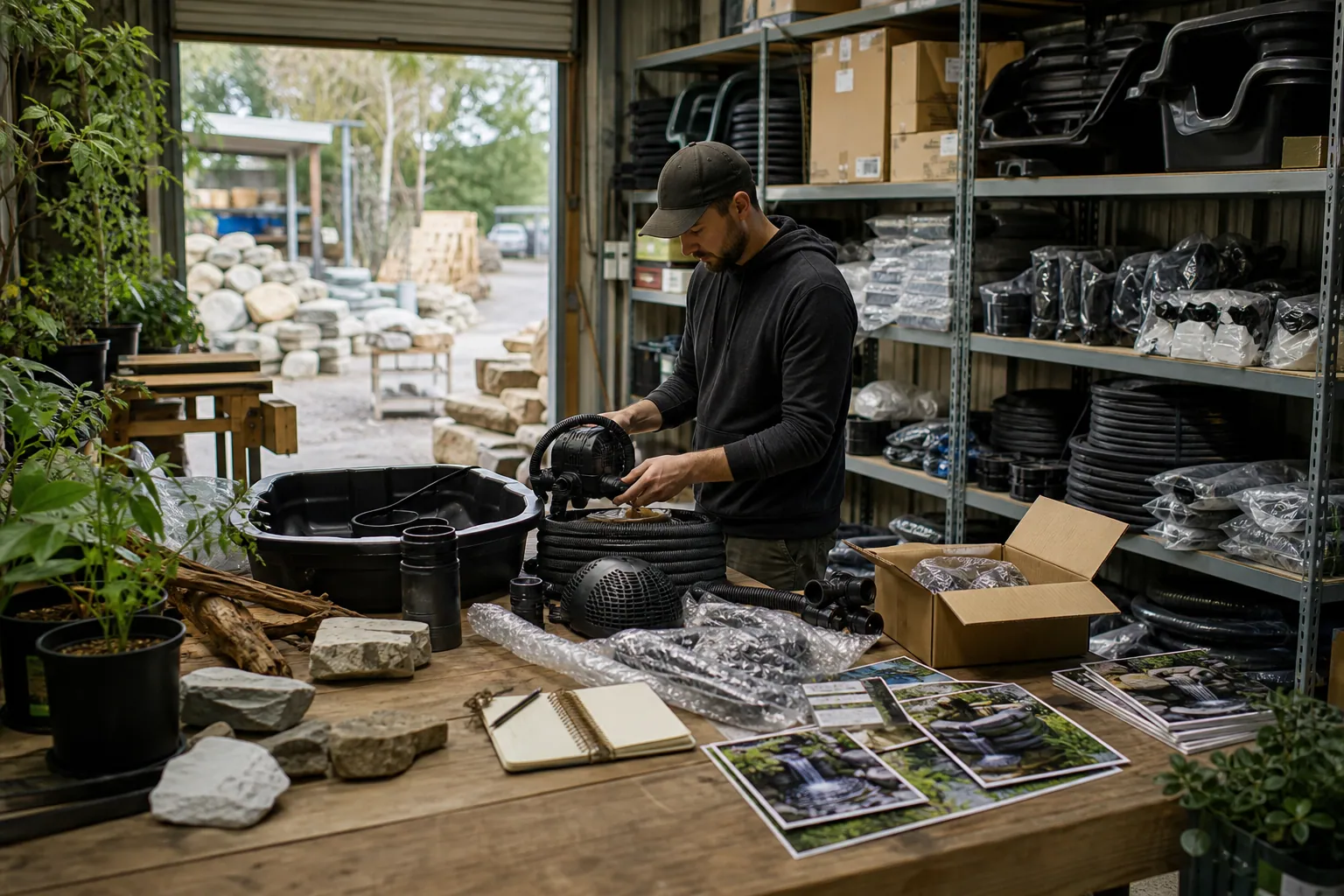
Case Study: How a Pond Kit Shop Turned Waterfall Saves Into Kit Orders
A composite Pinterest teardown of a backyard pond retailer that replaced pretty-waterfall traffic with sizing, planning, and kit-selection content that produced stronger carts.

Case Study Memo: How a Fence Contractor Turned Pinterest Saves Into Better Estimate Requests
A composite case study of a residential fence company that replaced generic backyard inspiration Pins with planning content designed to produce local, estimate-ready leads.

Case Study: How a Garage Floor Coating Contractor Turned Pinterest Saves Into Site Visits
A composite teardown of a garage floor coating company that traded broad inspiration Pins for planning content, local pages, and more estimate-ready Pinterest traffic.

Case Study: How a Merino Sock Shop Found Its Best Pinterest Pins by Tracking Net Revenue
A composite teardown of a merino sock shop that stopped treating saves as success and used UTMs, return reasons, and 21-day cohorts to identify Pinterest Pins that sold.

Holiday Table Pinterest Playbook for Table Linen Shops
A practical Pinterest routine for table linen shops that turns Thanksgiving, Friendsgiving, and holiday-hosting searches into collection visits and confident orders.