The Cold-Weather Pinterest SEO Playbook for Merino Sock Shops
A practical weekly routine for merino sock retailers to turn weather, boot-fit, and gift questions into Pinterest search traffic that reaches the right collection.
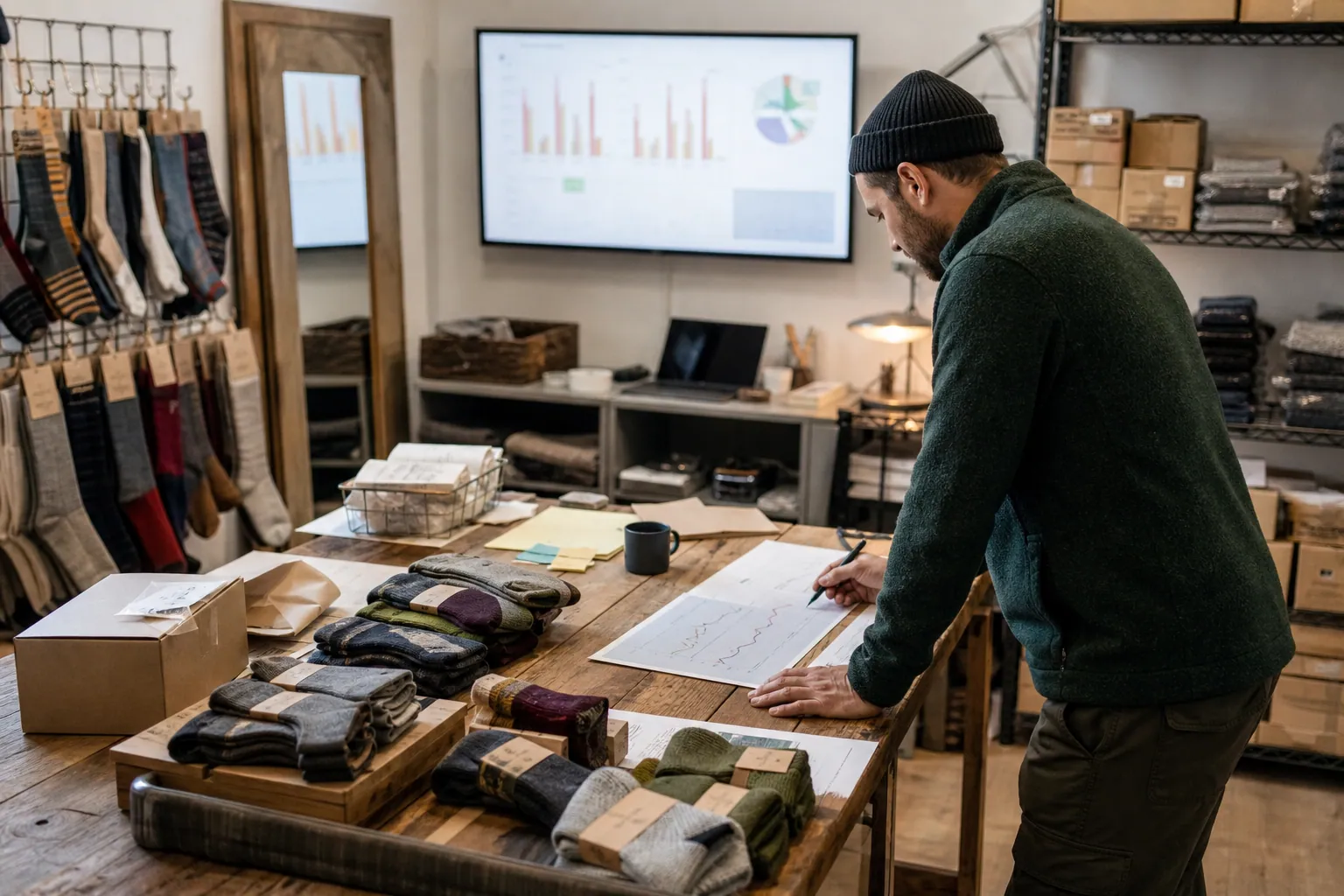
It is October 14, and a merino sock shop has 74 active styles, a reliable catalog feed, and plenty of lifestyle photos. Yet its Pinterest account is largely producing saves on cozy cabin images while shoppers who need hiking socks, work-boot socks, or practical gifts never reach the right collection.
The problem is not a lack of Pins. It is that the account is organized around colors and seasonal mood, while shoppers search around a decision: What sock will work for this person, activity, temperature, or boot?
For a small ecommerce team, Pinterest SEO should make those decisions easier. The goal is not to rank every individual SKU. It is to create a dependable route from a specific question to an in-stock collection or product page that answers it.
Start with a diagnosis: where does the searcher get lost?
Before publishing another fall outfit Pin, review the path from query to product. Pick 20 recent Pins and record four things:
| Check | What to look for | What it reveals |
|---|---|---|
| Search phrase | The words in the title, description, board, and Pinterest search suggestions | Whether the Pin matches a real planning question |
| Visual promise | What a shopper can infer at a glance | Whether the image supports the stated use case |
| Destination | Product, collection, fit guide, or gift page | Whether the click has a useful next step |
| Commercial result | Outbound clicks, add-to-carts, orders, and return notes | Whether the promise attracted the right buyer |
A common finding: “cute wool socks” gets impressions and saves, but lands on a broad all-socks page. A shopper looking for “warm socks for winter hiking” then has to interpret cushion level, height, and warmth claims alone. That is friction the store created.
Build search clusters around purchase decisions
For a merino retailer, start with four modest clusters rather than a sprawling calendar of generic lifestyle terms.
Terrain and activity
- Merino hiking socks
- Socks for winter hiking
- Merino socks for walking boots
- Ski sock thickness guide
Shoe and fit context
- Socks for work boots
- Socks for Chelsea boots
- No-show wool socks for sneakers
- Hiking sock height guide
Temperature and comfort questions
- Warm socks for cold weather
- Lightweight merino socks for hiking
- Merino socks for sweaty feet
- Wool socks for cold offices
Gifting and recipient needs
- Gifts for hikers
- Wool sock gift set
- Gifts for dog walkers
- Practical gifts for dads
Do not assume every phrase deserves a separate page. Group close variants around one useful destination. For example, a collection called “Merino Socks for Hiking and Walking Boots” can serve several terrain and boot-related Pins if it has clear filters, verified product specs, and a concise buying guide near the top.
This is a better use of ecommerce merchandising than creating a thin page for every keyword variation.
Match Pin types to page types
Catalog Pins are useful when someone already wants a particular style or product. Editorial Pins do the heavier work when the searcher still needs help choosing.
| Searcher moment | Best Pin destination | Helpful page element |
|---|---|---|
| “Best socks for walking boots” | Boot-compatible collection | Height, cushion, and seam details by style |
| “Merino socks for cold weather hiking” | Activity collection or comparison guide | Temperature context without unverified performance claims |
| “Wool sock gifts for hikers” | Gift collection | Recipient filters, gift box details, shipping cutoff |
| “Ankle socks for trail running” | Specific product collection | Activity, height, fit, and care information |
| “How to wash merino socks” | Care article with related products | Clear care steps and links to appropriate styles |
A collection page is not a failure of SEO. It is often the right landing page when several items genuinely fit the same need. The key is to make the collection decision-ready, not just a grid of product cards.
The weekly publishing routine: one question, several useful routes
A lean team can run this in about three hours each week. The point is to create a small set of accurate assets from one merchandising question, rather than inventing disconnected content every day.
Monday: choose one inventory-safe question (20 minutes)
Check three inputs:
- Pinterest search suggestions and recent search results for your core terms
- Site search, customer service questions, reviews, and return reasons
- Stock, discontinued colors, shipping deadlines, and bundle availability
Choose a question only if the store can answer it honestly this week. If the most suitable cushioned crew sock is almost sold out, do not build a batch around it. Choose a durable collection or make the Pin destination a category with several appropriate alternatives.
For example, a good October question is: “What socks work inside waterproof walking boots in cold, damp weather?”
That question has a product decision inside it: crew height, cushioning, fiber details, drying expectations, and avoiding bunching. It is more commercially useful than “cozy fall socks.”
Tuesday: prepare the destination before the Pin (35 minutes)
Improve or confirm the page first.
For a walking-boot collection, add:
- A descriptive H1 such as “Merino Socks for Walking Boots”
- A one-paragraph chooser explaining height and cushion options
- Product filters that work on mobile
- Current size and care information
- A related link to a sock-height or care guide, where applicable
- A visible shipping or gift cutoff when the page serves holiday intent
Add a consistent UTM structure before publishing. For example:
utm_source=pinterest&utm_medium=organic&utm_campaign=walking_boots&utm_content=crew_fit_chart
This makes it possible to compare a fit-chart Pin with a lifestyle Pin even when both send traffic to the same collection. Pinterest outbound clicks are useful early signals; tracked add-to-carts, orders, and net revenue are the decision signals.
Wednesday: make a four-Pin family (75 minutes)
Use one destination, one search cluster, and four distinct visual explanations. Repeating the same creative with a new headline is not a useful test.
For the walking-boot collection, create:
- Fit diagram — boot shaft next to ankle, crew, and knee-high sock heights.
- Cushion comparison — light, medium, and heavy cushion explained using verified product labels.
- Problem-first photo — walking boot plus a clear line: “Socks bunching inside your boots?”
- Packing or gift graphic — “Cold-weather walking kit: boots, socks, layers.”
Keep key text large enough to read in a mobile feed. The product does not need to dominate every image, but the Pin must make its promise quickly.
Use exact product facts supplied by the merchant: composition, height, cushion level, care requirements, country of origin, and available sizes. Avoid claiming that merino is waterproof, solves medical conditions, prevents blisters, or works at a precise temperature unless the claim is substantiated and approved.
Thursday: write search-led titles and descriptions (35 minutes)
Put the clearest query phrase near the beginning of the title. Then add the decision the Pin helps make.
A simple title structure is:
[search phrase] + [choice or use context] + [specific qualifier]
Examples:
- Merino Socks for Walking Boots: Choose the Right Height
- Warm Hiking Socks for Cold Weather: Cushion Levels Compared
- Wool Sock Gifts for Hikers: A Practical Gift Guide
- No-Show Merino Socks for Sneakers: When They Work Best
Descriptions should clarify the promised answer and the destination. They do not need to sound like product copy.
Choosing merino socks for walking boots? Compare crew height, cushioning, and fit considerations before a cold-weather hike. Browse merino styles designed for boots and long walks.
Notice that the description uses the search concept naturally, explains why the click is worthwhile, and does not pack in a dozen near-identical phrases.
Save approved titles, descriptions, image files, destination URLs, and UTM labels in a simple content library. If coordinating multiple owners or freelancers, a lightweight scheduler such as PinPinMe can help keep approved assets and publishing dates visible without turning publishing into a manual scavenger hunt.
Friday: publish, place, and log (25 minutes)
Publish the four-Pin family over several days rather than dropping them all at once. Place each Pin on the most relevant board first.
A sock retailer might maintain a compact set of boards:
- Merino Hiking and Walking Gear
- Cold-Weather Clothing Essentials
- Sock Fit and Care Guides
- Gifts for Outdoor Lovers
- Everyday Merino Basics
Boards should describe a useful shopper topic, not act as a dumping ground for brand imagery. Do not save a walking-boot Pin to five barely related boards just to manufacture distribution.
Log the publish date and planned review date. Give evergreen Pins enough time to gather search distribution; do not declare a winner after a few days.
Four examples: turn a catalog detail into a search asset
Here is how one product fact can become Pinterest content without making generic Pins.
Example 1: Crew height
Raw product fact: A sock sits above the collar of standard walking boots.
- Pin title: Merino Socks for Walking Boots: Why Crew Height Matters
- Visual: Simple side-by-side boot and sock-height illustration
- Destination: Walking-boot sock collection
- Commercial role: Helps a shopper choose before filtering products
Example 2: Cushion level
Raw product fact: The range has light, medium, and heavy cushion options.
- Pin title: Hiking Sock Cushion Levels Explained for Day Hikes
- Visual: Three labeled sock cross-sections or on-foot examples
- Destination: Cushion comparison section or collection filter
- Commercial role: Reduces ambiguity between similar SKUs
Example 3: Care question
Raw product fact: The brand has specific washing and drying instructions.
- Pin title: How to Wash Merino Socks Without Ruining the Fit
- Visual: Five-step care card using approved instructions
- Destination: Care guide with links to core collections
- Commercial role: Builds confidence and may support post-purchase retention
Example 4: Gift recipient
Raw product fact: Several styles are available in a giftable bundle.
- Pin title: Useful Gifts for Dog Walkers: Merino Socks for Cold Mornings
- Visual: Boots, leash, outerwear, and boxed socks in a practical flat lay
- Destination: Outdoor gift collection
- Commercial role: Converts a recipient-led search into a clear selection set
This approach also makes reporting cleaner. You can compare whether care content drives assisted purchases, while boot-fit content drives direct product-page engagement.
Mistakes that weaken Pinterest SEO for sock catalogs
Making color the primary keyword
Color matters after a buyer has selected the right type of sock. “Rust orange wool socks” can be useful catalog metadata, but it rarely replaces intent around hiking, work boots, warmth, or gifting.
Sending every Pin to the homepage
A homepage asks a Pinterest visitor to start over. Use Pinterest landing pages that preserve the context promised in the Pin.
Using one vague description on every Pin
A copied description creates no meaningful distinction between a hiking guide, care guide, and gift page. Write for the question and destination, not for a keyword quota.
Publishing around inventory you cannot support
Out-of-stock products, discontinued bundles, and expired holiday shipping claims turn qualified clicks into disappointment. Include inventory review in the weekly routine.
Calling saves the final result
Pinterest saves can indicate future planning value, especially for gift and seasonal content. But a Pin with saves and no outbound clicks may have a vague promise, weak call to action, or destination mismatch. Review saves alongside clicks, engaged sessions, add-to-carts, orders, and return feedback.
Refreshing by changing everything at once
If a Pin underperforms, decide what you are testing: image, query phrase, title, destination, or product mix. Change one major variable so the result teaches you something.
Short operating checklist
Before the next weekly batch, confirm:
- One real shopper question is selected from search, customer, or site data.
- The linked collection or guide is accurate, mobile-friendly, and inventory-safe.
- Every claim about warmth, fit, care, and performance is verified.
- Four creative angles explain the same decision without duplicating one image.
- Pin titles lead with a natural search phrase and name a useful outcome.
- Descriptions explain what the shopper will find after clicking.
- UTM labels distinguish each creative and campaign.
- Boards match the searcher’s topic, not just internal product categories.
- The team has set a review date based on clicks, carts, orders, and product availability.
A merino sock shop does not need thousands of Pins to build durable Pinterest discovery. It needs an honest library of decision-helping content, tied to pages that make choosing—and buying—the next step easy.

Pinterest SEO for Backyard Greenhouse Kit Shops
A practical weekly Pinterest SEO routine for greenhouse kit sellers turning foundation, placement, and size questions into qualified spring catalog traffic.

Pinterest Pin Descriptions for Personalized Notepad Shops: 4 Angles Compared
Compare four Pinterest description angles for personalized notepad shops, match each to a landing page, and test for clicks and gift-season orders.

Strategy Memo: Pinterest SEO for Gel Nail Brands—Prep and Removal First
A 30-day Pinterest SEO plan for at-home gel nail brands that prioritizes beginner prep, safe removal, and troubleshooting content over crowded shade inspiration.

The AI Gift-Intent Pinterest Desk for Merino Sock Shops
A practical weekly routine for merino sock retailers using AI to turn verified product facts, gifting questions, and stock signals into accurate Pinterest traffic.

Holiday Table Pinterest Playbook for Table Linen Shops
A practical Pinterest routine for table linen shops that turns Thanksgiving, Friendsgiving, and holiday-hosting searches into collection visits and confident orders.

Strategy Memo: Pinterest for Rain Boot Shops Before Wet-Weather Season
Use fit confidence, weather-specific collections, and practical outfit content to turn Pinterest fall planning into rain boot orders with fewer avoidable returns.