Pinterest SEO for Backyard Greenhouse Kit Shops
A practical weekly Pinterest SEO routine for greenhouse kit sellers turning foundation, placement, and size questions into qualified spring catalog traffic.
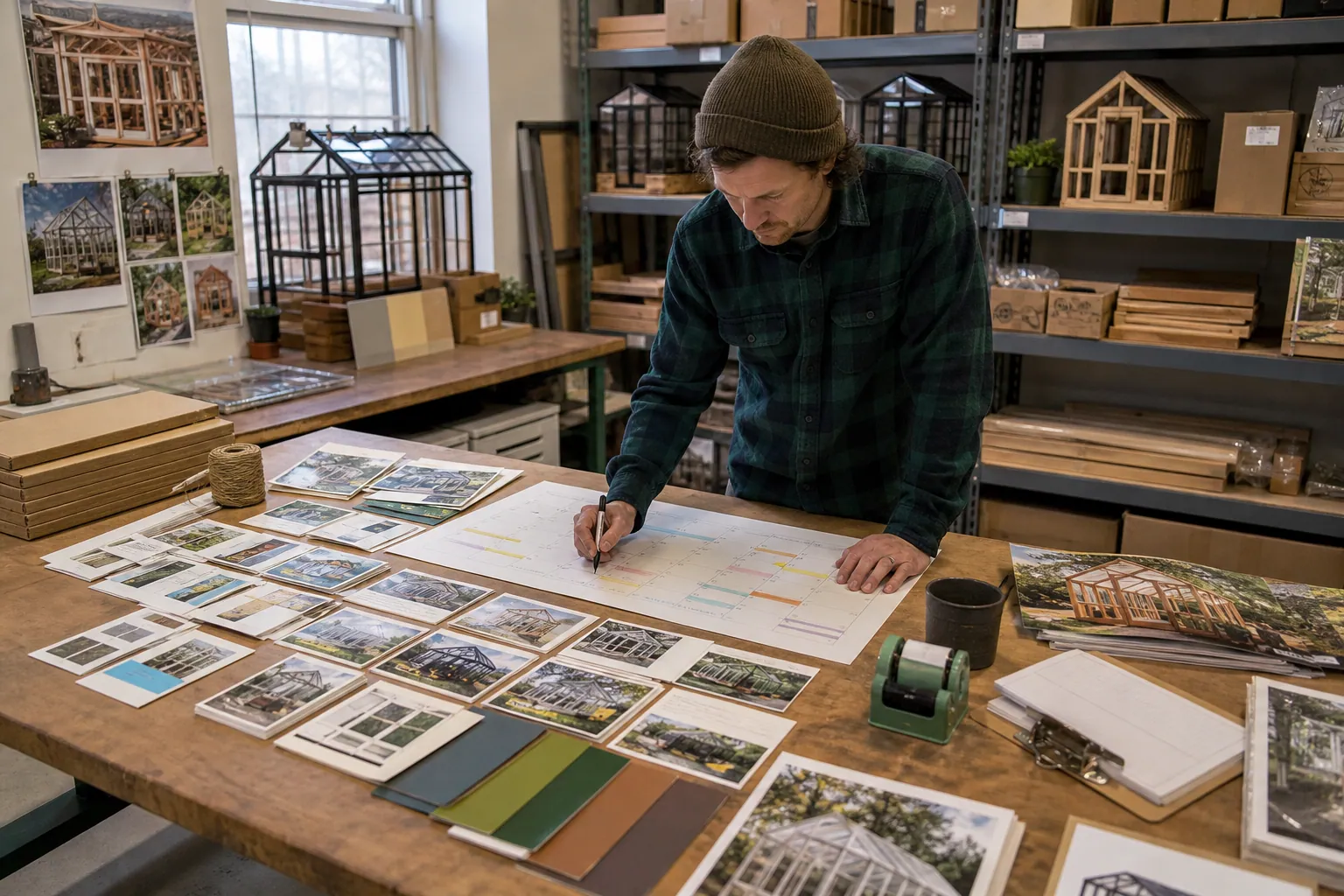
It is October, and a backyard greenhouse kit shop has just approved next spring’s inventory. The team has dozens of beautiful customer photos: cedar frames in snowy yards, tomato vines, tidy potting benches, glass doors at sunset.
Their Pinterest account gets saves, but the sales team keeps hearing a different set of questions:
- Will an 8x12 kit fit beside a garage?
- Do I need a concrete slab or can I use gravel?
- Where should a greenhouse go for winter sun?
- Which kit works for a windy, exposed yard?
Those questions are the content opportunity. They signal a buyer who has moved beyond “greenhouse inspiration” and is trying to make a build decision.
For a greenhouse retailer, Pinterest SEO works best when the account becomes a useful extension of the planning process—not a gallery of finished gardens.
Diagnosis: find the gap between saves and kit-ready traffic
Start with the last 60 to 90 days of Pins and group them by the page they link to. Do not begin by judging individual designs. First determine what job each Pin is doing.
| Signal | What it usually means | Operator response |
|---|---|---|
| Many saves, few outbound clicks | The image is aspirational, but the Pin does not resolve a decision | Pair it with a planning page or create a more specific title |
| Clicks to a collection, low product views | The collection is too broad or does not answer the question promised by the Pin | Add a decision guide and a filtered collection |
| Product views, few add-to-carts | Buyers need dimensions, foundation requirements, shipping clarity, or comparison help | Improve product-page proof before publishing more Pins |
| Add-to-carts, weak checkout completion | The problem is likely freight cost, delivery timing, financing, or checkout—not Pinterest SEO | Review store friction separately |
| Orders arrive weeks after first clicks | The product has a long Pinterest sales lag | Review tagged cohorts over 30 to 60 days, not just same-session revenue |
A greenhouse is a high-consideration purchase. Someone may save a placement guide while measuring their yard, return after discussing a budget with a partner, then buy months later. That does not make saves the primary metric. It means your reporting needs both early signals and patient revenue tracking.
Replace broad inspiration with a decision inventory
A useful content inventory starts with sales and operations, not keyword tools. Ask the people answering buyer questions to list the top 20 points of confusion.
For each question, record:
- The exact buyer wording. Use chat transcripts, support tickets, site search, and consultation notes.
- The verified answer. Include model-specific constraints, what is and is not included, and when local engineering or permit advice is required.
- The best destination. This may be a guide, comparison page, product collection, or product page.
- The commercial next step. Sample request, kit-size collection, quote form, or direct product view.
This prevents a common problem: a Pin promises “greenhouse foundation options,” then sends visitors to a generic catalog with no foundation guidance.
Build keyword clusters around decisions, not just products
“Backyard greenhouse” belongs in your account, but it is too broad to guide every Pin. Instead, create small clusters around moments that precede purchase:
| Search-intent cluster | Useful page to create or improve | Pinterest title direction |
|---|---|---|
| Foundation choice | A visual guide comparing gravel, pavers, and concrete, with model requirements | “8x12 Greenhouse Foundation: What to Plan Before Delivery” |
| Siting and sunlight | A backyard placement checklist with shade, access, drainage, and winter-sun considerations | “Where to Put a Greenhouse in a Small Backyard” |
| Size selection | A comparison of growing capacity, door clearance, shelving, and pathways | “6x8 vs 8x12 Greenhouse: Which Size Fits Your Garden?” |
| Wind and weather exposure | A careful guide explaining what buyers should verify, without making universal suitability claims | “Questions to Ask Before Buying a Greenhouse for a Windy Yard” |
| Interior setup | Layout illustrations tied to compatible shelving or accessory collections | “Simple Greenhouse Shelving Layout for an 8x12 Kit” |
This is Pinterest search intent in practical form: understand the decision behind the phrase, then make a page that earns the click.
The weekly content desk: one question, several useful Pins
A small shop does not need a daily avalanche of nearly identical greenhouse Pins. It needs a dependable weekly routine that produces accurate assets and gives each asset enough time to earn discovery.
Plan for about three hours each week.
Monday: choose one planning question
Select one question using three inputs:
- Repeated customer language from the previous week
- Seasonal relevance, such as fall site planning before spring delivery
- A page that already exists or can be genuinely improved this week
In October, “greenhouse foundation before winter” may be a better choice than a generic “spring garden ideas” Pin. It gives future buyers a concrete task they can complete now.
Open a one-row brief with these fields:
- Primary phrase:
greenhouse foundation options - Related phrases:
gravel base for greenhouse,greenhouse foundation checklist,greenhouse base before delivery - Destination URL
- Approved factual claims
- Models or collections that apply
- CTA: “Compare kit footprints” or “See foundation requirements”
- UTM campaign name
Use a consistent UTM convention, such as utm_source=pinterest&utm_medium=organic&utm_campaign=foundation-guide&utm_content=diagram-a. It makes Pinterest outbound clicks interpretable in analytics instead of blending them into generic referral traffic.
Tuesday: improve the destination before designing Pins
A decision page does not need to be a 3,000-word blog post. It needs to remove the uncertainty created by the Pin.
For a foundation guide, include:
- A clear statement of which kit models the guide covers
- A comparison table of common base approaches
- Drainage and level-ground considerations
- A note that site conditions, permits, and local requirements vary
- What customers must arrange before delivery
- Footprint diagrams with units shown consistently
- Links to the relevant kit-size collections
If your product has a requirement—such as an anchor pattern or a level perimeter—put it in the page, not only in an image caption. Search traffic cannot act on information it cannot find after the click.
Wednesday: create a small Pin family from one page
Create four to six Pins for the same destination, each with a different visual proof point. The goal is not to repeat a headline over different background colors.
For a foundation guide, the family could include:
- Comparison graphic: Gravel vs pavers vs concrete, with a simple “what to check” column.
- Annotated photo: A finished base with labeled perimeter, drainage, and access considerations.
- Checklist Pin: “Before Your Greenhouse Delivery: 5 Site Tasks.”
- Dimension-led Pin: An 8x12 footprint diagram with space around doors and paths.
- Mistake-avoidance Pin: “Do not choose your greenhouse size before measuring this.”
Each Pin should have one main idea visible without opening it. Tiny paragraphs, dense collages, and product labels that cannot be read on mobile are not evidence; they are clutter.
Thursday: write titles and descriptions that match the page
Use the primary phrase naturally near the beginning of the title. Then add the practical outcome.
Here are three examples for the same foundation page:
| Pin format | Title | Description approach |
|---|---|---|
| Comparison | Greenhouse Foundation Options: Gravel, Pavers, or Concrete? | Explain that the guide helps buyers compare base options and prepare for kit delivery. Mention that site and local requirements vary. |
| Checklist | Greenhouse Base Checklist Before Your Kit Arrives | List a few genuine checks: level area, drainage, access, and model requirements. Send readers to the full checklist. |
| Footprint visual | How Much Space Does an 8x12 Greenhouse Need? | State that the page includes footprint and access-planning considerations, then link to compatible 8x12 kits. |
Descriptions should add decision context, not repeat every keyword variation. For example:
Comparing greenhouse foundation options before ordering a kit? This guide covers site leveling, drainage, access, and questions to confirm for your model before delivery.
That is more useful than stacking “greenhouse foundation, greenhouse base, greenhouse ideas, backyard greenhouse” into one sentence.
Friday: publish, tag, and leave a review trail
Publish the Pin family across the most relevant boards. A board named “Greenhouse Planning and Setup” is more helpful than creating five thin boards with nearly the same purpose.
Log each Pin with:
- Publish date
- Search-intent cluster
- Destination page
- Creative type
- On-image promise
- UTM content value
- Inventory or lead-time status
- Review date, usually 21 and 45 days later
A lightweight content queue is enough. If several people contribute images, copy, and approvals, a tool like PinPinMe can keep briefs, approved variants, and publishing status together. The important part is not the tool; it is keeping factual product inputs attached to every Pin ticket.
Three content routes that earn more qualified greenhouse clicks
1. The “fit it in my yard” route
A customer has a narrow side yard or a small patio garden. They are not yet choosing a frame finish; they are asking whether a greenhouse is feasible.
Create: a small-yard greenhouse placement guide with measured examples, pathway considerations, door clearance, and a clear note that buyers should confirm their own site dimensions.
Pins to make:
- “Small Backyard Greenhouse Layout: What to Measure First”
- “Can an 8x12 Greenhouse Fit Beside a Garage?”
- “Greenhouse Door Clearance Checklist for Tight Yards”
Destination CTA: view compact greenhouse kits or download/print the measurement checklist.
2. The “plan now, grow later” route
Fall and winter visitors may not be ready to buy a kit, but they can prepare a site, choose a location, and understand delivery access.
Create: a seasonal pre-delivery planning calendar. Keep it operational: site measurement, base planning, delivery access, assembly scheduling, and planting planning—not vague seasonal inspiration.
Pins to make:
- “Fall Greenhouse Planning Checklist for Spring Setup”
- “What to Prepare Before Ordering a Backyard Greenhouse Kit”
- “Greenhouse Delivery Access: 4 Things to Check”
Destination CTA: compare delivery-ready kit sizes or request a planning call if your business offers one.
3. The “choose the right size once” route
Size comparison content is valuable because it lets visitors progress without forcing them to open six product tabs.
Create: a 6x8, 8x12, and 10x16 comparison page that shows actual growing zones, benches, center paths, door openings, and accessory compatibility. Only show arrangements your team has verified.
Pins to make:
- “6x8 vs 8x12 Greenhouse: Space for Beds, Benches, and Paths”
- “How to Choose a Greenhouse Size for Seed Starting”
- “8x12 Greenhouse Layout With Potting Bench and Shelves”
Destination CTA: choose a size, then view models available in that footprint.
Mistakes that make greenhouse Pinterest SEO expensive
Publishing only finished greenhouse photography
Beautiful photography earns attention, but it often attracts people saving style references rather than planning a purchase. Continue using finished-project imagery, but attach it to a real decision: size, siting, material, layout, or seasonal preparation.
Treating every question as a product page
A buyer searching “greenhouse placement for winter sun” is not asking for a catalog grid. Give them the placement guide first, then offer relevant kits after the guide has done its job.
Copying competitor claims about weather suitability
Do not turn a Pinterest title into an engineering claim. Avoid blanket promises such as “hurricane proof,” “snow safe anywhere,” or “no permit needed.” Explain what a buyer should confirm, publish model-specific documentation where appropriate, and defer to local requirements.
Letting stale lead times live indefinitely
Greenhouse inventory and freight timing change. Avoid embedding exact availability dates in evergreen graphics unless the team has a scheduled refresh process. Check high-traffic Pins before seasonal demand rises.
Declaring a winner after three days
Planning products have delayed conversion paths. Review early indicators such as outbound clicks and engaged sessions, then revisit the same Pins after enough time has passed for quote requests and orders to develop.
The short operating checklist
Before you call a weekly Pinterest SEO batch complete, confirm:
- One buyer decision—not a vague inspiration theme—anchors the batch.
- The destination page answers the promise made in the Pin.
- Product specifications, inclusions, availability, and model references were reviewed.
- Each Pin has a readable, distinct visual angle.
- Titles use buyer language without cramming variations.
- Descriptions add useful context and match the landing page.
- Every outbound link has a consistent UTM.
- The batch has a 21-day and 45-day review date.
- High-performing Pins will be checked again before spring inventory opens.
For greenhouse kit shops, the durable Pinterest advantage is not posting more garden beauty. It is being the retailer that helps someone make the next credible planning decision—then makes the right kit easy to find.

The Compatibility-Question Pinterest Desk for Sewing Machine Parts Shops
Turn model-fit questions, repair guides, and accessory decisions into Pinterest search traffic that reaches the right sewing machine parts page.

Strategy Memo: Pinterest SEO for Gel Nail Brands—Prep and Removal First
A 30-day Pinterest SEO plan for at-home gel nail brands that prioritizes beginner prep, safe removal, and troubleshooting content over crowded shade inspiration.

Pinterest Pin Descriptions for Personalized Notepad Shops: 4 Angles Compared
Compare four Pinterest description angles for personalized notepad shops, match each to a landing page, and test for clicks and gift-season orders.

The AI Gift-Intent Pinterest Desk for Merino Sock Shops
A practical weekly routine for merino sock retailers using AI to turn verified product facts, gifting questions, and stock signals into accurate Pinterest traffic.

Strategy Memo: Pinterest for Rain Boot Shops Before Wet-Weather Season
Use fit confidence, weather-specific collections, and practical outfit content to turn Pinterest fall planning into rain boot orders with fewer avoidable returns.
Case Study: How a Pond Kit Shop Turned Waterfall Saves Into Kit Orders
A composite Pinterest teardown of a backyard pond retailer that replaced pretty-waterfall traffic with sizing, planning, and kit-selection content that produced stronger carts.